





Nice read regarding turning GPU compute into tradeable securities (forward contracts) and the problems that need to be solved


Underappreciated.
The first question was all about capability. That will pass in the next two years and then it will be all about trust.


Dylan is first and foremost *the* expert on supply. So if he gives you a 2027 number you can believe it is backed by supply data (demand is a different story). Here is an interpretation of his numbers


SemiAnalysis's Dylan Patel predicts OpenAI and Anthropic could reach $600–700 billion in combined revenue by December 2027--and raises the possibility of $1.5 trillion by year-end
“As far as AI’s impact on the U.S. economy, if AI revenue is only $3 trillion in 2031, then, yeah, we’ll have big problems.
“But I’m of the belief that we can get to $600 billion or $700 billion across OpenAI and Anthropic alone by December of next year.
“I’m of the opinion that you can get to $1.5 trillion, maybe even by the end of 2027, with just those two companies. So that’s the end of 2027. Then the payback is clear, right? You know, where they’re getting that from.
“Ultimately, the capacity that people are building out is matched to what they think business is coming to. There’s always going to be a mismatch, if we’re in the building phase, between how much infrastructure you’re spending on and the AI revenue, because today’s AI revenue is really based on the infrastructure you spent on in prior years.”

Good read on getting across the general landscape of power needs for AI data centres
One aspect not discussed is the need for more pipelines to get the gas to the DC
Late 2027 is when a lot of power manufacturing capacity comes online that is going to cause shockwaves

"mathematicians did not ask for this" is my new favourite line to indicate a group who have lost the plot

This document is going to be an assigned reading in college classes that cover this moment in time, there's a lot happening in a few paragraphs... ahmath.org/statements


Travel is a major category. Surprised insurance isn't higher though

AI agents may already be influencing higher-value purchases.
Our latest META update introduces tracking of Muse/agent-facilitated spending, including payers, transactions, spend, and category-level trends.
A look at the current spending mix:
Travel: 30% of spend (just 12% of transactions)
Retail: 30% of spend (35% of transactions)
Insurance: 6% of spend (3% of transactions)
Entertainment & Events: 11% of spend (11% of transactions)
Travel’s outsized share of spend suggests agents are already helping facilitate larger-ticket purchases.

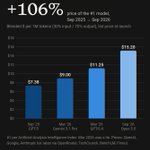
Best indicator that the new Gemini 4 is a big expensive model to run. Even the mighty google isn't willing to subsidize access.
This Post is from a suspended account. Learn more

Ben T was right - all the devices are "just" muse distribution mechanisms

🚨 side project alert 🚨
Announcing Muse Gadgets, an open source ESP32 firmware and Linux sdk so that you can make hardware devices that work with Muse.
Grab an API token from gadgets.muse.ai and point your favorite coding agent at the github repo to build your own peripherals for Muse.


Really interesting product with some really interesting integrations across Disney, NBA and UFC. Missing the 2026 Christmas shopping though is an absolute body blow

Meta's new VR goggles are a major upgrade on Apple's failed Vision Pro. Way cheaper ($1300 vs $3500), lighter (they feel like heavy glasses, not a helmet); better interface.
But primary use case is still "watching movies by yourself."
My hands-on: businessinsider.com/meta-vr-…

The underappreciated aspect of AI demand is how badly consumers will need AI just to have a chance against enterprise chaos.
🧑⚕️ Insurance blocking claims
☎️ AI customer service giving ppl BS
🚓 Automated fines

🦔Delta's CEO said AI will boost profits by 50% by setting a different ticket price for every passenger in real time. The airline uses an AI system called Fetcherr that generates a unique price for each shopping request. Delta told Congress last year it was not using personal data for individualized pricing. Its investor presentation described building toward offers for "you, the individual." Airlines are exempt from FTC pricing oversight.
My Take
This is what AI does for a company like Delta. It doesn't make your flight better or your bag show up faster. It watches how you shop and figures out the most you'll pay before you close the tab. Consumer Reports found Uber and Lyft charging 42% different prices for the same ride at the same time, and the House Oversight Committee found one case where two people got quoted $76 and $24 for the same trip. Delta is building the airline version of that, and every carrier will follow because the economics are too good to pass up.
Walmart told us this week that families are choosing between gas and groceries at $4 a gallon. Delta's answer to those same families is an algorithm that squeezes them for every dollar they have left. Airlines are exempt from FTC pricing rules, state laws are preempted by federal deregulation, and the CEO told Congress one thing while telling investors another. When people ask me where the trillions going into AI actually end up, I think Delta just gave us one of the most honest answers we've gotten.
Hedgie🤗


Without the number of cars in California this is dangerous data. I strongly suspect Waymo has been redeploying out of the bay into places like Texas or Florida

Q2 CPUC data is out, and @Waymo trips per day declined in May and June (MoM).
CA trips per day:
April: 47,205
May: 46,935
June: 44,964
Consistent with @_balaji_km's point that AV scaling curves look different from rideshare's supply-led ramp. Noise or signal? @dkhos $UBER

$NVDA quality on full display

