Every child has an inner mathematician, and our mission is to nurture it through play. Teachers and parent join us in making maths an adventure, not a chore.

London
Joined November 2025
Maths teachers: join us live TODAY at 4pm (UK) for a free cZeus School League webinar with Jo Hodge. See how puzzle-solving builds maths fluency and how the league works. Join: meet.google.com/qnt-mtcj-gdy #MathsEducation #TeachingMaths #STEM
41
Get ready for the cZeus Competition 🧩 2,699 sessions: pupils became up to 33% faster, used 56% fewer hints and nearly doubled perfect runs. Free webinar with Jo Hodge: 📅 Wed 21 Oct, 4pm UK 📲 Scan the QR code to book #MathsEducation #STEM #EdTech
1
35
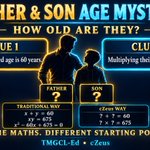
Two ages. Two clues. They add to 60 and multiply to 675. How old are the father and son? Traditional: solve a quadratic. cZeus: find the factor pair that fits both clues. Same maths, different starting point. No calculator 👇 #MathsChallenge #MathsPuzzle #cZeus
20
AI answers instantly: Two digits add to 10 and multiply to 24 → 4 and 6. But the maths is explaining why: test factor pairs, then keep the only one satisfying both clues. That is cZeus thinking—answers checked against connected constraints. #MathsEducation #AIinEducation
21
Try this number trick: Think of any number. ×2, +10, ÷2, then subtract your starting number. You always land on 5. The number cancels; half of 10 remains. Now swap 10 for 20. What changes? Making your own version is algebra before the name. #MathsEducation #Algebra #Maths
31
Three ages multiply to 36 and add to house no. 13. Still, the observer cannot tell them. Only two triples fit: 1,6,6 and 2,2,9. “My eldest plays piano” rules out the tie. Answer: 2,2,9. Sometimes “I can’t tell” is the strongest clue. #MathsEducation #MathsPuzzle
36
Greatest number that divides 12 and 18 exactly? 12: 1,2,3,4,6,12 18: 1,2,3,6,9,18 Biggest shared factor: 6. That’s HCF—no formula. In cZeus, a square can sit in product-12 and product-18 clues: the same thinking before the name. #MathsEducation #NumberSense
29
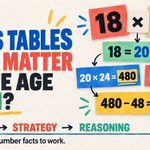
Do times tables still matter in the age of AI? 18×24 becomes (20×24)−(2×24)=480−48=432. Fluency is not the finish line; it makes flexible strategy possible. cZeus puts number facts to work. Recall, strategy—or both? #MathsEducation #AIinEducation #NumberSense
26
Dividing fractions. Do you teach 'keep, change, flip' first and reason later, or withhold the trick until they can explain why it works? Both camps have a real argument. Which are you, and did you ever switch? #MathsTwitter #mathschat #EduTwitter
1
57
First week back and you can already spot the Year 7s who have decided they are 'not a maths person'. What gives it away first for you: the hedging, the rubbing out, or waiting to be told they got it wrong? #MathsTwitter #mathschat #iteachmath
1
46
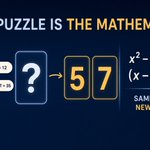
Two hidden numbers add to 12 and multiply to 35. Year 7s find 5 and 7 by reasoning. In Year 10, the same thinking factorises x² − 12x + 35. The puzzle is the maths; notation names it. Does teaching it in that order work? #MathsEducation #GCSEMaths #KS3Maths
🤖 Made with AI
37
Seating plans get set for behaviour. But motivation is contagious - lower attainers gain from sitting beside stronger habits (Kobe Desender, cited in Tes today). If motivation travels desk to desk, teams are the same lever at scale. #MathsTwitter #TeacherTwitter #numeracy
32
Enrichment becomes an entitlement next week. Schools get no dedicated funding for it, and half of teachers say they won't run extra clubs unpaid (Tes, 28 Aug). So the enrichment that survives will be whatever runs without extra staff hours. #MathsTwitter #SLTchat #EduTwitter
23
51% of teachers say AI eased their workload. 55% work the same hours anyway (BETT/YouGov, 1,033 teachers). The saved hour doesn't vanish - something fills it. Enrichment is usually what loses. #MathsTwitter #EdTech #ukedchat
21
One solution: 6 ÷ (1 − 3 ÷ 4) = 24. Since 3 ÷ 4 = ¾, then 1 − ¾ = ¼, and 6 ÷ ¼ = 24. The key: dividing by a quarter asks how many quarters fit into 6. Did you solve it differently? #MentalMaths #ProblemSolving #MathsChallenge
18
Can you make 24 using 1, 3, 4 and 6 exactly once? Use +, −, ×, ÷ and brackets. No calculator—and no skipping a number. Share your equation and explain why order of operations matters. #MentalMaths #ProblemSolving #MathsChallenge
14
Answer: all four can be the odd one out. 16 is the only power of 2; 25 the only multiple of 5; 36 the only triangular number; 49 the only number above 40. Did you find another valid argument? #MathsTalk #NumberPatterns #MathsEducation
13
Ritangle is back in October: MEI's team maths challenge drew 1,854 teams last year. No exam, no marks, thousands enter anyway. Appetite for team maths is real - it just arrives at 16, once pupils decide if maths is for them. #MathsTwitter #ALevelMaths #secondarymaths
14
Which number doesn’t belong: 16, 25, 36 or 49? There’s no single answer—choose one, identify a property and make your mathematical case. Which would you remove, and why? #MathsTalk #CriticalThinking #MathsEducation
11