

Building multi-agent systems for autonomous engineering. Pre-AI: hypervisors, operating systems, RISC-V, and analog electronics.
Cambridge, England
Joined May 2019
- Tweets292
- Following309
- Followers348
- Likes1.3K


Gianluca Guida retweeted

will happily vouch for martin, superb kernel engineer who can get the buggiest of hardware to bend to his will!!!

Did I just say out loud "Good night" to my agents? Yes I did, weirdly. After all, I left one on night-watch for the various teams left running.
The hardest problem in personal kernel and alternative OS development has just been majorly simplified.
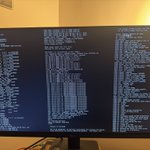
You want basic device drivers for your local dev machine? Just drop a picture of the lspci output to the screen.


Thinking about computers have always had for me the magic power of bringing me to a calm state. Turns out the above is true even in the darkest of days.
Thank you CPUs!
Gianluca Guida retweeted

Running the kotama experiment on just 4 MiB of RAM to see how small we can push TamaGo on @Ainekk0 platforms.
Is this the smallest ever deployment of Go (not TinyGo) runtime?


The $50 Operating System.
I've let my agentic system use Opus-5.5 to recreate one of my favorite OS architecture: the MIT Exokernel.
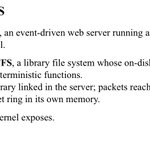
In a few hours, I have a full SMP kernel booting in QEMU (i686, as per original), with network and device drivers (virtio and PCI), filesystem implementation and enough libc to have basic tools (shell, ls, grep, etc.). And an HTTP server.
All using the library OS required by the architecture.
Total cost: $50.131615 in tokens.
I am not sure how to process this information.


Code is here: major holes, but respects the architecture. github.com/asys-projects/xok…
the agents have continued. Last time I checked cost was $78.
It is a fun chip!

Spent last two weeks learning electronics by having Opus run experiments on the Esperanto AI chips and condensing the results into interactive diagrams like this spacesheep.dev/@yaroslavvb/e…

Experiment of the past few days: asking a particular workflow that's making me happy to implement an entire operating system from scratch (using my beloved kernel library to speed things up, NUX).
One run is using gpt-5.5 and the other gpt-6.1-sol.
Findings: they are both proceeding at an insane scale (AHCI, virtio net and blk, RLT8139, E1000 device drivers as found in qemu implemented, all respecting the architecture I asked). BUT:
1. GPT-5.5 constantly tries to chicken out from a complex work, escalating to ask "should I do what you asked or just call the task failed". If you insist to continue, it actually does.
2. GPT-6.1-SOL goes instead where no man has gone before with a courage that would make Captain Kirk smile in approval, but then it finds a security issue in its own code, tries to explain it to itself and trips into its own cybersecurity censorship. Which is funny and not useful at all.
Leaving my agents for a two hours flight and landing to 7000 lines of code, well committed and actually not drifted towards something silly is quite pleasant.
You know you exaggerted with your overnight tests when you wake up and find out that your 2-hour drive distant workstation has stopped responding to pings.
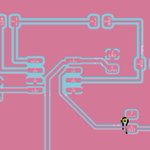
Terrible placing and interesting developments on the pcie lanes routing. Agents believe this does respect the gen1 pcie spec. Too tired to even think of checking.

Fixing and rewinding a MSX cassette tape is useful to remember that nostalgia is the dumbest of feelings.
And this is why I love working with LLMs. You just ask to please test this with a "UNIBUS terminator" and it doesn't think you're a weirdo. Also you don't have to explain UNIBUS.
It's time for self-deprecating humour when the simplest genetic algorithm beats your LLMs hands down, and in 1/10th of the time! Can I call GAs agentic so I can still pretend to be all modern and contemporary? :-)

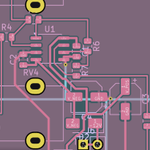
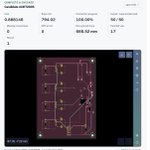
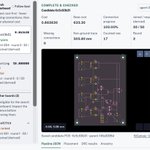
More automated routing and placing. Grouping implemented.Agent ignored the tl072 datasheet layout suggestion, but this is actually really good. ouf course no ground pouring on a tl072 is highly suggested, but I like how clean this placement is.

Well, on this morning episode of "let's check the agents", the engineer now finally decides to use different width for different nets, ground still connected through a wide wire despite the subsequent pour. Power properly delivered.
All connected and working.
There's only one thing left to make it what it should be: supporting grouped components so that all the bypass capacitors, diodes etc are close to where they shoud be.
This is all from a single prompt of "make an eurorack module". Yeah, getting happier with my generic agentic system for engineering. PCBs is just the first test.
