

Ecommerce Shipping help is here. Unlock your Free Parcel savings report at: https://xitter.cf/t.co/8PfzzXDvEd
Austin, TX
Joined December 2009
- Tweets204
- Following154
- Followers115
- Likes610



🚨 Peak fees start this weekend.
UPS turns on Additional Handling, Large Package and Over Maximum demand surcharges September 27.
FedEx follows September 28 with Additional Handling, Oversize and Unauthorized demand charges.
At peak, some of these get expensive fast:
• UPS Additional Handling: up to $11.90
• UPS Large Package: up to $117.50
• FedEx Unauthorized: up to $595
Then comes the surcharge that impacts far more shipments.
Per-package residential demand surcharges begin October 25 for UPS and October 26 for FedEx.
At peak:
📦 UPS Ground Residential: $0.75/package
📦 FedEx Ground Residential / Home Delivery: $0.80/package
Before Friday, audit the dimensions and weights of your top SKUs.
One $117.50 UPS Large Package demand surcharge costs as much as the peak surcharge on 156 standard residential packages.
A few dimensional mistakes can get expensive fast.
Parcel carriers bill using the higher of Actual or Dimensional weight.
Shipping 5 lbs. of popcorn vs 5 lbs. of bricks makes a big difference.
The popcorn will take up a lot more space, reducing capacity for other packages.
Apply this formula to calculate Dimensional Weight (using inches):
➡️ Length x Width x Height of the package, divided by the DIM divisor.
DIM divisor (aka DIM factor) is the denominator. For example:
23” x 12” x 10” package with a standard FedEx DIM divisor of 139
= 2760 / 139
= 20 lbs. dimensional weight rounded up
If the actual weight is only 5 lbs., the charge will be based on the higher 20 lbs. dimensional weight.
Knowing this, some retailers will negotiate a higher DIM divisor.
They will also work on optimizing their package size selection or choose a service that offers flat rate shipping.
Optimizing packaging is especially important as the new cubic volume thresholds for Additional Handling and Large Package will go into effect in January with UPS and FedEx.
UPS is investing in 400 hundred robots to unload trucks, as reported in Bloomberg.
The UPS order puts a spotlight on Pickle Robot Co., a Charlestown, MA based startup that’s raised $97 million since 2018.
Unloading boxes from a trailer is one of the most labor intensive warehouse jobs.
This is part of a broader multi-year automation push by UPS to drive efficiency and lower costs.

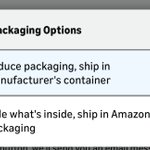
Amazon defaulted to this selection for its Ships in Product Packaging program.
They’re clearly serious about pushing this capability.
Reducing packaging makes sense.
But heads up on your holiday gifts!

🚨 NEW Logistics Remix Podcast episode is out. 📺
Breaking down 2026 parcel GRIs with Nate Skiver of LPF Spend Management.
If you ship small parcel, the headline GRI number is not the real story and this is a must listen.
Nate has spent over two decades inside retail and ecommerce parcel programs and now advises brands on how carrier pricing actually works behind the scenes.
🎙️ In this episode, Nate and I discuss:
- Why most shippers underestimate the true impact of GRIs
- How UPS and FedEx surcharge changes quietly drive costs higher
- What’s really happening with USPS Ground Advantage in 2026
- Why fuel surcharges matter more than most people think
- How to model rate increases correctly instead of guessing
- What shippers should be doing now to plan for 2026
We also had some fun talking about his meme posts and why humor can be a powerful way to get people to pay attention to serious cost drivers.
Full episode link, enjoy!
youtu.be/-f-L_G5Axlw

New episode dropping soon on YouTube.
Nate Skiver with LPF Spend Management joins me on the podcast to break down the rate changes that matter heading into 2026 and more.
Subscribe to the channel for alerts 👇
youtube.com/@LogisticsRemix
New episode coming SOON. Holiday special featuring Nate Skiver.
Subscribe to the YouTube channel to get notified when the episode goes live.
youtube.com/@LogisticsRemix
Walmart just expanded drone delivery with Google’s Wing to six stores across metro Atlanta. Shoppers can now get groceries, over the counter medicine and essentials in minutes. Drone delivery is starting to become common in certain markets.
And Walmart isn’t betting on one partner.They’re working with Wing, Zipline, and DroneUp across multiple cities. Walmart isn’t letting Amazon have all the fun.

If you’re bracing for a 5.9% GRI in parcel shipping, here’s what you should keep in mind:
The cost impact might not be as straightforward (eg. fuel, accessorials, etc…).
Explore your options, you may not have opened all the doors.
It’s a great time to reassess your strategy and make sure you’re not leaving money on the table going into Q1.
Are you a large package shipper with UPS? Planning to adjust your package size? 📦
Here’s what you need to know about UPS domestic changes starting January 26, 2026.
Large Package Surcharge (LPS)
- Applies to domestic packages over 17,280 cubic inches.
- Applies to domestic packages over 110 lbs.
- All other existing LPS rules stay in place.
Additional Handling Charge (AHC)
- Applies to domestic packages over 10,368 cubic inches.
- All other existing AHC rules stay in place.
A few extra inches can push your package into a surcharge that doubles your cost or more. Now is the time to review your packaging.
Have you received an online order with a product that was 1/10 the package size?
Why is that?
My hunch: missing data!
If product dimensions are missing, how does the retailer know if the optimal packaging was used for shipping?
Not to mention the intended carrier service with the expected shipping rate.
There’s really no way to optimize, manage or measure this with missing input data.
The opportunity to save on shipping cost and reduce waste is massive so don’t let it slip away.
Prioritize data accuracy.
4 Reasons Parcel Shippers Might Not Be Seeing Savings in January:
1️⃣ Fuel Surcharge Increases: Fuel surcharges have risen 10 times in 2 years by approx 1% each, cutting into expected savings.
2️⃣ General Rate Increase (GRI): Carriers have implemented a 5.9% GRI, driving up baseline shipping costs.
3️⃣ Demand & Peak Surcharges: These surcharges are lingering into mid-January 2026, impacting budgets.
4️⃣ Not Hitting Incentive Tiers: Lower post-holiday volumes might mean missing key incentive thresholds, leading to reduced discounts and higher per-shipment costs.
Not all shippers face the same challenges.
As we enter the new year, it’s crucial for shippers to carefully analyze their agreements and pinpoint where costs may climb in order to stay ahead.
Denmark’s postal service is ending letter delivery due to a steep decline in demand. A 90% drop in letter volume pushed the country to phase out mail entirely. The organization will focus solely on parcel delivery going forward.
Is this the start of the end of mail delivery? Which country will follow next?
Two-day delivery is not cool.
You know what’s cool? 30 minute delivery.
Amazon just started testing it in Philadelphia and Seattle for thousands of everyday essentials and fresh grocery items.
Prime members get discounted delivery fees starting at $3.99 per order vs. $13.99 for non-Prime.
What’s next? 15 minutes by Drones. Oh wait…

According to recent report by The Washington Post, Amazon is preparing to end its long standing partnership with the USPS by the end of 2026 as it brings more parcels into its own delivery network.
Amazon currently spends more than $6 billion in annual volume to USPS, approx. 7.5% of USPS’s annual revenue.
The company has allocated more than $4 billion to expand its U.S. rural delivery network by the end of next year.
Amazon is on track to exceed USPS volumes by 2028 with 8.4 billion parcels, per Pitney Bowes forecast.
What shippers want in 2026 from their parcel program.
- Lower costs that actually stick
- Better visibility into spend
- Protection from constant price hikes by the national carriers
What alternative carriers want:
- Consistent volume growth
- Partnerships that make sense for both sides
- Customers who move with urgency and complete onboarding fast
The opportunity is at the intersection.
⛽️ Another FedEx fuel surcharge increase just dropped.
And it goes into effect today, December 1. 🚨
For Ground, Home Delivery, and International Ground:
a 150 basis point increase or 1.5%.
Adobe is predicting $43.7 billion in online spend in the U.S. during Cyber Week.
That’s up 6.3% for the period from Thanksgiving/Black Friday to Cyber Monday.
The pressure will be on to get every order to the customer’s door.
Thank you to all the operators making those deliveries count. 🚚📦