
inactive | go @timohillmann.bsky.social | PhD student @chalmersuniv. Interested in circuitQED, bosonic error correction & driven-dissipative phase transitions
Gothenburg, Sweden
Joined March 2022
- Tweets98
- Following292
- Followers525
- Likes1K
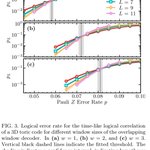

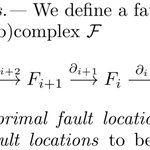



Check out @mike_vasmer views on our project about fault complexes! Thanks for keeping an open mind about my vague ideas and intuitions throughout!
This Post is from an account that no longer exists. Learn more
Last year I’ve spent some months at @XanaduAI. I wanted to use that time to finally properly understand fault-tolerant MBQC. Digging in the literature I found that previous works didn’t fit my style of thinking. It was time for something new!
scirate.com/arxiv/2410.12963
I hope that the concept of the fault complex proves to be useful beyond our work. We’ve sketched out a few extensions to subsystem codes and also circuit-level noise models.
I see it as a step of going away from the picture of static codes to fault-tolerant channels!
Thanks again to the whole @XanaduAI team and especially my close collaborators on this project, Guillaume, Ilan, and @mike_vasmer
Tired of quantum error correction feeling like a bad trip? Fear no more!
Meet our new method: Localized Statistics Decoding
(LSD). Today's the day that we bring it to the masses!
scirate.com/arxiv/2406.18655
(1/7)

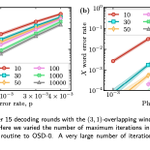
Our recipe is openly available as part of the LDPCv2 package which contains lots of other good stuff. stim/sinter integration, overlapping window decoders for circuit-level noise, you name it.
github.com/quantumgizmos/ldp…
(6/7)

Thanks to the team for this fun collaboration; @lucasberent @armanda_oq @jenseisert @rbrtwll @QuantumGizmos
(7/7)
It’s the longest day of the year for everyone on the northern hemisphere, so don’t tell me there’s not enough time for you to read our new paper where we propose a new family of codes we call radial that are single shot with a high threshold!
scirate.com/arxiv/2406.14445
Our simulations of circuit-level noise show that radial codes maintain error suppression similar to surface codes, even when decoded using a single-shot approach, but require 5x fewer physical qubits. This can enable faster logical clock speeds and reduced decoding complexity.

This was a fun collaboration with Tom Scruby and @QuantumGizmos that I joined when Tom and I met at the 2024 YITP Quantum Error Correction Workshop in Kyoto. Thanks again to @BBaragiola, Andrew Darmawan and Yoshifumi Nakata for organizing!