

Executive Editor at Life Science Alliance: https://xitter.cf/t.co/RCS3L4PRC9 Now with even less Musk: https://xitter.cf/t.co/C7i7rnBOT0
New York, NY
Joined June 2008
- Tweets5.9K
- Following679
- Followers1.5K
- Likes10.9K





Pinned Tweet
Writing about negative data was fun because I read a bunch of Stephen Jay Gould, plus a related commentary by Howard Bowerman.
Both provided fantastic examples outside cell biology and biomedicine that perfectly highlight the universality of this issue:

Honestly impressed with how tone-deaf this marketing from @qedScience is!
"Judge the science before you commit to a full read"
Their calm assurance that you should turn off your brain and go with their little number ... insane.


timisstuck retweeted

Congratulations to Karl, Peter, and Georg! Another great example of how basic research - in this case, understanding how an algal cell responds to light - can have an enormous impact on our understanding of something as complex as the brain.

BREAKING NEWS
The 2026 #NobelPrize in Physiology or Medicine has been awarded to Karl Deisseroth, Peter Hegemann and Georg Nagel “for their discoveries concerning light-gated ion channels and optogenetics.”

timisstuck retweeted

In our October issue: Combining two spatial transcriptomics probe sets on the same sample, how epithelial cells remember prior physical constraints, and a novel single-cell translation profiling technique!
hubs.la/Q04z0HPY0

timisstuck retweeted

Haha. Wow glam journals stepping it up a notch. "Open peer review" with redactions. They should charge another 16K for access to the redactions 😆


Human vs murine IL-2?? If you are a mouse T cell, prevailing wisdom says it doesn't matter. But papers on IL-2 species specificity are ~30 years old. Brian Sheridan and colleagues found a modest but persistent survival advantage for murine IL-2 👇
life-science-alliance.org/co…

How the heck do super broad acting antimicrobials actually work?? these authors have some answers.

Drug-induced metabolic remodeling promotes antimicrobial activity in macrophages and extends longevity in vivo
@RSUinfo @RutgersU @RutgersNB @Waksman_Inst
hubs.la/Q04xQYgF0
timisstuck retweeted

I wish we didn’t need these again, but here is the honest version of Anthropic’s biology announcement 🥳🥳🥳
(Caveat: I haven’t worked in bioinformatics for many years.)
The good: Anthropic ran ~950 Claude agents over a large biological sequence database. Claude searched, wrote code, compared sequences and genomic neighborhoods, and found an interesting pattern that apparently had not been noticed before: a known reverse transcriptase associated with another gene and a repetitive DNA array.
That is cool. Automating this kind of open-ended bioinformatics search at scale is useful, and Claude may have found a lead a human would have missed.
But: Claude did not do a biological experiment. It searched databases and analyzed data.
Humans then took the candidate into the wet lab. And the wet-lab result so far is modest: they showed that the repeat array produces short RNAs.
We still don’t know what the system does. No function, mechanism, phenotype, targeting, defense activity, or programmability has been demonstrated.
This is also where the CRISPR framing gets ahead of the result. Right now, “it has some features reminiscent of known programmable systems” is a hypothesis for what to investigate next, not a discovery that it behaves like CRISPR.
And there is a missing baseline: bioinformatics has had tools for finding unusual gene neighborhoods and candidate systems for years. The interesting comparison is 950 Claude agents vs. an expert using the best existing computational pipelines - not Claude vs. someone manually looking through 200,000 sequences.
So my honest announcement would be:
Claude autonomously found an interesting candidate for a previously uncharacterized biological system. A small human wet-lab experiment confirmed that part of the candidate is expressed. We don’t yet know what it does.
That is a good result.
But in a regular biology lab, this isn’t the finished paper. It is the result you show at lab meeting and say: “This looks interesting. Now we need to figure out what the hell it does.”
Maybe that next step leads to a major discovery. But that discovery hasn’t happened yet.

Claude has discovered a previously unknown enzyme system hidden in the DNA of bacteriophages. Beside the enzyme’s gene sits a long array of repeating DNA—a structure that looks somewhat similar to CRISPR.
We don’t yet understand what this system does, but only a handful of known systems share its features, and all of them are able to cut, copy, and paste DNA. Historically, the discovery of such programmable systems has helped revolutionize medicine. CRISPR, for instance, is now the foundation of genetic medicines. But it will take much more work to learn what this system does, and whether it can be put to similar use.
Read more: anthropic.com/news/claude-di…

timisstuck retweeted

Every so often I look at who is publishing what, and how often.
When I was looking at the the last three years, I saw that Scientific Reports has more documents indexed on Scopus that any other outlet.
The infographic shows how many documenst have been indexed by Scopus in the last three years, how many documents Scientific Reports has had indexed and how this translates to how many articles they publish each day.
I have also calcuated what this would translate to in revenue if we take the current article processing charge (APC) of $2,850.
These figures should be taken with caution and treated as an upper bound as the APC could have been less a couple of years ago, there may be waivers, individual arrangeements etc.
.. but if this is information is not shared by the publsiher then we can only make our own estimimates.

Today in a webinar an immunology journal editor said:
"reviewers spend 1-2 hours to write a quality review"
Seems kind of low to me? Is that true, immunologists?
Awesome work combining cell biology of macrophages with C elegans lifespan studies.
Bridging labs, experimental approaches, and biological scales to tease out subtle but persistent effects of this broad-spectrum anti-microbial K21! 🎉
A potent antimicrobial promotes mitochondrial fission and mitophagy, boosting the effectiveness of macrophages in defending against bacterial infection and promoting lifespan extension in C. elegans.
@RSUinfo @RutgersU @RutgersNB @Waksman_Inst
hubs.la/Q04xQRvT0
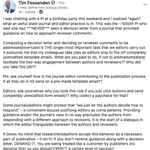
Researchers deserve better. Journals need to step in with guidance for all, and editors must intervene when nonsense like this goes on.
Vote with your feet and do not go to a journal if the editor abdicates their role as it seems they did here.

We seriously need to discuss the use of AI in scientific peer review.
Yesterday, we prepared a ~15-page response to a reviewer. We addressed every comment individually and revised the manuscript accordingly.
About 12 hours later, the same reviewer came back with another 2 pages of comments. And these were not simply an assessment of whether we had adequately addressed the original concerns. There were new analyses, new technical details, and new requests that had never been raised in the first round.
Is it humanly possible to carefully read a 15-page response letter, check the revised manuscript and all the changes, critically evaluate them, and then develop an entirely new set of methodological requests within 12 hours?
Perhaps. But it certainly raises questions.
With AI, you can generate an endless list of things authors “could also do”:
“Please perform this subgroup analysis.”
“Add another sensitivity analysis.”
“Repeat the analysis using a different model.”
“Adjust for this additional variable.”
“Validate the findings using another statistical method.”
There is literally no end to this.
And this is not just about whether reviewers use AI. The bigger problem is peer review turning into moving goalposts. Authors address the first-round concerns, only to find that the goalposts have moved and an entirely new set of requests appears in the next round.
Journals need clear rules for AI-assisted peer review. AI use should be disclosed, and unless a genuinely new and critical issue is identified, subsequent review rounds should primarily assess whether the original concerns were adequately addressed.
Otherwise, peer review risks becoming an endless AI prompt loop rather than scientific evaluation.
I fully recognize how difficult it has become for journals to find reviewers, and I am among those who criticize many aspects of the current academic publishing system. But please, if you volunteer to review a paper, don’t make an already exhausting process even more exhausting for authors. Enough is enough.

It's Peer Review Week!! The one week a year when I actually read the peer reviews at LSA 😌
(this was a joke)
But seriously this week I worked with a 1st time peer reviewer to significantly improve their comments which were initially not really appropriate. A win for us all!


timisstuck retweeted

Out of claude tokens so Onlyfans support bot is my software engineer now
🤖 Made with AI

Readers added context they thought people might want to know
This screenshot was generated with AI.
openai.com/research/verif…
timisstuck retweeted

For all the good they have done, I’m becoming more certain that B16 models are actively impeding research into cancer.

It’s normal for a journal to pay $20-50 per incoming submission. If submissions skyrocket there is a real cost, even before you account for staff time/effort.

timisstuck retweeted
Single-cell chromatin profiling study identifies diagnosis-stage regulatory features associated with relapse-prone pediatric AML, highlighting immune/inflammatory programs and transcription factor networks hubs.la/Q04v9bHB0
