
Neuroscientist
Princeton, NJ
Joined May 2009
- Tweets101
- Following56
- Followers1.4K
- Likes94




Tim Buschman retweeted

We live with the limitations of our memory, but don’t really know where they come from. Our new paper (doi.org/10.1073/pnas.2401032…) studies "swap errors", which we argue arise during memory manipulation – see thread for more! @timbuschman, @MattPanichello, @wjeffjohnston

New preprint! @tafazolisina shows the brain builds complex tasks by compositionally combining simpler sub-task representations. By dynamically reusing neural subspaces for sensory inputs and motor actions, the brain can flexibly perform multiple tasks. 🧵 biorxiv.org/content/10.1101/…

6/7: Finally, monkeys had to discover the task in effect, updating their internal belief based on feedback. As they learned which task was in effect, we found the task-relevant shared subspaces were gradually engaged and task-irrelevant information was compressed.

7/7: Very excited about this paper! Culmination of a very long-term project led by @tafazolisina in collaboration with @neuro_flora, @adelardalan, @Nikola_T_Markov, @Mu_neuro, @marcelomattar and @nathanieldaw .
New @CurrentBiology paper with @CamdenMacDowell relating individual differences in behavior to neural dynamics! Individuals differently expressed ‘motifs’ of cortex-wide neural activity, which explained variability in functional connectivity and behavior🧵 doi.org/10.1016/j.cub.2024.0…
In sum, this supports a ‘sampling hypothesis’ that suggests differences in behavior are due to differences in the top-down control mechanisms that govern the moment-to-moment selection of specific interactions between brain regions.
Research was done by a wonderful team of Camden MacDowell @CamdenMacDowell, Brandy Briones @brandy_briones, Michael Lenzi, and Morgan Gustison @MorGusto
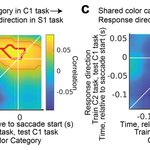
3/5: Recordings in prefrontal and parietal cortex found attentional templates were semantically structured: templates for perceptually similar stimuli had similar neural representations. Such structured geometry could allow for generalization to new templates.

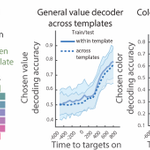
5/5: Finally, attention re-mapped sensory stimuli into a common ‘value’ space which generalized across templates. This could allow the brain to use the same decision-making circuitry to decide which stimulus to select, regardless of changes in the template or environment.

Project was led by @cjahn_neuro in collaboration with @Nikola_T_Markov, Britney Morea, @nathanieldaw and @BecketEbs.
