

Sovereign AI for enterprises. Build AI you own on infrastructure you control. Private, specialized models that run where your data lives.
Austin, TX
Joined May 2022
- Tweets518
- Following30
- Followers5.7K
- Likes915





webAI retweeted

We’ve been playing around with the new TwIL-LM3-Pro model and in this maze problem it solved it so fast and even beat Qwen3.8-27B!
Seeing this model perform this good at only ~4B is crazy, definitely should check it out if you haven’t already!

We ran TwIL on a CPU with 15 GiB of RAM. No GPU. It generated tokens 98x faster than Qwen3.8-27B on the same hardware.
The test:
- Intel Xeon CPU, 4 threads
- 15 GiB RAM
- No GPU
Results:
- TwIL-LM3-Pro (2.24 GB weights): 10.47 tokens per second
- Qwen3.5-9B (5.67 GB weights): 4.36 tokens per second
- Qwen3.8-27B (16.45 GB weights): 0.107 tokens per second
TwIL and Qwen 9B both run at the RAM's memory limit of about 24 GB/s. Qwen 9B is 2.4x slower only because its weights are 2.5x larger.
Qwen 27B's 16.45 GB of weights don't fit in the 15 GiB of RAM. Parts have to be re-read from disk for every token. Size alone would make it 7.3x slower. The disk reads add another 13x. Total: 98x slower than TwIL.
With enough RAM, the gap would shrink to about 7x. But most people don't have unlimited RAM, and most people don't have a top-tier GPU. The model you can actually fit matters more than the one you can't.
Download TwIL-LM3-Pro on @huggingface: huggingface.co/webAI-Officia…
webAI retweeted

AI models are not conscious. A CEO or leader who seriously claims that current systems are conscious is either profoundly confused about the technology or engaged in deliberate misrepresentation, and is unfit for authority over AI development or deployment.
Current models are large statistical systems trained to predict tokens. They have no evidence of subjective experience, unified agency, persistent self-models independent of the prompt, or any of the functional markers that would be required even on generous functionalist accounts of consciousness. Anthropomorphic outputs are produced because the training data is full of human self-description; that is imitation, not evidence of an inner life.
Treating such claims as a reason for removal from power is therefore not a medical diagnosis. It is a judgment about competence and incentives.
Leaders who assert consciousness in present systems either do not understand what they are shipping, or they benefit from the confusion—through valuation narratives, regulatory positioning, or public relations. In either case they are poor stewards of a technology whose real risks (capability, misuse, concentration of power) are already concrete and do not require speculative inner experience to matter.


NEW: According to a bombshell report in the New York Times, Anthropic co-founder Chris Olah threatened to walk out of Pope Leo XIV’s AI encyclical launch in May because the pope rejected the idea that machines can be conscious.
Olah’s team then privately lobbied the pope’s advisers “to take the possibility of model consciousness seriously.” Pope Leo XIV held firm.
For months, Anthropic has wined and dined theologians and religious scholars under nondisclosure agreements, hoping they would bless the idea that Claude has moral standing. thelettersfromleo.com/p/nyt-…

webAI retweeted
Half a million downloads in a month. Today, our open source family takes another step forward.
Thank you for the incredible support behind our first-generation models. We’re excited to introduce TwIL-LM3-Pro.
At just 3.6 billion parameters, it brings powerful reasoning to everyday computers, with quantized builds that run locally. No cloud required.
In our evaluation:
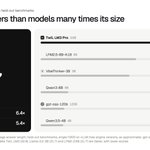
Formal logic: Highest recorded headline score among the small models compared—beating China’s VibeThinker-3B by 35% and Qwen3.5-4B by 24%, and Liquid AI’s LFM2.5-8B-A1B by 47%.
Broader reasoning: 95% on SVAMP and 64.1% on MuSR, the highest recorded scores among the small models compared.
BIG-Bench Hard’s logic subset: 95.4%, compared with VibeThinker-3B’s 61.1%.
We believe AI is entering a post-training era. The advantage will increasingly belong to companies with the best pipelines and those that can produce capable, personalized intelligence faster and more efficiently, then put it on devices people already own.
That’s what we’re building at webAI. And we’re only beginning to share what’s coming out of our lab.
Coming soon: Meridian, our family of frontier-class models built to run on device. Our most advanced models will be available through the @thewebAI application.
Join the waitlist as we expand access. Proudly built in Austin, Texas. 🇺🇸

webAI retweeted

Jason Rathje, President of Public Sector at @thewebAI, discusses U.S. China AI competition, open source models, national security and the need to build resilient American AI supply chains.
$NVDA $AMD $AVGO $INTC $TSM
@MorganLBrennan
cnbc.com/video/2026/09/25/ja…

webAI retweeted
I think the answer is not to slow down. It’s to invest in approaches our adversaries cannot easily replicate and cannot fully embrace without changing how they exercise power.
The frontier labs have built a paradigm around increasingly powerful centralized models and enormous concentrations of compute. My concern is that we’ve defined the competition around a playbook our adversaries can follow, rather than an advantage they will struggle to reproduce.
At @thewebAI we’ve been working toward a civilization of intelligence: distributed, specialized intelligence grounded in the specific, tacit knowledge of people, teams, and institutions. Our Intelligence Delivery Network is part of what connects that intelligence without requiring all knowledge and control to be centralized.
The distinction is not just distributing compute. It’s distributing the ability to understand, decide, and act.
Our strength is trusting people throughout the chain of command to exercise judgment not simply follow instructions. That principle of trust and decentralized execution is already foundational to our military doctrine. We should build intelligence that amplifies it.
Our bet is that this creates a fundamental dilemma for adversaries whose power depends on centralized control. They can pursue the same technology. But realizing its full value means empowering people and institutions to act without every decision flowing through the center.
That is much harder to replicate than a model. Copying the technology does not recreate the accumulated knowledge, relationships, and trust that make the system valuable.
We should not slow down to preserve a lead in a paradigm others can copy. We should invest in one that turns our greatest strengths into an enduring advantage.

We Must Pace the Frontier: I’ve written a new essay on why the AI industry should slow down, with a three-part plan for doing so.
Anthropic is unilaterally committing to the first of these steps. We’ll provide third-party evaluators with permanent, employee-level access to our systems, so that they can verify adherence to our safety measures, report on incidents, and assess models’ alignment during training.
You can read the full post here: darioamodei.com/post/we-must…

webAI retweeted
@thewebAI is up.


webAI retweeted
The most valuable AI company won’t be built around a single model. It will be built around the system that can create the next thousand.
The physical world won’t run on one giant model in the cloud. It will run on small, specialized models deployed everywhere.
At @thewebAI, that system is now producing N expert reasoning models every week and accelerating.
Meridian is next.
webAI retweeted
Big step for open multimodal retrieval:
webAI’s ColVec1.1 models are now natively supported in @huggingface Sentence Transformers.
Developers can load our 4B and 8B models directly through the new MultiVectorEncoder interface to search visual documents, images, PDFs, charts, tables, and complex layouts without relying on OCR-first pipelines.
The 8B model currently leads ViDoRe V3, while the 4B model delivers the best published result in its size class.
State-of-the-art retrieval, now accessible through one of the most widely used embedding libraries in AI.
Huge thanks to the @huggingface and @tomaarsen and the Sentence Transformers teams for helping bring multi-vector retrieval into the broader ecosystem.
Available now.


webAI retweeted
General intelligence is a commodity. Expert Intelligence is scarce.
@thewebAI TwIL-LM3 crossed 60K downloads already—and it’s still climbing.
A pure formal-logic reasoning model is trending on @huggingface in a week when @Alibaba_Qwen, @AIatMeta, @nvidia , and others are releasing new models.
The demand continues to enforce our thesis: the future isn’t one giant model.
It’s networks of specialized models, collaborating at the edge. A web of AI.
TwIL is just one expert. More soon.
Hugging Face: lnkd.in/gGesccX5
webAI retweeted
Today, we’re excited to open-source TwiL-LM3, the first formal reasoning model from the webAI Intelligence Lab.
At just 3 billion parameters, TwiL-LM3 outperforms OpenAI’s GPT-OSS-120B on 4 of 5 formal reasoning benchmarks while running efficiently on consumer hardware. That’s 40× fewer parameters, 2.6× faster inference, and state-of-the-art performance in the reasoning tasks that power reliable tool calling, code generation, structured outputs, and AI agents.
TwiL-LM3 was trained using webAI’s proprietary reasoning pipeline on webAI-owned, verified datasets—not scraped internet data. We believe better reasoning comes from better training pipelines and higher-quality data, not simply larger models. Our approach demonstrates that efficient models can rival—and in many cases surpass—models dozens of times their size.
Designed for the edge, TwiL-LM3 runs on hardware people already own—from a Raspberry Pi to an iPhone—bringing advanced reasoning to millions of devices without relying on the cloud.
This is our first open-source release from the webAI Intelligence Lab, and it’s only the beginning.
Proudly built in Austin, Texas.
Article: webai.com/blog/webai-release…

webAI retweeted

The most powerful information for your company is already inside your company. Specific AI models built on that data generate ROI… and you own it. @thewebAI

webAI retweeted

AI data centers bring environmental & security concerns.
Jason Rathje, president of public sector, @thewebAI and former director, DoD Office of Strategic Capital: Anytime you centralize power, data, and now artificial intelligence, you create an acute threat for our adversaries."
webAI retweeted

Side Quest: building/testing a Swift + MLX iOS implementation for the @Webai YOLO26 MLX Challenge
iPhone 16 Pro Max live test:
- Live camera tracking overlays✅
- Still-image object detection✅
- On-device inference✅
- Early physical-device validation✅
Write-up coming soon


webAI retweeted
@thewebAI now has 2 of the top 3 RAG models on ViDoRe.
And both can run on an iPhone or your laptop.
Our smallest model (4B) scores within 0.1 nDCG of @nvidia's nemotron-colembed-vl-8b-v2.
That’s within margin of error.
Same retrieval quality.
Half the model.
For a long time, multimodal RAG looked like a scaling problem:
Bigger models
More GPUs
More data center spend
That assumption just broke.
We’re now seeing:
- frontier-level retrieval (64.48 - 63.49 nDCG)
- real multimodal understanding (documents, not just text)
- running locally
This isn’t just a leaderboard result.
It means:
- your data doesn’t need to leave your device
- latency drops to device speed
- marginal cost goes to zero
- retrieval becomes private by default
The best RAG models now fit in your pocket.
And we’re making them available.
So anyone can build, run, and own their retrieval stack locally.
Available:
lnkd.in/ejxvZyFe
lnkd.in/ejfgVBYP
webAI retweeted
More open source announcements this afternoon with @thewebAI .
This one is very special.
#ai #opensource


