

Experimenting with local models, agents, and independent research. Really good at asking dumb questions.
Joined December 2019
- Tweets2.5K
- Following1.2K
- Followers15K
- Likes51.5K




Pinned Tweet
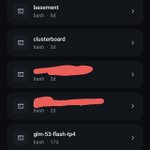
just launched basement
1-click model management for DGX Spark
curl -fsSL basement.punkjazz.ai/install… | bash
Simone retweeted

Hire Grok @Bot today. You won’t regret it.

Tested this with 4 DGX Sparks with a switch. The coding battery finished was 3x faster (~8 mins TensorFold vs ~24 mins vLLM) with better correctness.
Great work @MiaAI_lab @ashxhart !


Run GLM 5.3 Flash EXL3 with TensorFold ⚡️
Now on 4x DGX Sparks, switchless or not!
For now, TP4 is on its own branch, so please make sure you use the correct branch!
- Around 6M KV cache.
- Decode on prose 95 tok/s, single stream
- Decode on prose 163 tok/s, 4 streams
- Decode on prose 222 tok/s, 8 streams
- Prefill ~2500 tok/s across the board.
These numbers were measured on a switchless setup!
The recipe works both with or without a switch, each has it's own startup script.
Links below 👇


It took quite some time and plenty of fable and astra tokens but my tested four-Spark TP4 adaptation of @MiaAI_lab’s excellent GLM 5.3 Flash recipe is now
public.
Get it here: github.com/punkjazz-labs/glm…
In the latest comparison against Mia’s TP2 recipe:
• 3 coding jobs + a cron finished 54% sooner
• Long-generation decode was 2× faster
• 8-stream aggregate throughput was 3.4× higher
Huge cold prompts remain the trade-off: TP2 prefills faster.

Update on the Fable-driven optimization of GLM 5.3 Flash TP4 using @karpathy autoresearch, starting from @MiaAI_lab recipe. Not bad at all!

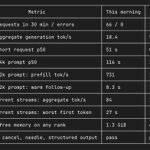
First tests on GLM 5.3 Flash tp4 (on four DGX Sparks) vs t2:
+59% decode
22% faster coding+cron
34% lower 24k p50
0/66 errors
Bigger win: mixed prefill cut short-request latency during a long decode from 330s to 0.7s for ~1% decode cost.
Running tp4 optimizations now


I just finished testing Qwen 3.8 Flash.
GLM 5.3 Flash is the better model despite the lower tok/s, which don't matter because it's faster to get to result anyway.
GLM: best primary coding worker. Slightly better first-pass quality than DS4F and dramatically more efficient.
DS4F: ultimately matched GLM’s quality, but with much higher time/token usage.
Qwen: excellent for small parallel jobs, but not as reliable for substantial work.
Qwen is useful as a fast specialist for short parallel jobs, but its long-task reliability, stopping discipline and tool consumption remain substantially worse.

Ran a few more tests, this is the result:
GLM was 24.9% faster overall while using 79.3% fewer output tokens and 59.4% fewer tool calls. Its lower tok/s is outweighed by much greater agent-loop efficiency.
I'll test Qwen 3.8 flash next, but so far @Zai_org shipped a clear winner here.

Don't get fooled by lower tok/s in benchmarks.
GLM 5.3 flash was 40% faster overall vs ds4f despite lower tok/s because it generated far fewer tokens and made fewer tool calls.
Both tested with @MiaAI_lab recipes

Simone retweeted

Great example on why you need to try the model by yourself and stop staring at benchmark numbers.
Running GLM-5.3 Flash is worth it.
Get it here:
github.com/MiaAI-Lab/GLM-5.3…

Don't get fooled by lower tok/s in benchmarks.
GLM 5.3 flash was 40% faster overall vs ds4f despite lower tok/s because it generated far fewer tokens and made fewer tool calls.
Both tested with @MiaAI_lab recipes
Don't get fooled by lower tok/s in benchmarks.
GLM 5.3 flash was 40% faster overall vs ds4f despite lower tok/s because it generated far fewer tokens and made fewer tool calls.
Both tested with @MiaAI_lab recipes

Here's the solution.
Truth is chatgpt (plus local models plus grok) just works.


Something is seriously wrong with Claude Opus 5 right now.
I've been digging through recent user reports, and the same problems keep appearing independently:
→ bizarre sentence structure and borderline gibberish
→ unnecessary or invented jargon
→ hallucinating facts, issues or context that were never there
→ correcting itself repeatedly inside the same task
→ ignoring explicit instructions / CLAUDE. md constraints
→ doing work nobody asked it to do
→ creating bugs, then burning huge amounts of time fixing its own bugs
→ declaring tasks finished while leaving major pieces incomplete
→ turning trivial changes into enormous multi-step projects
The communication bug is especially bizarre. People aren't just complaining that it's verbose. They're describing output they genuinely struggle to understand, with mangled phrasing and weird word choices.
Basically, one of the smartest coding models on paper occasionally sounds like a drunk senior engineer who swallowed an enterprise software dictionary.
Anthropic also recorded degraded-performance incidents affecting Opus 5 on Aug. 17, 18 and 19.
Important caveat: that does NOT prove the outages caused these behavioral issues, and I found no evidence that Anthropic intentionally "nerfed" the model.
But the complaints are real, widespread, and remarkably consistent.
Something is off.
@bcherny @AnthropicAI @ClaudeDevs

Simone retweeted

We promised open weights for Qwen3.8. Now, time to meet them! 🎉
⚡ Qwen3.8-27B:
- A native multimodal dense model. With just 27B parameters, it outperforms Qwen3.7-Plus overall and shines in real-world coding & office workflows.
- 262K native context, easily extendable to 1M tokens via YaRN.
- Built for builders. Highly efficient, high-quality, and licensed under Apache 2.0.
🚀 The open weights for Qwen3.8-2.4T-A95B (Max-level) have also been released recently.
Whether you're shipping lightweight applications with Qwen3.8-27B locally or building agents with Qwen3.8-2.4T-A95B, they're yours now!
Download, deploy, and build something we haven't imagined yet. 👀👇
- Hugging Face:
huggingface.co/collections/Q…
- ModelScope:
modelscope.cn/collections/Qw…

Basement now supports 1-click MiniMax H3 install + local video generation on DGX Spark.
basement.punkjazz.ai

