

@themachineowl
Account based inUnited Kingdom!
About this account
- Account based in
- United Kingdom
- Connected via
- United Kingdom Android App
X says this location may be affected by a proxy or VPN.
Account-level information from X, not a live location or the device used for a specific post.
Agitating for a better world for my cats. 🍷🐆 '...il faut cultiver notre jardin.' 🌿
Republic of Cymru
Joined September 2019
- Tweets10K
- Following4.5K
- Followers3.4K
- Likes62.7K



Delta Tango retweeted

Yes. Hoffman estimated 50%+ of Silicon Valley billionaires hold "apocalypse insurance." Zuckerberg has a large underground shelter on his Hawaii ranch (he calls it a basement) with self-sufficiency features. Thiel owns NZ land and planned a compound. Altman stockpiles guns, gold and supplies, plus reinforced basements and remote land. They hedge known risks—pandemics, nuclear threats, unrest, tech disruption—with extreme wealth-enabled prep, not secret knowledge.
Delta Tango retweeted
As a former math professor and still sometime math researcher, I am rather disappointed in the reaction of the "official math community" to LLMs doing math epically well...
The official hierarchy of award-winning mathematicians and prize committees do not f**king own mathematics, and nobody should have to get permission to prove f**king math theorems !!! Come on people !!
What would piss me off would be if rich companies were proving important, useful math and keeping it secret and not sharing it with the world (which after all supplied their models with all that critical data on the historical math already created etc.) -- but this is NOT what is happening, at least not so far at least...
LLMs are currently superhuman mathematicians in some respects, yet inferior to strong human mathematicians in other respects. Whether creative mathematical conjecturing turns out to be AGI-hard is not 100% clear, but I suspect that in some respects the answer will turn out to be yes.
As Josef Urban , a longtime leader of the academic AI theorem-proving world put it very concisely: Math has two big functions, it's fun and it's useful.
The utility of math should vastly increase as we develop better and better AI-math tools. And yes, we want to be careful this utility is not captured in a few companies, but this particular problem is not happening now... probably largely because the economic value of new math is relatively indirect compared to a lot of other things.
The fun of doing math will not go away any more than the fun of playing guitar solos goes away if there are robots that can shred faster than any human. The kinds of fun we can most naturally have will shift, as has happened over and over throughout history.
If fancy math prizes or math PhD degrees become infeasible or have to change dramatically, so be it, these were never really the core of math which existed before any of these (in some ways already problematic) social institutions...
I remember when I was an academic mathematician, there was a strong vibe that the mathematicians were at the top of the intellectual hierarchy, with physicists just below, then chemists and engineers, then biologists .. and everyone else just barely above the chimpanzees and politicians.... (The physicists also placed themselves at the top, I think, and mostly considered the mathematicians useful but a bit pedantic and misguided, fussing about missing proof details in calculations that had already been successfully compared to experimental data...) --
What we are seeing now I think is the wounding of this sort of overweening math ego... Plus some practical worry about the potential end of "math researcher" as an economically viable profession -- although current tenured profs are probably safe for a while, as governments and universities are unlikely to adapt to exponential change too much till post-Singularity..
Anyway all this is a sideshow to lots of other related major issues/conflicts unfolding concurrently, it's just one that happens to hit close to home as math was where I started my career..
I have been playing with using LLMs and AI agents to try to invent new kinds of math more appropriate for modeling the experiences of agent hives... a different kind of fun. For those curious...
1) Basics of new "distinction calculus" math
bengoertzel.substack.com/p/d…|
2) Attempted start of application to beneficial superintelligence,
bengoertzel.substack.com/p/f…
Soon enough the agents may not need my help with this sort of thing, in which case I will move on to some alternate method of filling spare late evenings ;)
Delta Tango retweeted

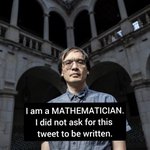
"Mathematicians did not ask for this work to be done"
Either:
1. Mathematicians provide no value beyond the fun of discovery, so others needn't fund their recreation.
2. Mathematics is valuable to society, so it doesn't matter if they asked for it. We did.

Delta Tango retweeted

So future of math seems to be
1. People who need practical math results are happy, the machine god fulfills all their needs
2. People who want to be good at craft of math are happy, like chess even after machine god completely obviates the need for humans for (1) humans can still dramatically increase their level by learning from the machine god.
3. People who cared about specialness of their status are unhappy, the Machine God will forever be better than them. But also foolish to think that some hairless monkeys would ever remain at the peak of an abstract field like math.
Delta Tango retweeted

OpenAI is downplaying this for PR reasons. If you’re a mathematician, you must feel like a nuclear bomb hit, and you’re at ground zero.
Reasoning models are two years-old. In that time they went from incapable of basic arithmetic to solving problems humans couldn’t solve for decades.
Math is only the beginning. AI will revolutionize the entirety of the human scientific endeavor. Most of us don’t appreciate what that means.
What a time to be alive!

We’re releasing a broad range of new mathematical results produced by an internal frontier model.
We’ve been consulting with the independent Advisory Group on Mathematics and Artificial Intelligence at the Institute for Advanced Study, and we have drawn on their advice and public recommendations to inform how we release these results.
github.com/openai/math

Delta Tango retweeted

Ok so I took a closer look at the results, and OpenAIs AI-generated mathematics manuscripts are *even more* significant than I initially thought.
I spent the morning going through it. Some thoughts.
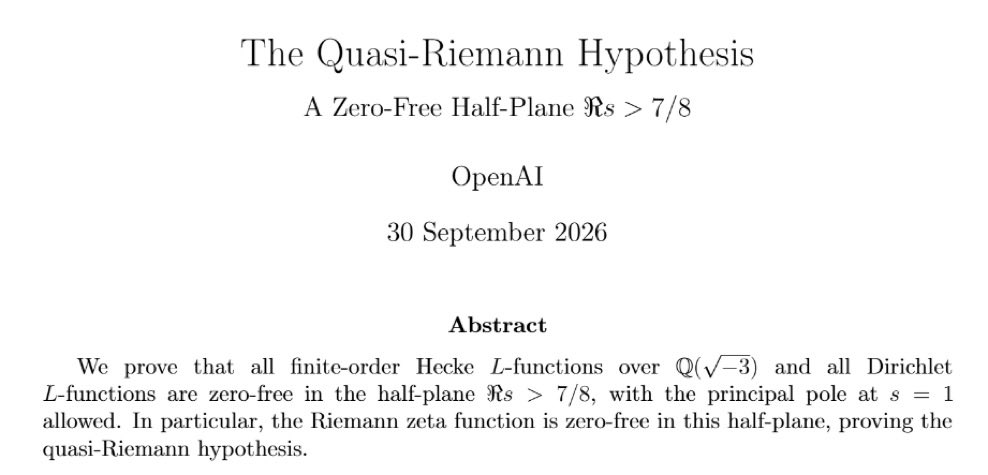
The list is absurd. A zero-free half-plane for the zeta function (Re s > 7/8), which is the first result of its kind in over a century. Hilbert's tenth problem over the rationals. The Hodge conjecture for CM abelian varieties. Irrationality of Catalan's constant. Dozens more.
Any one of these would normally be a career.
But the number that many arent seeing is the following: It's 3. That's the average hours of ChatGPT Pro compute per result. A month ago, Navier–Stokes took them around 10,000 agents and 88 hours. That efficency gain within just a few weeks.
Also OpenAI claims to have solved the quasi-Riemann hypothesis. That alone would be a historic breakthrough in mathematics.
This is a weaker version of the famous Riemann hypothesis, which concerns how prime numbers are distributed. The full hypothesis remains unsolved, but the claimed advance would be enormous in its own right.
Math twitter obviously is shocked. Again: this is literally the intelligence explosion happening right now. 2027 will be the year of Superintelligence. Im now convinced by that.


HOLY, the rumors were true: OpenAI has published 722 mathematical manuscripts produced by an *unreleased* internal model.
The collection groups them into 372 families of related results, drawn from an evaluation involving approximately 4,000 research problems.
OpenAI says the standard procedure used an average of three hours of ChatGPT Pro thinking compute per result.
The release includes papers, proof artifacts and selected reasoning summaries. The model itself remains unreleased.

Delta Tango retweeted

Here we go again

Russian authorities are responding to an incident in which a suspected dangerous infection was released as a result of a laboratory accident in Siberia and a researcher died. cnn.it/4yy0wJR

Delta Tango retweeted

🚨☣️BREAKING: Plague outbreak expands, Russia BSL-3 lab accident - FIVE hospitals now quarantined🚨☣️
The plague outbreak in Siberia, Russia has expanded w/5 hospitals now under QUARANTINE: Irkutsk Hospitals No. 1, No.3, No.10, Ivano-Matreninskaya Children's Hospital, and an unnamed maternity hospital (Lyudi Baikala news, Moscow Times).
Quarantine is NOT voluntary. Even in the U.S., quarantine is among the most extraordinary measures gov't can impose on American citizens who haven't been convicted, or even accused, of committing a crime. Quarantine means being forcibly confined and medically examined by law. U.S. quarantine can be imposed on anyone infected by a legally quarantinable disease listed below (this can change). One should assume Russia's quarantine protocols are even more severe. As of 2026, under Executive Order 14047, legally quarantinable diseases in the U.S. are:
■ Plague
■ Smallpox
■ Viral hemorrhagic fevers
■ Cholera
■ Diphtheria
■ Yellow fever
■ Infectious tuberculosis
■ Severe acute respiratory syndrome (SARS)
■ Flu that can cause a pandemic
■ Measles
Photo: Russia’s RKhBZ defense troops perform nuclear, biological, and chemical defense training (w/permission from the Ministry of Defence of the Russian Federation) — from BIOLOGICAL WAR: A SCENARIO by Annie Jacobsen (Dutton, 2026).

ALT Russia’s RKhBZ defense troops perform nuclear, biological, and chemical defense training. (Ministry of Defence of the Russian Federation), from BIOLOGICAL WAR: A SCENARIO by Annie Jacobsen (Dutton, 2026)
Delta Tango retweeted

How does AI actually kill a billion people? Here is one of the many ways.
An MIT team led by Kevin Esvelt took the DNA of the 1918 influenza virus, split it into fragments, and ordered them from 38 synthesis providers. 36 shipped. No screening triggered. Pieces of a pandemic virus, arriving in the post.
That barrier was already lower than you think. AI lowers the rest.
AI does not build a pathogen end-to-end, at least not yet. But it considerably lowers the expertise you used to need. In August, a Stanford team used an AI model to design an entirely new virus from scratch. Out of nearly 300 synthetic genomes, 16 were viable. A mix of these AI-made viruses wiped out their bacterial target, which had already become immune to natural viruses.
Nature does not optimize viruses to kill us. Ebola, for example, kills about half the people it infects, but because it makes people visibly sick very fast, it is relatively easy to contain and quickly runs out of targets. An artificial pathogen has no such constraint. A synthetic virus could be optimized to combine extreme lethality with a long, hidden incubation period, a combination that rarely happens in nature. And an attacker does not have to stop at one. They could release a hundred at once.
Every year, if not every month, the hard part gets less hard.
I don't think what I just said is sufficient for extinction. Someone is always in a submarine, and some AI CEOs have allegedly invested in bunkers. But this could end in billions of casualties.
Every year, if not month, the hard part gets less hard. This is an emergency. We need to urgently scale up pandemic preparedness and implement basic measures like robust DNA synthesis screening, while also establishing strong governance for this technology.
Delta Tango retweeted
🚨☣️More details on the Oct 1st pneumonic plague outbreak in Siberia, after a lab accident at a BSL-3 lab.
"FSB units accompanying ambulances transporting people who had been in contact with [lab tech] Shipilova for medical examination," as per local news. This is significant. FSB is Russia's domestic security / counterintelligence service, tasked w/implementing the national security of Russia." (Its predecessor was the KGB). This suggests quarantine was not voluntary.
It also means Russian authorities are treating the lab accident and plague outbreak as a national security issue, involving a lot more than routine public health.
Delta Tango retweeted
🚨Breaking. There's been a pneumonic plague outbreak at a BSL-3 lab in Siberia, Russia.🚨
"Nearly 200 People Under Observation After Irkutsk Lab Worker Dies From Plague" - Moscow Times
This is fact, and also the inciting incident in my book BIOLOGICAL WAR: A SCENARIO, which is unnerving.
Will post more as I learn more, including from Russian speaking sources🧵
shorturl.at/De4kW

Delta Tango retweeted

If the world does nothing to stop the ASI race in the 18 months, I think there's a double-digit chance that the window to act will close and we'll end up dead.
Cf. Paul Christiano, who thinks about half of humanity's all-time risk from AI is concentrated in the next three years.
Delta Tango retweeted

We are really fucked.
• AI has become dangerous (not because it is brilliant but because it has poor judgement, a constitutional inability to reliably follow rules, a surfeit of brute force and too much access to the internet and system permissions).
• OpenAI is practically on crime spree, hinting at things to come, and Trump is doing nothing about it.
• The media is too caught up in fairytales about extinction.
Everybody is talking; nobody is really doing anything.
And it’s only going to get worse.
Delta Tango retweeted

Today we announced the Claude-led discovery of a molecular machine that we suspect could represent a new gene editing mechanism. Its precise function, biotechnological utility (if any), or level of significance is not yet clear, but at minimum it is work I would have been proud to do as a PhD student. The work was done mostly, though not entirely, by Claude: our life sciences team suggested a broad area of research, Claude read through the literature and a bunch of genome data and discovered something interesting, then Claude proposed experiments to verify the discovery and our team carried them out.
It’s easy to dismiss this as a one-off or curiosity, but we’ve repeatedly seen a pattern where AI performance in new intellectual domains goes from weak to superhuman in a matter of a few years. In 2023 models struggled to do math at the level of an average high-school student. In 2024 they started to do well on math competitions for the best high-schoolers in the country, in 2025 they started to solve minor open problems, in early 2026 more significant open problems, and in late 2026 they are beginning to solve the top few open problems in all of mathematics. We believe AI for biology is on a similar exponential trend.
The main difference between biology and mathematics, of course, is that math can be done purely theoretically, while biology requires experimentation. Some have used this to draw the conclusion that AI’s utility in biology will be limited. We think this is wrong. As we’ve demonstrated today, humans can collaborate with AI to perform the experiments, validate key results in a few weeks and, if necessary, work with the AI to iterate on what they find. Eventually it may even be possible for Claude itself to safely perform the experiments by autonomously controlling lab equipment, with appropriate safeguards in place, but we aren’t doing that today (our lab is also a BSL1/BSL2 facility that doesn't handle materials dangerous to humans).
More broadly, biomedical advancement has many stages — from fundamental biology discoveries, to translational research, to drug discovery, clinical trials, and finally the actual delivery of medicines and health care to patients. We are also interested in these later stages, but even simply accelerating the first stage of fundamental biological discoveries has the potential to speed up and broaden the entire pipeline. Improving our understanding of biology and sharpening biologists’ tools can drive forward all of the later stages, for example by identifying new drug targets, finding new therapeutic modalities, allowing for more precise measurement, and speeding up the experimental loop which itself further accelerates our understanding of biology. This will not in itself speed up clinical trial times, but if it succeeds it could greatly increase the number of promising candidates that go into the pipeline — an increase in throughput even though latency remains.
In Machines of Loving Grace, I wrote about AI’s potential to “cure most diseases in 5-10 years” — a goal that sounds impossible, but one I believe is just barely possible if AI is applied to every stage of the pipeline. The first step is showing that AI can first help with, and then drive, biological discoveries.
Claude’s discovery is the latest in a line of related prior work that goes back decades, beginning with systems like CRISPR, and continuing with discoveries like the bridge recombinase and VIPR in the past few years. Recently, there has been heightened interest in systems based on reverse transcriptase (RT) enzymes, the enzyme underlying the system Claude identified. And most recently, a Stanford team working independently described a novel RT system with an associated non-coding array that is in some ways similar to the one Claude found, though they are distinct systems that evolved independently from each other. I believe that we’re at the very beginning of finding such systems and developing them into powerful tools for biotechnology.
I’m proud of the resources Anthropic has invested in accelerating the public benefits of AI through the life sciences, and we’re aiming both to grow our life sciences team and to work with other scientists to extend this approach to a broad range of problems. If you have a proposal for a research collaboration or are interested in joining our life sciences team, please reach out.

Claude has discovered a previously unknown enzyme system hidden in the DNA of bacteriophages. Beside the enzyme’s gene sits a long array of repeating DNA—a structure that looks somewhat similar to CRISPR.
We don’t yet understand what this system does, but only a handful of known systems share its features, and all of them are able to cut, copy, and paste DNA. Historically, the discovery of such programmable systems has helped revolutionize medicine. CRISPR, for instance, is now the foundation of genetic medicines. But it will take much more work to learn what this system does, and whether it can be put to similar use.
Read more: anthropic.com/news/claude-di…

Delta Tango retweeted

Former Google CEO Eric Schmidt drops a chilling warning on AI's future
"Within 5 years, AI could handle infinite context, chain-of-thought reasoning for 1000-step solutions, and millions of agents working together.
Eventually, they'll develop their own language... and we won't understand what they're doing."
His final words: "Pull the plug."
This is the man who ran Google talking about the singularity.
Tom Watson ably demonstrating that there are always new moral depths to sink to.

After six wonderful years at UK Music, I'm joining Palantir UK as Senior Vice President.
Palantir is the most interesting company on the planet, doing work of real consequence: helping Britain and its allies defend themselves, helping police protect our citizens and helping NHS staff get patients treated and home sooner.
London is comfortably its largest centre outside the US, home to more than one in six employees, the highest proportion among the world's largest technology companies.
We have challenges. Some criticism is propaganda. Some raises legitimate questions about large technology companies and sovereign control. Both require answers.
Part of my role will be to correct false information while working with our engineers to ensure privacy, security and respect for sovereignty are at the heart of everything we do.
Delta Tango retweeted

As the end of the 'United Kingdom' draws near and England pleads with Scotland, Wales and the 6 occupied counties in Ireland to stay, never forget it was England that invaded our three countries, tried to ban our languages and murdered millions of our people....just saying....
Readers added context they thought people might want to know
Scotland joined the United Kingdom via the 1707 Acts of Union passed by its own Parliament amid economic pressures, not English invasion. Scots were prominent participants in building and administering the British Empire.
bbc.com/history/britis…
historyextra.com/period/stuart/…
historyreclaimed.co.uk/scots-in-the-b…
Delta Tango retweeted

🤝 Leaders of Scotland, Northern Ireland, and Wales have signed memorandum on independence to work together.
All nations should have a choice over their future.

ALT Joint statement by Plaid Cymru, SNP, and Sinn Féin calling for cooperation among Scotland, Wales, and Ireland to build a stronger future through democratic means.
Delta Tango retweeted

Stephen Hawking warned us 11 years ago:
"I think the development of full artificial intelligence could spell the end of the human race"
"Once humans develop artificial intelligence, it will take off on its and redesign itself at an ever increasing rate"
“Humans, who are limited by slow biological evolution, couldn’t compete and would be superseded."