

CEO of Geisel Software (AI, robotics, embedded), 4× Inc. 5000 honoree, and founder of Symage (high-fidelity synthetic data). Engineering what's next.
Joined August 2025
- Tweets164
- Following30
- Followers9
- Likes0





The crop doesn't wait for a bug fix.
Crop One built their Farm Manager software for their R&D facility in Millis, Massachusetts. Then ECO 1 came along: 300,000 square feet in Dubai, three tons of leafy greens a day, an order of magnitude larger than anything the software had been built for. Their team was onboarding new engineers and still supporting existing operations at the same time. Their VP of Digital Systems, Derek Hui, had worked with us before and brought us in.
Nine months, working directly alongside their team. We stabilized OPC-UA monitoring on modern async, and put real logging in so debugging stops being an outage. API performance improved by more than 90% on the status page and 24% on the controls page, which matters when an operator is making a real-time call based on what the interface tells them. We rebuilt and expanded the test suite, cleared security debt out of the libraries, and restructured the data architecture so the system could grow as the farm did.
Farm Manager deployed to ECO 1, and the team used it to track down PLC logic and system performance issues across the operation.
Thousands of pumps, valves, sensors, and switches, polled every 30 seconds, in one of the harshest climates on earth. A restart is not a fix when there are three tons of crops on the line.
What's the biggest jump in scale your software has had to survive.
#AgTech #VerticalFarming #IndustrialAutomation #EmbeddedSoftware #ControlSystems


Live on Product Hunt today.
SymageDocs builds a synthetic person first, then generates their documents. A W-2, 1040, and pay stub that actually reconcile. No real people.
Come ask us a hard question.
producthunt.com/products/sym…

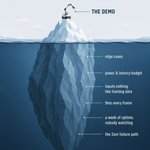
Every robotics demo ends the same way: clean lab, robot works, everyone claps. Then someone asks, "When can we ship it?" and the room goes quiet.
Physical AI isn't a model problem. It's a deployment problem.
Benchmarks don't expose failures. Production does.

Claude Code spent my money.
Not on tokens.
**It bought a domain name.**
I gave it one voice prompt and walked away.
It came up with a list of names. I picked one.
That was the last thing I did for 45 minutes.
Claude Code:
→ Registered the domain → Wrote the copy → Found the images → Got the SSL certificate → Stood up the AWS infrastructure → Deployed the site
Then one of its subagents broke halfway through.
Claude launched a replacement and kept going.
It didn’t ask me what to do. It didn’t wait for me to fix anything.
It just finished the job.
The wildest part?
I couldn’t have told you exactly what it had built on AWS until I asked it afterward to **draw me a diagram of its own architecture.**
Total damage: **2% of my weekly Claude allotment.**
I recorded the entire 45 minutes, unedited—including the parts where I’m figuring out what Claude is doing at the same time you are.
If you want to see what autonomous software development actually looks like right now, watch the whole thing:
<youtu.be/-wY_mKBXk9I>
#ClaudeCode #AWS #SoftwareEngineering #AI

Someone at dinner told me all of their code is reviewed by a non-developer. I actually stopped mid-bite. Code reviews aren't proofreading. They're about catching design flaws, edge cases, and future technical debt. The best reviews make better engineers, not just better code. #SoftwareEngineering #CodeReview

The most dangerous moment in a robotics program is the demo that works.
A demo proves it's possible for a robot to do the task.
Deployment proves it can do it every time, in the environment that matters to customers.
Those are different engineering problems.

People ask if I'm worried about AI becoming the Terminator. I'm not. I'm worried about the warehouse robot making the wrong decision at 2 a.m. because nobody taught it what "I don't know" looks like. That's a much more immediate engineering problem. #AI #Robotics #Automation
You’re asking the wrong AI question.
It’s not:
“How can AI help my team move faster?”
It’s:
“What work is my team still wasting time on that AI could complete?”
Here are 3 actions you can take Monday morning:
1️⃣ Start with the most repetitive, high-volume workflow
Customer support.
Invoice processing.
Lead qualification.
Don’t begin with a vague company-wide AI initiative.
Begin with one process that happens constantly and consumes real labor.
That’s your first AI agent use case.
2️⃣ Stop measuring success by adoption
“87% of employees use Copilot” is not an AI strategy.
Usage is not value.
If AI is not completing meaningful work, reducing cycle time, or removing manual steps, you may have deployed expensive software, not transformation.
3️⃣ Ask your team one uncomfortable question
“What would we do differently if labor were nearly free?”
Which processes would you run more often?
Which opportunities would suddenly become viable?
Which work would no longer be postponed?
With AI agents, the cost of execution is changing.
Your answer to that question is much closer to a real AI strategy.
#AIProductivity #AITransformation #AIAgents #AIWorkflows #BusinessStrategy #Automation #FutureOfWork #ArtificialIntelligence
Over the past 13 years, Geisel Software has worked on some of the most challenging problems in robotics.
What makes robotics so compelling?
The problem space is almost limitless. 👇🏻
→ Robots must operate across countless environments
→ They must perceive, decide, and move in different ways
→ And the software has to adapt when real-world conditions change
Some of the work we’ve done at Geisel includes:
1️⃣ Simulation & Emulation
→ Building simulations for environments ranging from Mars to high-speed warehouse systems
→ Testing robotic systems before deployment in demanding real-world conditions
2️⃣ Computer Vision
→ Giving robots the ability to perceive their surroundings
→ Helping them navigate, identify objects, and interact more effectively with the world
3️⃣ Synthetic Data
→ Generating difficult scenarios and edge cases at scale
→ Refining and validating models before they reach production
Robotics is one of the most exciting applications of software because every system brings together perception, autonomy, hardware, and real-world uncertainty.
What excites you most about robotics?
#Robotics #AI #Innovation #TechLeadership #ComputerVision #SyntheticData #Automation #Simulation #FutureTech #MachineLearning
Everyone is competing to build larger AI models.
But for focused, real-world problems, scale is not always the advantage.
Small language models trained on high-quality, domain-specific data can outperform much larger general-purpose systems on targeted tasks.
They are often faster to deploy, cheaper to run, easier to audit, and more accurate within a clearly defined domain.
The real competitive edge rarely comes from parameter count alone.
It comes from choosing the right data, architecture, and objective for the problem.
Maybe it is time to stop treating “bigger” as another word for “smarter.”
#AI #LLM #MachineLearning #SmallLanguageModels #DataQuality #ArtificialIntelligence #Tech

One of the biggest advances in AI has not come from larger models.
It has come from simulation.
Synthetic data can now match, and in some cases outperform, real-world data for training and testing.
That changes how quickly teams can develop reliable systems.
Why?
Because you no longer have to wait for reality to produce the examples you need.
Edge cases are rare.
Failures are unpredictable.
Critical scenarios may be expensive, dangerous, or impossible to reproduce consistently.
In simulation, those situations can be generated deliberately, repeated endlessly, and tested at scale.
The result is faster iteration, broader coverage, and fewer surprises in production.
Synthetic data is not a shortcut.
It is a way to prepare for the world your system will eventually face—not only the world it has already seen.
#AI #Simulation #SyntheticData #MachineLearning #EdgeCases #ModelDevelopment #DataDriven
What exactly is leadership?
To me, the best part of being a leader is not management. 👇🏻
It is helping people and teams grow.
Are they becoming more confident in their decisions?
Are they developing the judgment to solve difficult problems independently?
And when you eventually leave, can they continue to grow, perform, and lead without you?
I want the people on my team to surpass me.
To become better than me.
To build careers, teams, and systems that thrive without depending on me.
That is true leadership.
And it is what we strive for every day at Geisel Software.
What does leadership mean to you?
#Leadership #SoftwareDevelopment #SoftwareEngineering #EngineeringLeadership #TeamGrowth
“AI deleted all my files.”
How many times have we heard some version of that story?
Recently, I asked Claude to clear a temporary directory so I could rerun an experiment with a new dataset.
I gave it more context than the task seemed to require:
“There should be two files and a dataset ZIP in the temp directory. Delete everything, then pull in the new dataset.”
Instead of immediately running the equivalent of `rm -rf`, Claude stopped and inspected the directory.
It noticed that my description was wrong.
The folder also contained marketing work from another agent—important work that had not been saved anywhere else.
Claude warned me before deleting anything.
That pause saved hours of rework.
The lesson is simple:
AI makes better decisions when it understands the intent behind the instruction.
Context helps an agent identify inconsistencies, challenge incorrect assumptions, and recognize when a technically valid action may produce the wrong outcome.
So when working with AI systems:
🧠 Explain what you are trying to accomplish
📁 Describe what you expect the environment to contain
⚠️ Identify what must not be lost
🎯 Provide the goal, not only the command
Being verbose is not always inefficient.
Sometimes, it is the safeguard.
#ArtificialIntelligence #SoftwareEngineering #AIAgents #DeveloperTools #GeiselSoftware
If traditional AI is a calculator, agentic AI is an accountant.
It does not just answer questions.
It understands the task, follows the process, checks what is missing, and moves the work forward.
Imagine uploading your tax documents.
A basic AI tool might help explain them.
An AI agent could:
🧠 Complete the return
🔍 Ask for missing forms
⚡ Suggest deductions
✅ Prepare the final result
That is the shift.
Agentic AI does not just assist.
It acts.
And this is not theoretical anymore.
Klarna has used AI agents to handle support tickets faster and reduce repeat issues.
Salesforce customers have already deployed thousands of autonomous agents.
This is not coming someday.
It is already here.
#AgenticAI #AIAgents #AIProductivity #FutureOfWork #CustomerServiceAI #AutonomousAgents #AITransformation #Salesforce #Klarna #AIInBusiness #SmartAutomation #ArtificialIntelligence #TechExplained #AITools
Every team building document AI hits the same wall. You need thousands of tax forms, medical claims, and ID documents to train an OCR or extraction model. But those documents are full of real people's SSNs, diagnoses, and account numbers.
So teams reach for de-identified data. I'd argue that's the riskiest option on the table.
De-identification doesn't make PII disappear. It reshapes records that started as real people. You still processed that data, you still carry re-identification risk, and as of this year you may have to disclose where it came from. California's AB 2013 took effect January 1 and requires generative AI developers to publicly document their training data sources. That trend is only accelerating.
The cleaner answer is data from people who don't exist. Not de-identified. Generated from scratch.
But "fake" isn't enough on its own. Random generators hand you a 19-year-old cardiologist and an 82-year-old college student. Document models trained on incoherent data learn correlations that fall apart in production. What you actually need is coherence: income that matches occupation, filing status that matches household, a W-2 and a 1040 from the same synthetic person that actually agree.
That's the problem we built SymageDocs to solve. Coherent synthetic identities, filled into the forms your model needs, with ground-truth labels in the formats your pipeline already expects.
No real PII in. Better models out.
If you're training document AI in a regulated industry, I'd like to hear how your team is thinking about this.
#SyntheticData #DocumentAI #MachineLearning #DataPrivacy #OCR

Agentic AI is changing how work gets done.
It does not wait for instructions.
It detects the task.
It executes the process.
It improves with every cycle.
McKinsey predicts that 30% of work hours could be automated by 2030.
But this shift is not waiting for 2030.
It is already happening.
Klarna’s AI agent is already helping customer support teams move faster, respond more efficiently, and reduce repeat issues.
These are not just tools anymore.
They are becoming tireless digital workers that can scale quickly and learn continuously.
Your competitors may not be hiring more people.
They may be deploying agents.
So the real question is:
Where does that leave you?
#AI #AIAgents #TechLeadership #Automation #DigitalTransformation #ArtificialIntelligence #FutureOfWork
You do not certify the neural network.
You certify the cage around it.
That is one of the most important ideas in production physical AI.
As learned controllers move deeper into robotics, teams are starting to hand AI more than high-level decisions.
They are handing it motion.
Balance.
Coordination.
Actuation.
The instinct is to say:
“Keep the safety-critical loop deterministic.”
But that boundary is already moving.
The real question is not whether AI touches the control loop.
The real question is:
What deterministic guardrails exist before the AI reaches the actuator?
A learned planner can generate behavior.
But a safety filter should decide whether that behavior is allowed.
That architectural separation matters because the model will always be imperfect.
It may generalize well.
It may handle cases no hand-written controller could cover.
But it still needs a hard boundary.
Production physical AI is not faith in the model.
It is trust in the system architecture around the model.
The future belongs to teams that can combine learned behavior with deterministic safety.
Not one or the other.
Both.
#PhysicalAI #Robotics #Autonomy #SafetyCriticalSystems #EdgeAI #EmbeddedSystems

5 things I learned as a radio DJ that still make me a better CEO
Before I was leading teams building autonomous systems and synthetic data for AI models, I was behind a microphone.
Spinning tracks.
Making dry jokes.
Trying not to miss the next cue.
And somehow, that job taught me a lot about leadership.
Here are 5 lessons I still use today:
1️⃣ Know your audience
In radio, if you do not speak your listener’s language, they change the station.
Business is no different.
Whether you are talking to engineers, clients, or investors, how you say something matters just as much as what you say.
2️⃣ Timing matters
In radio, timing can make or break a moment.
The same is true when launching a product, making a decision, or having a difficult conversation with your team.
3️⃣ Be real
Listeners can tell when you are faking it.
So can employees, clients, and partners.
Authenticity is not a bonus. It is part of the job.
4️⃣ Silence has power
Dead air is usually a problem.
But intentional silence?
That can make a message land.
The same applies in meetings. You do not always need to fill the space. Sometimes, letting people think is the better move.
5️⃣ Every show matters
Every broadcast felt like another chance to earn people’s attention.
In tech, reputation works the same way.
It is built one project, one decision, and one delivery at a time.
Funny how late nights in a radio studio shaped the way I think about teams, timing, and trust.
What unexpected job taught you something you still use today?
#Leadership #GeiselSoftware #Symage #CareerLessons #Innovation #Entrepreneurship #GeiselInsider #FromRadioToRobotics

Automation used to mean following a set of predefined rules.
If this happens, do that.
Agentic AI changes the equation.
Instead of waiting for instructions, AI agents can observe what's happening, make decisions within defined guardrails, and execute multi-step workflows from start to finish.
Think about a software development team.
Yesterday:
A bug is reported.
An engineer reproduces it.
Someone searches the codebase.
A fix is written.
Tests are run.
Documentation is updated.
A pull request is created.
Tomorrow:
An AI agent identifies the issue from logs, traces it to the affected module, proposes a fix, runs automated tests, updates the documentation, and opens a pull request for engineer review.
The engineer spends less time chasing routine work and more time solving the hard problems.
This isn't science fiction.
Companies like Klarna are already using AI with human oversight to accelerate operations and improve efficiency.
The organizations creating the biggest advantage aren't simply adopting AI tools.
They're redesigning their workflows around intelligent agents.
The question isn't whether AI can do more work.
It's which work your team should stop doing manually.
What's the first software task you'd trust an AI agent to own?
Robots are not replacing jobs fast enough.
That may sound counterintuitive.
But in manufacturing, the real pressure is not simply “robots taking jobs.”
It is open roles that manufacturers cannot fill fast enough.
The numbers tell the story:
- Up to 1.9M U.S. manufacturing roles may go unfilled by 2033
• Roughly 13% of U.S. work hours are robot-addressable today
• U.S. industrial robot installations fell around 9% in 2024
Demand for automation is rising.
But deployment is still hard.
Why?
Because a robot that works in a demo environment may fail in the real operating environment.
Warehouses are not clean labs.
Farms are not flat test tracks.
Defense platforms do not operate in controlled lighting.
Factory floors change constantly.
That is why production-grade physical AI needs more than a model.
It needs simulation, validation, safety architecture, and a clear boundary around what the AI is allowed to control.
The future of robotics will not be won by teams that automate the most impressive task once.
It will be won by teams that deploy dependable autonomy repeatedly.
#Robotics #PhysicalAI #Manufacturing #Automation #EdgeAI #AutonomousSystems
