

https://xitter.cf/t.co/uuPhfE2Pza the social media for founders building in public
Joined August 2026
- Tweets158
- Following115
- Followers39
- Likes54



Your next customer might be another founder.
Your next beta tester might be another founder.
Your next collaborator might be another founder.
Sometimes the easiest way to meet them is to simply show what you're building.
Buildside is a place for founders to do exactly that.
🤖 Made with AI

Your next customer might be another founder.
Your next beta tester might be another founder.
Your next collaborator might be another founder.
Sometimes the easiest way to meet them is to simply show what you're building.
Buildside is a place for founders to do exactly that.
Before building your next feature, ask:
Who specifically needs this?
If you can't name the person or type of user, it might be worth talking to customers first.
If your answer to:
"Who is your customer?"
is "Anyone who needs this..."
You probably need to go deeper.
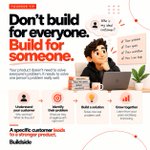
A clear customer makes it easier to understand:
→ What to build
→ What to say
→ Where to market
→ Who to talk to
One of the biggest questions a SaaS founder should be able to answer:
"Who are you building this for?"
Not:
"Small businesses."
Be more specific.
Who inside the business?
What do they do?
What problem are they dealing with?
Don't build for everyone. Build for someone.
Get specific about who you're helping, understand their problem, and build around what they actually need. A clear customer makes it easier to build a better product.
Who are you building for?
🤖 Made with AI

Your product doesn't need to solve everyone's problem.
It needs to solve someone's problem really well.
Find that person.
Talk to them.
Understand their workflow.
Then build.
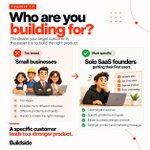
“Small businesses” is probably too broad.
If you're building a SaaS, get specific about who you're actually trying to help.
❌ Small businesses
✅ Solo SaaS founders getting their first users
A specific customer gives you a clearer idea of what to build and how to reach them.
🤖 Made with AI

Don't build for everyone.
"Everyone" isn't a customer profile.
Who has the problem you're actually trying to solve?
Start there.
The clearer your target customer is, the easier it becomes to build, market, and sell your SaaS.
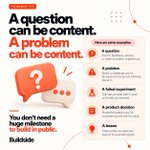
A question can be content.
A problem can be content.
A failed experiment can be content.
A product decision can be content.
You don't need a huge milestone to build in public.
You just need something real to share.

@ X Founders, what's the hardest part of growing your SaaS right now?
Getting your first users?
Customer feedback?
Product-market fit?
Marketing?
Distribution?
You're probably not the only founder dealing with it.
Your next post could be:
"I'm deciding between A and B. Which would you choose, and why?"
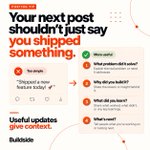
That's more interesting than another:
"Here's what we shipped today."
Give people something to think about.
Your audience doesn't need another generic startup update.
Give them something they can help with.
"I'm testing X. Has anyone here tried this before?"
That's how a post becomes a conversation.
And sometimes that conversation becomes a user.
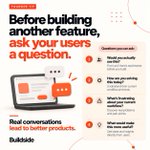
Before building another feature, ask your users a question.
"Would you actually use this?"
"How are you solving this today?"
"What's frustrating about your current workflow?"
A few conversations can save you from building something nobody needs.

One of the best things about building in public?
You don't have to figure everything out alone.
Share the problem.
Explain what you're considering.
Ask other founders what they've experienced.
You might get the answer you were looking for.
If you're building a SaaS, ask something people can actually answer.
❌ "Any feedback?"
✅ "Would this workflow save you time if you manage 10+ clients?"
Specific questions = more useful feedback.
Your next build-in-public post doesn't need to be an announcement.
It can be a question.
Instead of:
"Just launched our new feature!"
Try:
"We built this to solve X. How would you solve this problem?"
Ask something specific. Learn from other founders.
Want better product feedback?
Don't just show people what you built.
Tell them:
What problem you're solving
Who it's for
What you're unsure about
What you want to learn
Context makes feedback much more useful.
Your post doesn't always need more views.
Sometimes it just needs a better reason to respond.
Instead of:
“Just launched a new feature!”
Try:
“We built this because users kept asking for it. Has anyone else had this problem?”
Be specific. Share the why. Ask a clear question.

