

I write about #investing and #PublicSpeaking to make you a better person than yesterday. https://xitter.cf/t.co/vSoYUBv7Sc Personal views.NOT investment advice.RTs≠endorsements
Sri Lanka
Joined September 2010
- Tweets3.7K
- Following13
- Followers4.7K
- Likes1.7K
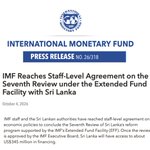
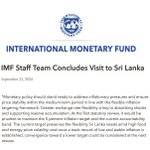




IMF and Sri Lanka reached a staff-level agreement on the 7th review of the Extended Fund Facility.
@IMFNews Board approval is subject to:
• presentation of the 2027 budget, in line with program parameters
• completion of the financing assurances review
- to confirm multilateral partners’ contributions
- to assess progress with debt restructuring
Once approved, we will have access to ~USD 345 Mn.
IMF emphasised:
• amidst a protracted Middle East (ME) war, Govt. should allow domestic fuel prices to adjust in line with international price movements, while protecting the vulnerable.
• in case of a stronger second-round inflationary effects from the ME war, @CBSL should stand ready to tighten monetary policy.

IMF advises CBSL to retain the current 5% inflation target
Inflation Targeting Framework
Sri Lanka's Flexible Inflation Targeting framework is based on an agreement between the Finance Minister and @CBSL, signed on 03 October 2023, which set the quarterly headline inflation target at 5%.
Measurement
Quarterly headline inflation = simple average of the year-on-year change in the CCPI for the three months of a given quarter.
Compliance
The target is missed if inflation stays 2% away from 5% (below 3% or above 7%) for two consecutive quarters.
Review
Central Bank Act requires the target to be reassessed at least once every three years.
IMF's View
At the end of the staff visit for the 7th EFF review (yesterday), International Monetary Fund recommended to retain both the 5% target and the ±2% accountability band.
Rationale
The current target gives flexibility given volatile food and energy prices. A lower target could be considered at the next review (in another 3 years), once there’s a track record of low and stable inflation.

Back to B: Fitch Upgrades Sri Lanka from CCC+ to B-
@FitchRatings has upgraded Sri Lanka's credit rating from CCC+ to B-, with a Stable outlook.
According to Fitch, the upgrade reflects the implementation of macro-stabilisation policies and structural reforms, which have eased external financing risks and given the economy some resilience to shocks.
• Primary surplus: 5.4% of GDP in 2025, forecast 2.6% in 2026
• Govt debt/GDP: 96.7% → 92.9% (2026F), heading to the low-80s
• Interest/revenue: 45.6% → 41.0% (2026F), down from a peak of 76.3% in 2023
• FX reserves: USD 7.7 Bn by end-2026 (2.9 months of external payments)
Fitch notes that the current @IMFNews programme ends in March 2027, and a follow-on facility is likely.
Fitch does not expect further policy rate hikes. It sees price pressures as temporary and forecasts inflation to fall to just below @CBSL's 5% target next year.

"Forecasts may tell you a great deal about the forecaster. But they tell you nothing about the future." - Warren Buffett
@CBSL regularly publishes its “Inflation Fan Chart”. With the recent buzz on the future path of Overnight Policy Rate (OPR), it’s ideal time to revisit that.
How did we get here?
Colombo Consumer Price Index (CCPI) inflation bottomed near -3.6% in Q1 2025, turned positive in August 2025 and closed the year at 2.1%.
Middle East tensions began at end-February 2026. Brent crude passed USD 100 in March and peaked above USD 126 by end April.
With domestic energy prices adjusted sharply, inflation hit 5.4% in April and CBSL proactively raised the OPR by 100 basis points to 8.75% in May, and then held in July.
Inflation prints kept climbing: 6.8% in June and 7.3% in July.
What does the chart say?
The projection fans out from Q2 2026, near 6%. Inflation stays above the 5% target in the near term. The mid path then drifts back to 5% and holds there through 2028.
Interestingly, at Q1 2027 (three quarters into the future), the 90% CI roughly reads 0% to 14%. Even the 50% CI roughly spans from 3% to 10%.
This shows the current uncertainty and challenge in forecasting inflation - even few quarters ahead.
What are the risks?
CBSL lists the risks to the projection, transparently.
Upside:
• Escalating geopolitical tension
(disrupts commodity markets, energy supply and shipping routes = higher domestic energy, transport and fertiliser prices)
• LKR depreciation
(= higher prices for imported goods and production inputs)
• Adverse weather, including El Nino
(cuts agricultural output and hydropower = higher food and energy prices)
Downside:
• Lower global energy prices, if tensions ease
(= lower domestic energy and transport prices)
CBSL's own judgement:
Risks are skewed to the upside.
TL;DR
• Inflation is at 7.3%
• CBSL forecasts it'll fall through 5% by Q2 2027
• But the 90% CI forecast runs from -4% to +12 (approx.)
• CBSL's own judgement is that risks are skewed to the upside
Against this backdrop, can CBSL afford to hold OPR at the same level?

Reinsurance is the business of sharing risk. Last week, it was also the business of sharing knowledge.
I was privileged to take part in the 46th Life Insurance Seminar (LIS) hosted by Munich Re - five days with participants from 29 countries.
The content was as forward-looking as it gets. But the sessions were only half of the story.
The other half sat in the room. Underwriters, actuaries, product and technical specialists from across the globe.
One lesson from the week has stayed with me: technology redefines industries, humans define value.
After five days with this group, I believe it.
To Jakob G. Weiglein, Nick van der Nest and the entire Munich Re team - thank you. A great deal of thought and planning clearly went into the LIS, and it showed in every detail.
Many thanks to the eminent panel of resource persons who shared such rich insights and experiences with us.
I am grateful to Ceylinco Life for nominating me and giving me this valuable opportunity.
Risk is best shared. So is knowledge.
#LifeInsuranceSeminar #MunichRe #Reinsurance #Insurance

CBSL flips from heavy seller to heavy buyer in two months.
In July 2026, @CBSL purchased USD 349 Mn from the domestic FX market, with no sales.
That’s the largest net purchase after February 2026 (USD 461 Mn), and first zero-sales month since then.
Two months ago, CBSL was a net seller of USD 211 Mn.
LKR slightly appreciated through July, as CBSL absorbed foreign inflows into Govt. Securities.
Year to date, CBSL has bought USD 1,331 Mn and sold 426 Mn, netting 905 Mn.
CBSL has given an undertaking to the @IMFNews to make net purchases of USD 2,200 Mn during 2026. 41% of that is now covered while 58% of the year has elapsed.
Is July the start of sustained reserve accumulation?
Or it's just an outlier?

CBSL USD sales spike to a 33-month high!
In May 2026, @CBSL sold a massive USD 223 Mn while purchasing just USD 12 Mn.
This is the highest since Aug 2023, when CBSL sold USD 467 Mn*, but also bought USD 296 Mn*.
In context, sales in May 2026 were almost equal to:
• total sales during Nov 2025 to Apr 2026
• total purchases during Mar to May 2026
These figures clearly show the pressure on the LKR during May, when the exchange rate shot up towards 350 before falling back to the 330 level.
However, CBSL remains a net purchaser, with cumulative year-to-date net purchases amounting to USD 486 Mn.
In addition, CBSL has given an undertaking to the @IMFNews to purchase USD 2,200 Mn during 2026 - which seems challenging in the current context.
P.S.
Since Jan 2026, CBSL has shifted to reporting on a value-date basis. Accordingly, historical data in the table (compiled by me when CBSL reported on a transaction-date basis) may not fully tally with the restated figures.
#SriLankaEconomy #CBSL #ForeignExchange

Money Market lost LKR 93 Bn Liquidity during 1H 2026!
@CBSL moves market liquidity in two ways.
(-) Money flowing into CBSL drains the market
(+) Money flowing out of CBSL adds to it
Net these two for Jan – Jun 2026, and the market tightened by LKR 93 Bn.
1. SRR and Other Net Injections/Absorptions: -8 Bn
Banks held more with CBSL under the SRR (Statutory Reserve Ratio) - which drained market liquidity.
2. T Bond Maturities: -11 Bn
CBSL collected maturity proceeds on its own T Bond holdings from the Govt. and liquidity left the market.
3. Net Currency Withdrawals: -73 Bn
Banks pulled cash out of their CBSL accounts.
4. Coupon Payments to CBSL: -94 Bn
CBSL collected coupons on its T Bond holdings from the Govt., which is another drain.
5. Net Govt. Foreign Loan Repayments: -212 Bn
Govt. bought foreign currency to settle external debt and paid the corresponding LKR into CBSL - the largest source of liquidity drain.
6. Profit Transfer to the Govt.: +42 Bn
CBSL transferred profits to the Govt., which is an inflow to the money market.
7. Net FX Swaps by CBSL: +93 Bn
On net basis, CBSL bought FX (foreign exchange) and injected LKR through swaps.
8. Net FX Purchases by CBSL: +170 Bn
CBSL bought USD from the market, injecting LKR as settlement. This is the largest source of liquidity injection.
TL;DR
Govt. foreign debt servicing drained liquidity more than what was injected via CBSL's USD outright purchases, resulting in a net liquidity drop of LKR 93 Bn.

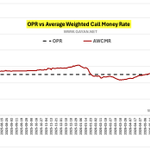
Call money rates stay above CBSL OPR
Overnight Policy Rate (OPR) is the primary instrument of the @CBSL’s monetary policy stance.
CBSL periodically reviews OPR and adjusts, if necessary, to guide short-term interest rates in the money market.
Average Weighted Call Money Rate (AWCMR) serves as the benchmark for short-term money market interest rates.
It also functions as the operating target of CBSL’s monetary policy.
Unlike in the past, AWCMR has consistently remained above the OPR over the past two months, particularly following the latest OPR hike on 26 May 2026.
Interestingly, CBSL has also allowed the AWCMR to remain above the OPR.
All in all, does this imply that:
• CBSL expects AWCMR to decline in the coming weeks?
• or that OPR will be hiked to move near the AWCMR?
What’s your take?

What is the similarity between PDMO and Captain America?
July opened with the third consecutive fully accepted T Bill auction.
Week-on-Week Summary:
• 91-day: +9 bps → 10.23% | 146% accepted
(vs. +12 bps, 100% accepted last week)
•182-day: +9 bps → 10.30% | 54% accepted
(vs. +5 bps, 100% accepted last week)
• 364-day: +3 bps → 10.20% | 53% accepted
(vs. +1 bp, 100% accepted last week)
Two notable shifts:
1. The auction offer amount was increased. After two weeks at LKR 70 Bn, PDMO raised the offer amount to 100 Bn. This was due to the larger volume of maturities falling due (99.7 Bn maturities this week, vs. 70.5 Bn last week).
2. The majority of the accepted amount was from 3-months. In fact, PDMO accepted 46% more than the amount offered (73 Bn accepted against 50 Bn offered), while accepting only about half of the 6-month and 1-year.
The real test begins in mid-July, as weekly maturities climb above 147 Bn and remain there for five consecutive weeks, peaking at 164 Bn on 31 July.
Given these large maturities, continuing to accept significant volumes of 3-month T Bills will only add fuel to the fire. This is because whatever is accepted now will mature again in October 2026.
How long can PDMO keep this up?
Maybe, as Captain America says: “I can do this all day!”

T Bond auctions are getting interesting and mysterious
Yesterday's T Bond auction results are not yet published.
As per market sources, 2030 T Bond WAY is at 11.65%, but cut-off was around 12.80% levels, which is - due to lack of a better word - crazy!
More on this later.

Gayan Lakmal Alwis, CFA retweeted
All T Bills hit double digits for the first time in 20 months!
This week's auction crossed two significant thresholds:
• Entire T Bill curve is now in double-digit territory for the first time since Oct 2024.
• 182-day (10.27%) now yields above the 364-day (10.16%).
Summary
• 91-day: +25 bps → 10.09% | 87% accepted
(vs. +48 bps, 85% last week)
• 182-day: +26 bps → 10.27% | 16% accepted
(vs. +33 bps, 84% last week)
• 364-day: +14 bps → 10.16% | 31% accepted
(vs. +19 bps, 48% last week)
Interestingly, on the 182-day, PDMO rejected 84% of bids, yet the WAY still rose 26 bps.
The market is pushing hard, and the PDMO is pushing back.
Overall, PDMO raised just LKR 72 Bn against LKR 140 Bn offered, while maturities for this week amounts to LKR 170 Bn, leaving a ~LKR 98 Bn deficit to be covered from the Govt.'s cash buffer.
How long can this strategy hold?
Why Monetary Policy Matters?
Because there's no clear line between managing vs. defending - at least not in real time.
With a significant lag, yes. But by then, it's too late.
In hindsight, many will argue the signals were there for all to see. But in real time, that's easier said than done.
This is precisely why @CBSL's monetary policy - and more importantly, any changes to it - must be debated, data-driven, and above all, independent.
History has repeatedly shown what happens when it isn't.
#lka #MonetaryPolicy

IMF cuts Sri Lanka's medium-term Foreign Reserve projections
With recent Middle East tensions and their ripple effect on Sri Lanka, IMF has revised its projections for Gross International Reserves (GIR).
Contrary to what many experts and the media suggest, GIR is not a target. It's a projection made by @IMFNews. The actual target is not GIR, but NIR (Net International Reserves).
Summary of the GIR Projection Revisions
• Good: 2025 actual GIR was at USD 6,838 Mn, USD 288 Mn (+4%) above the projection
• Bad: 2026 GIR revised down by USD 239 Mn (-3%) to USD 8,645 Mn
• Ugly: 2027 GIR revised down by USD 1,592 Mn (-12%) to USD 11,779 Mn
Despite a higher 2025 starting base, 2026 is revised down and 2027 cut deeper still.
IMF sees reserves rising, but at a slower pace.
This is a stark reminder of how a single external shock can ripple through an economy for years to come.
If you are interested to know the story behind the cut in GIR, pls comment below. I will write a follow-up post, if there's significant interest.
#lka #IMF

CBSL USD sales spike to a 33-month high!
In May 2026, @CBSL sold a massive USD 223 Mn while purchasing just USD 12 Mn.
This is the highest since Aug 2023, when CBSL sold USD 467 Mn*, but also bought USD 296 Mn*.
In context, sales in May 2026 were almost equal to:
• total sales during Nov 2025 to Apr 2026
• total purchases during Mar to May 2026
These figures clearly show the pressure on the LKR during May, when the exchange rate shot up towards 350 before falling back to the 330 level.
However, CBSL remains a net purchaser, with cumulative year-to-date net purchases amounting to USD 486 Mn.
In addition, CBSL has given an undertaking to the @IMFNews to purchase USD 2,200 Mn during 2026 - which seems challenging in the current context.
P.S.
Since Jan 2026, CBSL has shifted to reporting on a value-date basis. Accordingly, historical data in the table (compiled by me when CBSL reported on a transaction-date basis) may not fully tally with the restated figures.
#SriLankaEconomy #CBSL #ForeignExchange
CBSL USD sales surpass purchases after 22 months!
In April 2026, @CBSL sold USD 96 Mn while purchasing USD 83 Mn, resulting in a net USD sale of 13 Mn.
The last time CBSL was a net seller of USD was in June 2024*.
This marks a sharp reversal from March 2026, when CBSL recorded a net USD purchase of 49 Mn.
Despite the April outflow, CBSL has remained a net purchaser in 2026, with cumulative net purchases amounting to USD 697 Mn.
#SriLankaEconomy #CBSL #ForeignExchange
P.S.
Since January 2026, CBSL has shifted to reporting on a value-date basis. Accordingly, historical data in the table (compiled by me when CBSL reported on a transaction-date basis) may not fully tally with the restated figures.

6-Month T Bills reach double-digit levels after 87 weeks
This week's T Bill auction crossed an important threshold. 182-day WAY closed at 10.01% - for the first since 03 Oct 2024. The 364-day also crossed over, finishing at 10.02%.
Pace of yield increases has slowed. However, this is because we saw a sharp adjustment last week, following @CBSL policy rate hike.
• 91 days: +48 bps → 9.84% → 85% accepted
(vs +118 bps → 110% last week)
• 182 days: +33 bps → 10.01% → 84% accepted
(vs +143 bps → 32% last week)
• 364 days: +19 bps → 10.02% → 48% accepted
(vs +134 bps → 33% last week)
Acceptance levels have recovered. 182-day fill rate jumped from 32% to 84% - proving that investors are drawn at the right yield.
However, overall auction acceptance levels still remain below 100% - a bid-to-cover of 1.52x with 79% overall fill rate.
Crossing the 10% threshold is a psychological marker more than a technical one.
But it reminds us how far rates have moved in a short period. 182-day was at 8.25% on 20th May 2026, i.e. a 176 bps spike in just two weeks.
#SriLanka #FixedIncome

Gayan Lakmal Alwis, CFA retweeted
Econ Impact from Middle East Conflict
@IMFNews published a valuable analysis of how ME conflict affects #SriLanka.
• 2026 GDP growth revised down from 4% to 3%
• End 2026 inflation revised up from 5% to 6.1%
• FX reserves projection revised down from USD 9.5 Bn to 8.6 Bn
Middle East accounts for around 50% of Sri Lanka’s petroleum imports, 40% of remittances, and serves as a hub for 34% of flights to Sri Lanka.
Higher energy prices erode real incomes and increase production costs, dampening demand and creating BOP pressures.
On a positive note, IMF expects remittances and the primary fiscal balance (as a % of GDP) in 2026 to remain broadly in line with 2025 levels.
Tale of a Tight T Bond Auction
Following the hike in @CBSL policy rate and the T Bill auction, the T Bond auction also saw rates spike, with elevated cut-offs.
Good news: The PDMO raised the full LKR 240 Bn on offer, against 442 Bn in bids, with a bid-to-cover ratio of 1.84x.
Not-so-good news: It came at very costly yields.
Weighted Average Yields (WAYs)
• 01 Aug 2030 (4-year) → 11.86% → 100% accepted
(+170 bps from 12 May)
• 15 Jan 2033 (7-year) → 12.32% → 100% accepted
(reopened series)
• 15 Mar 2035 (9-year) → 12.93% → 100% accepted
(reopened series)
However, following Tuesday's T Bond auction and subsequent positive sentiment in global markets, the spike in yields reversed somewhat from the high cut-off levels.
• 01 Aug 2030 (4-year) → fell from 12.20% to 11.90% levels
• 15 Jan 2033 (7-year) → fell from 12.60% to 12.30% levels
• 15 Mar 2035 (9-year) → fell from 13.20% to 12.95% levels
In a further positive turn, LKR 24 Bn offered across all three series at the WAYs via the Phase II window was oversubscribed, attracting LKR 51.9 Bn in bids.
Given the bullish sentiment and the drop in yields from their elevated cut-off levels, a valid question arises:
Was the PDMO too aggressive - or too anxious - in accepting too many bids at too high a rate?
A strategy by design, or an action in haste?

BREAKING: IMF approves USD 695 Mn as Sri Lanka Clears Double Review
@IMFNews Board completed the combined 5th and 6th Reviews under the EFF, releasing USD 695 Mn.
It’s the largest single disbursement so far - as it bundles two reviews (two tranches), into one.
This is because 5th review was deferred from Dec 2025 to early 2026 following the need to reassess the program after Cyclone Ditwah and opting for a separate Rapid Financing Instrument (RFI).
Sri Lanka has now caught up, clearing both reviews in one go. Performance was generally strong.
But Middle East tensions and the aftermath of Cyclone Ditwah have reshaped the outlook.
As per IMF:
• Growth is cut to 3.0% for 2026, down from 5% in 2025, due to higher oil prices and weaker tourism.
• Inflation climbs from -0.5% in 2025 to average 5.0% in 2026. End-2026 inflation climbs to 6.1%.
• Current account swings from a 1.6% of GDP surplus to a 0.5% deficit.
• Fiscal policy eases with 2026 primary surplus target drops to 1.4% of GDP, from 5.4% in 2025, funding a temporary relief package and Cyclone Ditwah reconstruction.
• From 2027, the Govt. reverts to the 2.3% of GDP primary surplus target.
• Two continuous criteria were missed - (1) no new external payment arrears, and (2) no new import restrictions.
• FX reserves projected to rise to USD 8.6 Bn by end-2026, from 6.8 Bn.
IMF emphasise that:
• Monetary policy should continue prioritising price stability - @CBSL should be prepared to act if inflation keeps ticking-up
• Greater exchange rate flexibility and gradually phasing out the BOP measures is critical to rebuild external buffers

IMF approval on 27th May?
@IMFNews has added Sri Lanka to the Executive Board agenda for 27 May 2026.
Given that all preconditions have been completed, we can look forward to approval and disbursement shortly.
Some good news (and inflow) for the FX market after a while.
