

13th Root | Arizona Desert Off-grid • Rainwater harvesting • Living soil Ganja • Microbes • Epigenetics • Lineage Exploring the Genesis Resonance Loop Theory.
High Desert · 4,200 ft
Joined December 2025
- Tweets2.7K
- Following662
- Followers112
- Likes3.4K




Pinned Tweet
I rarely see a moonset, seems like such an impossible event to catch, but when you do..
It hits a 3 from the logo.🙏
I bet thats an amazing view pressed up against the mountains. Maybe one day..
Good vibes.🌬️
#azwx


Before the first true leaf, there is a little pair of structures most growers barely think about.
The cotyledons.
They arrive carrying part of the seed's original inheritance — stored resources that help the newly awakened seedling establish itself while its roots reach into the soil and its first true leaves begin learning to capture sunlight.
I like to think of them as something like the seedling's first set of training wheels.
Not an umbilical cord in the literal sense, but a temporary bridge between the world contained inside the seed and the world the plant is beginning to enter.
For a short time, the plant is living between two systems:
seed → seedling
AND
root → soil → leaf → photosynthesis
Eventually, the balance changes.
The cotyledons become less important as the developing plant begins producing its own energy and establishing a much larger relationship with the soil around it.
That transition has me wondering about something I've observed repeatedly in the garden:
Is there a moment when the seedling has received everything it needs from its first set of leaves — and is ready for the training wheels to come off?
I'm beginning to think there might be.

The molecule leaves the plant.
It enters the human.
And we discover we were already making its own cannabinoid signals.
The plant did not create the system.
It was already there.
So why can the two chemistries speak to each other?
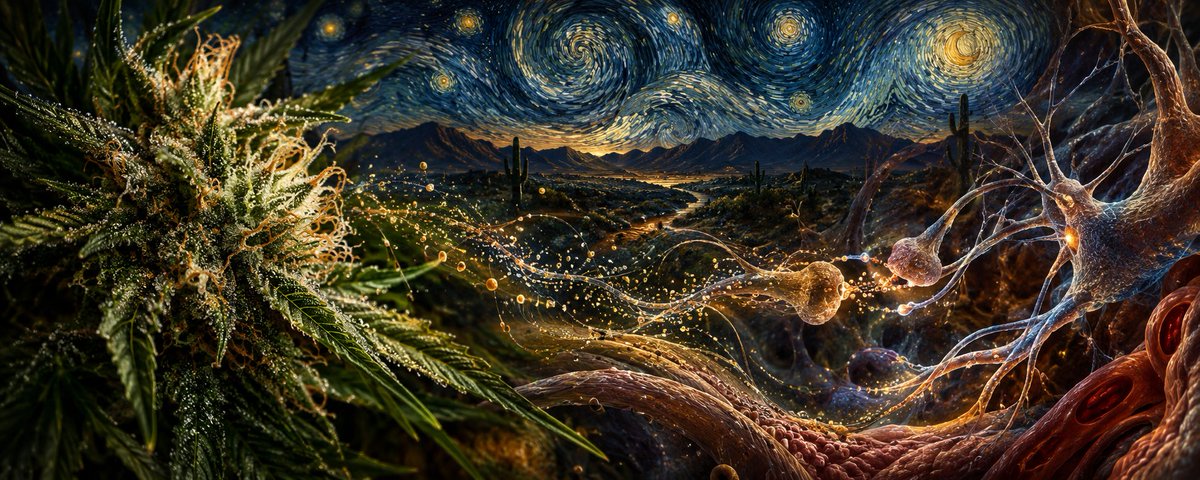
We once looked at the flower and called it medicine.
Then we learned to name the molecules.
But the molecule is only the visible end of a much larger story.
Genetics. Environment. Signaling. Metabolism. Expression.
So how did the plant make it?


One of my go to moves this past season.
Comfry ferment tea. brewed straight off grid style.
Shredded material. Daily shaking to introduce oxygen.
Made with native run off water that in theory contains native microbes thats going to help the system adapt smoother.
Bcz living soil is an ever changing environment.
It's about 2-3 weeks before I ever use once its created.
Trick is keeping that comfry happy here in the desert..☀️
Close the loop.
#offgrid
#selfsustaining


Around here the cool, windy will dry a plant out as quickly as dry, heat.
If im not careful I'll lose my go to for microbial happiness.
Would be hell ironic making it through this summer just to let it die now..
This gem I brought from the South DOES NOT like arizona.
Its stays in full shade..😮💨

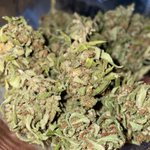
'Fadeaway' pheno showed out for us.
a product off crossing our 'palomina sunrise' x 'gelato44' by @royalqueenseeds
The terps off this one throw me back in time to visiting my great aunt.
The fragrance of an elder lady in the south on Sunday coupled with stale peppermint stick on the aftertaste..
And will sit you down.
Menthol lovers might fall out..
One of a few phenos that all expressed differently it'll be cool to go back into this cultivar next season.

We see color.
The plant is doing chemistry.
A flower existed before we called it beautiful.
Its chemistry existed before we called it medicine.
So what happened between the plant and its world that caused it to be there?

One of the best cultivars in the jar thus far.
'Tortoise Breath' born from our 'palomina sunrise' x 'mimosa'
Breaking it down, closing your eyes and vision of a skunk breaking up a grape sweet tart rises from the tray..
On the exhale,. lights you up with caryophyllene. ⛽️
Highlights the muscles in your face.
It's in the next run for sure.

Why won't anything eat the horse lubber?
This western horse lubber grasshopper doesn't exactly try to hide.
It's large.
It's slow.
It's brightly colored.
And when threatened, it raises its wings, revealing flashes of pinkish-red beneath them.
That's not decoration.
It's a warning.
Horse lubbers use a combination of color, behavior, sound, and chemistry to discourage predators. Their diet includes a wide variety of desert plants, and they can incorporate some plant chemicals into their defenses. They also produce defensive compounds of their own.
In other words, the landscape becomes part of the insect's defense.
A predator that ignores the warning may get something it doesn't forget.
So the next time you see one standing boldly in the desert, consider the possibility that you aren't looking at an insect that failed to hide.
You're looking at one that doesn't need to.
Nature has already written the warning.
#loop


Here we have a traditional example of the hardships of wanting a cut and trying to re veg a cultivar.
We had taken this clone of 'gelato 44' bcz, well, its speaks for itself..
I haven't quite been able to have 24hrs of light like I would like or give someone advice to do,. but regardless 15+hr day cycle.
Its been cool, damp and some mold as set up on some of the old dried calyx where the seeds have fully developed from early pollination but the plants life is moving along..
We'll try to clean this up using simply our fingers to get the mold..
Will we eradicate mold? No.
Will we spread it? Maybe.
But what we are doing is presenting a situation to this cultivar, one in which these seeds have now got a record of this environmental encounter.
This cultivar itself could adapt to its situation and change its expression due to this mold.
It's the beauty of the process. Trust the process.
We'll clean it up, helping along natural processes, collect our seeds, and cross our fingers for green growth out the top soon before it finishes flowering.
Will we worry about smoking moldy flower? No bcz if we're successful this plant has a long season ahead of it and the flower you see wont exist in that future plant. It'll be stripped away. We just need clones.
We have plenty of time no need to freak out, sometimes cultivars are slow and reluctant to reverse back to veg.


Waking up to 42F too bad we're already jarred up.
Air feels so much thinner compared to origins.
Grateful everyday we get. 🙏
#azwx

Before the flower has a smell, color, or effect, chemistry has already happened.
Genes provide the machinery.
Environment helps shape the conditions.
And somewhere between the two, a plant becomes itself.
What if the chemistry is the receipt?
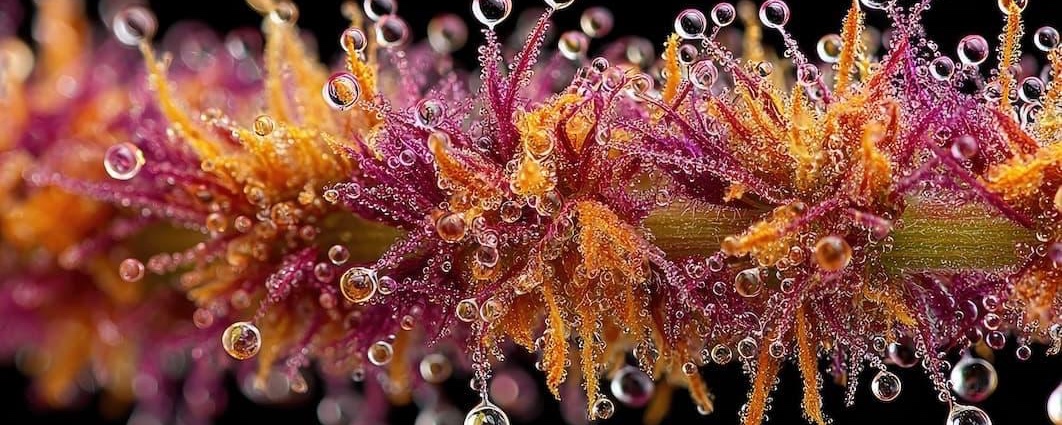
A plant doesn't need to understand its environment to respond to it. Chemistry becomes signal. Signal becomes response. And somewhere between the soil and the leaf, the outside world becomes biology.

Beneath every plant is another world. Millions of organisms breaking down, building, competing, cooperating and transforming. We call it microscopic because we cannot see it. But what if this hidden community is part of how the plant experiences its world?

A leaf falls. We call it the end. But what if it is an inheritance? Yesterday’s plant becomes tomorrow’s environment. The soil carries the consequences forward. Perhaps we aren’t only growing plants. Perhaps we’re growing what comes next.

