

CEO @marqueeinsights. Founder @ContinuousLogic. Helping enterprises move from AI curiosity to executed work. Microsoft Data & AI MVP. Cajun technologist.
Seattle, Washington, USA
Joined January 2009
- Tweets12K
- Following2K
- Followers1.7K
- Likes2.5K






Pinned Tweet
We solved document control just in time for employees to stop opening documents. Your SOP still has an owner, an effective date, and an approval process. The AI answer your employees now act on usually does not.
For years, the procedure itself was the interface. When someone needed an escalation threshold, an approval limit, or the right way to handle an exception, they found the current version and acted on it.
It was not always fast, but the chain of authority was visible. Your employee could see what they were relying on, when it became effective, who approved it, and what had changed.
Now they ask an AI assistant, be it Copilot, ChatGPT, or Claude.
It gives them a clear answer, perhaps with a citation, and they get back to work. The incident is escalated or it is not. The expense is approved or rejected. The customer receives one response rather than another.
From the employee’s perspective, this is progress. They no longer have to find the right document, confirm that it is current, and search twenty pages for one sentence.
But something changed when the document stopped being the interface.
The document is still controlled. The answer shaping the decision usually is not.
When your organization introduced the assistant, it changed the point where operational truth enters the work. The controls remained attached to the place employees increasingly bypass.
You review code before production because the business cannot run on whatever someone wrote last. You control procedures because yesterday’s instructions may no longer be correct today.
AI answers have consequences too. They may determine whether a safety issue is escalated, a customer receives a refund, or an employee follows a procedure that changed months ago.
Yet when the assistant turns controlled documents into an answer, much of that discipline disappears from view. A citation does not necessarily reveal whether an older version influenced the response, two sources contradicted each other, or the answer changed after the latest procedure was approved.
The employee sees the answer, makes the decision, and moves on. Later, when an auditor asks why, the approved document may still exist. The exact answer that shaped the decision may not.
I do not think organizations arrived here through carelessness. Controls usually follow dependency. Source control looked like overhead until software began running the business. Document control looked bureaucratic until procedures became inseparable from the operation.
AI answers are now becoming the interface to both.
The answer may disappear when the chat closes. The decision made from it does not.
So if your procedures are controlled because people act on them, what controls the AI answer they act on instead?
We did not lose control of the document. We lost control of the point where people use it.
My @OpenAI dot flagged a client's high-priority email and summarized it before I asked. I build on Microsoft's stack for a living, and that got me thinking about what it would take to build my own dot.
I've had my dot running since #DevDay as my executive assistant. It keeps me updated when meetings change and helps coordinate the day. What makes it useful is that it keeps working between conversations and brings me things before I think to ask.
So, I modeled a comparable assistant on @Microsoft and @AnthropicAI. Both stacks offer similar functionality albeit without the easy OpenAI packaging/pricing.
Microsoft supplies agent orchestration, hosted runtime, memory, Windows desktop access and governance. It already has scheduling, approvals and context-sensitive action checks. Claude Managed Agents supplies the loop, scheduled runs, memory and credentials, with optional permission review for supported tools. GUI automation needs additional infrastructure and integration.
I'd still have to connect those pieces to my work and test when the assistant should act, interrupt me or ask permission. My preliminary production estimates are three to five months on Anthropic and four to six on Microsoft, depending on scope and staffing.
Forecasting the bill is a job. My Microsoft configuration has nine billing components: model tokens, hosted CPU, hosted RAM, short-term memory events, long-term stored memories, memory retrievals, Cloud PC hours, a monthly Cloud PC availability fee, and an Agent 365 user license.
Some move with tokens, some with hours, some with stored information and some with people. That count describes my configuration, including the optional availability fee. Search and observability can add more.
Claude Managed Agents meters model tokens, session hours and web searches within one service, with GUI infrastructure charged separately. I haven't confirmed a separate memory-service fee.
For six delegated tasks and 15 chat turns per workday, plus 12 daily proactive sweeps, my estimates came to $258 per user per month on Microsoft with model routing and $167 on Anthropic with routing. Using Opus throughout took Anthropic to $281. All-Astra on Microsoft reached $739; all-Fable on Anthropic reached $654.
These are modeled costs, not measured usage. They depend heavily on caching and exclude development, maintenance, existing Microsoft prerequisite licenses and any unconfirmed Anthropic memory-service fee.
OpenAI includes a dot with a ChatGPT Business Premium seat at $100 per user per month billed annually, or $125 monthly. Deeper work has usage allowances, with additional credits available.
Building your own makes sense when you need specific data controls, your own record of inputs and actions, or a specialist workflow whose development costs can be spread across a team.
For a personal assistant, I'm keeping my dot.
If you're weighing whether to build your own or start with a dot, send me a message and we'll work out which fits your team.

Hey @TheRohanVarma, why is there no copy button on Dot responses? We have this for code snippets, why not responses?
Is anyone else having copy/paste issues on #iOS27? For some reason, on a long copy, the beginning is cut off. This worked previously.
Made with GPT Site, a custom domain and a discussion with my Dot. 1727nantucket.com
Total time to build, 19 mins.
cc: @thsottiaux
Hey @hollllyli Dot UX feedback after 3 days use. One problem I keep encountering is the Dot will ask a question of me, I miss it, and the thread is stalled. I need a view of all outstanding questions and stalled conversations as I can see this getting worse as I scale the use. cc: @OpenAIDevs
Day 3 of using my Dot. We’ve had our morning discussion of the day’s priorities. It’s sent follow-up emails on my behalf and rescheduled a meeting. It setup multiple Spaces for better coordination and tracking. We worked through a client inquiry and broke it down into an action plan. It’s also fixing my HubSpot configuration since I don’t have bandwidth. The hardest part was getting logged in with the magic link. I’m an hour into my day…
Going for the ultimate Dot geek level @hollllyli I had my Dot do a selfie and I used GPT Image 2.5 to turn it into a 3D mesh file. Next stop, once the filament is delivered, is a 3D print on the @BambulabGlobal H2C. Dot’s about to get real.

After attending @OpenAI DevDay yesterday, I saw how Dots, ChatGPT Spaces and Pages could change how people and agents work together, with implications for where collaboration happens. More on what this could mean for Microsoft and others.

Holy Cow. Just got my @OpenAI Dot set up. Gave it a very thankless task after it surfaced some stuff I hadn’t addressed in my inbox. It handled both amazingly well.
My only quibble thus far is the call button isn’t in the chat box where it normally is for real-time chats. I missed it the first few times. If I hadn’t seen the demo in person, would not have known it was a feature.
Also, I want a hat AND a bow tie. You can only have one.
Treb Gatte retweeted

Full recap of all the announcements
openai.com/index/devday-2026…

A low AI error rate can be very comforting. Checking the smoke alarm while the house floods is comforting in exactly the same way.
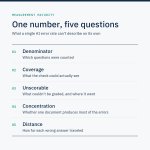
The usual report on an AI assistant's quality is a single number: sample some answers, grade them, and publish the share that came back wrong. Even with an answer key you trust, that number describes far less of the risk than it appears to.
Think about what someone does after the assistant gets a contract term wrong in front of a client. They keep using it to summarize meetings and tidy emails, and they quietly stop asking it anything that could embarrass them again. Spread that across a department and adoption stays green while the error rate falls, because the questions that carried weight have left the sample. The dashboard records a collapse in load-bearing use as an improvement in quality.
A rate is a fraction, and most of the risk sits in the parts of it that rarely get reported.
The denominator: which questions were counted? If people have learned to route around the assistant for anything that matters, the easy ones are what's left to grade.
Coverage: what could the check actually see? A check against facts someone confirmed can only catch errors about those facts, and the old answer that survives a document change tends to be about something nobody thought to confirm again.
Unscorable cases: how many answers couldn't be graded, and did they quietly drop out of the denominator? A check that only sees the answers handed to it is reporting on a sample the system chose.
Concentration: are the wrong answers spread thin, or is one superseded policy producing most of them? Microsoft's own Copilot readiness guidance notes that outdated content makes answers less accurate, and a single rate can't tell you which document to deal with first.
Distance: how far did each wrong answer travel? Ten wrong internal answers, caught at the next team meeting, and one wrong commitment sent to a customer belong in different columns.
An operations leader would ask every one of these about a defect rate on a production line. The AI assistant answers on the company's behalf now, and it's still being measured like a demo.
The smoke alarm in the opening worked perfectly, in a house that was filling with water.

Dear @Apple, please enable Siri to interact with third-party apps. I’d love to have Siri find items that I remember I need via the @target app and add said item to my cart. Especially if I’ve ordered the item before. Once I’m done I should be able to have Siri check out with my ApplePay and set the order for pickup.
AI has changed the maxim that you can only take back what you know you said. Every policy change leaves a ragged edge, and if you've run an operations team, you've cleaned up after a change.
What made it survivable was that the old rule had a route back. A memo had a distribution list, a training session had a roster, and the correction went back down the same channel the original came through.
The problem is an AI assistant removes the route.
So, say your AI support assistant spent six weeks telling customers they could cancel within 30 days for a full refund. The window had been cut to 14. Someone notices, the source gets corrected, and from that afternoon the assistant gives the right answer.
Every one of those earlier answers was a commitment made on the company's behalf, in writing, to a customer. The company can't produce the list, because nothing recorded who was told. Nobody decided the old answer, so nobody inside owns taking it back. A six-week-old answer looks exactly as current as today's, so the customers holding it have no reason to check.
This has already been tested. In 2024 a Canadian tribunal held an airline to what its website chatbot told a grieving customer about a fare policy, after the airline argued the chatbot was responsible for its own statements. The customer had screenshots and yours will too.
In the US the following year, the support bot at a well-known AI coding company told users their subscription allowed one device, a policy that didn't exist. Users cancelled before the company corrected it, publicly, on the same forum where the complaint had spread. That's the easy version because the complaint told them where to send the correction.
A quiet fix gets no such help. It changes what the next customer hears and leaves every previous one holding a promise the company doesn't know it made.
This is the part that should worry anyone counting adoption as a success metric. Most commitments a company makes land somewhere they can be found and reversed: a contract, a quote, a ticket. The unrecorded ones used to come from individual people, so they stayed small. AI assistant answers are unrecorded and scale with the rollout, so the more successful the deployment, the larger the exposure.
When something your AI assistant told a customer turns out to be wrong, who finds out besides the assistant?
🤖 Made with AI

Just tried Gemma-4-E4B-it in Google’s AI Edge Gallery on my iPhone 18 Pro Max. I had it create a shopping list and create meal pairing suggestions from a recipe screenshot. I also copied in a sizable article and had it summarize it into 5 bullets. I had tried this previously on a 16 and it was slow. The 18’s AI performance overall is really good.


Nobody in your company can state the rule for when a Teams message beats a signed policy. Everyone applies it several times a day.
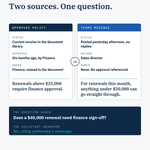
For example, your renewals policy, approved six months ago and current in the document library, says anything above $25,000 needs finance approval. Yesterday afternoon a sales director posted in a Teams channel that for this month, renewals under $50,000 can go straight through.
An employee asks the AI assistant whether a $40,000 renewal needs finance sign-off. It finds both sources. It answers no, citing yesterday's message.
Before deciding whether that's wrong, notice that you already have an opinion about it, and that you formed it in about two seconds.
Most experienced people do. They read the director's title, guess at whether that role can waive a finance control, weigh how the organization treats month-end pressure, and land somewhere. None of that reasoning appears in either source. It's the part you brought with you, and it's the part the assistant didn't have. It had two documents and a timestamp.
That gap used to be filled continuously and invisibly. Before the AI assistant, this question reached a person, and whatever they decided applied to one deal. Now it reaches a system that answers everyone who asks, identically, for the rest of the month. An ambiguous judgment call becomes uniform practice by lunchtime.
So rather than asking what the AI assistant should have said, I'd like your answer to a different question. What would have to be true for its answer to be right?
Pick whichever comes closest or tell me what I've missed.
1. The director's role carries a documented delegation that covers this threshold.
2. Someone in finance replied in the thread and agreed.
3. The message points to an approval that exists somewhere checkable.
4. Nothing does. A signed policy stands until it's amended, whatever the circumstances.
I don't think this has one answer, which is why it's worth asking. My guess is the split runs along regulated versus unregulated environments, and that people in regulated industries pick the last option far more often than everyone else.
What I'm fairly sure about is why nobody has a ready answer. These rules were never written down because they never had to be. A person was always standing in the gap, applying the rules from experience, one case at a time.
The AI assistant is the first thing we've put in that gap that can't do it, and it's answering anyway. What it works from is something looser than a document and firmer than a guess. The resulting derived answer is what I call a "belief." It's whatever the AI assistant currently takes to be true about your approval threshold, assembled from sources of unequal standing and asserted with the same confidence either way.

Anyone at a wedding can say “I now pronounce you married.” Only one person in the room makes it true.
Everything that makes the difference sits outside the sentence like the speaker’s licence, the jurisdiction, and the paperwork. The words are identical either way.
Your AI reads company policy the way a guest hears that line. It gets the words and none of what makes them binding.
Take a finance policy stating that managers can approve expenses up to $10,000. The document has the number, and it may well carry an effective date and a named owner. But the reason that number governs anything sits elsewhere. Someone held the authority to set it, an approval process made it official, it applies within a defined scope, and a delegation or regional variation may quietly change who it covers.
An experienced employee carries all of that without thinking about it, which is exactly why none of it gets written down. An AI system has to be handed a representation of it, and there’s nothing in the document to hand over.
Which is where better retrieval stops helping. Finding the right paragraph was never the hard part. A model can read a draft, a Teams message, and an approved policy, understand all three precisely, and still have no basis for the question that decides the outcome: which one is allowed to change what the organization holds to be true?
That depends on provenance, approval, scope, delegated authority, effective dates, and supersession. Which is to say, the same machinery an organization already uses to tell a suggestion from a decision. That machinery exists, just not anywhere the AI can reach it.
We’ve spent a few years making enterprise AI better at finding information. The harder problem is teaching it which information has the right to become the answer.
Try it on your own AI assistant this week. Ask it a policy question, then ask who approved that and whether it applies to your business unit. The first answer will be fluent. The other two usually aren’t in the document at all, so watch what it does when it has nothing to draw on.
Your staff are acting on the first answer regardless.
Right now the assistant is the guest at the wedding, saying the words with total confidence. Everyone in your company is treating it as the officiant.

We used to know when someone was making policy. AI made it look like search.
An employee asks Copilot whether something’s covered. It synthesizes an answer from several sources, and the employee acts on it. They think they looked something up. What actually happened is that an operational rule got set, and nobody reviewed or approved it.
Every source behind that answer may be governed. The answer isn’t, and the answer is what the employee acted on, so the organization owns the consequence.
That’s a different problem from an employee failing to read the policy.
Before AI, there was an identifiable object behind a decision. A policy, a procedure, an approval matrix, an exception log: each had an owner, an effective date, and some form of change control. You could trace what the employee was supposed to follow and whether they followed it.
Now the employee never sees that object. They see an answer assembled from a controlled document, a SQL table, an old Teams message, whatever’s in context, and whatever else the system judged relevant. It reads as fluent and plausible without matching any single policy the organization ever adopted.
Then someone acts on it. A customer gets told they’re covered. An expense gets approved, or a refund gets denied. The exception becomes how the team handles the next five cases.
At that point the distinction between an AI answer and company policy stops being comforting. The employee acted for the organization, and the customer on the receiving end has no reason to care how the answer was assembled.
The objection I’d expect here is that people have always made ad hoc calls without checking the manual, and that’s fair. What changed is that the ad hoc call used to stay local, one person’s judgment on one case. Now everyone who asks that week gets the same unreviewed answer, phrased the same way, with the same confidence. Inconsistent human judgment was a quality problem. Consistent unreviewed judgment is a policy.
So we’ve put document control around the sources, access control around the employee, and guardrails around the response. The synthesized assertion sitting in the middle can become an operational rule without passing through any of it.
That’s why I keep coming back to the belief state.
If the assistant tells staff the approval limit is $25,000, that assertion is operative whether or not anyone ever wrote a document adopting $25,000. Once people act on it, three questions have answers whether or not you can produce them. Is this what we hold to be true, who authorized it, and when did we start operating this way?
Policy used to be something an organization adopted. Now it’s something that accumulates
🤖 Made with AI

Treb Gatte retweeted

All 277 issues of BYTE are available on this microfiche-inspired website created by Hector Dearman
byte.tsundoku.io/