

Simplifying End-to-End API Testing.
Bengaluru
Joined March 2020
- Tweets442
- Following86
- Followers36
- Likes192





qAPI retweeted

Rewrite the old thing. Check the new thing. Repeat until retirement.
Enterprises call this the lifecycle. We think it is broken.
Too many tools. Disconnected teams. Zero shared intelligence.
We went around the office to see how ready the team is to finally fix it. The excitement speaks for itself.
We have spent months rethinking the entire loop from the ground up. Not just a minor tool upgrade. A fundamental shift in how enterprise software actually works together.
The full picture arrives soon.
Are you ready?
#Qyrus #EnterpriseTech #SoftwareEngineering #DigitalTransformation #ApplicationLifecycle #ComingSoon
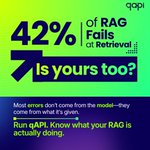
42% of RAG retrieval failures its not just another statistic.
These failures can often be traced to three key challenges: poor chunking strategies, weak retrieval relevance, and gaps in data quality or coverage.
The problem is that most teams know retrieval is failing, but not why.
qAPI provides deep visibility into your RAG pipeline, helping you understand what was retrieved, why it was selected, and where breakdowns occur.
With actionable insights into retrieval behavior, qAPI enables teams to identify root causes faster, optimize performance, and build more reliable AI applications.
Try now- qapi.qyrus.com
#rag #testing #pipeline #qapi #software #development #trust #build #scale #route #systems #AI #applications

Most LLM features don’t fail in the model. They fail in the handoff.
How?
Data science validates prompts in notebooks. Engineering ships to prod. Then context drifts, retrieval degrades, a minor prompt tweak breaks downstream logic, or a model swap changes tone overnight.
By the time users notice, you’re debugging in production.(Yes it's too late)
A checklist won’t catch that. Static benchmarks don’t reflect your data.
Manual “spot-checking” doesn’t scale. And without automated gates, every RAG update, embedding change, or prompt revision becomes a roll of the dice.
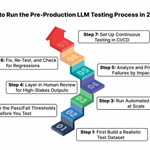
In 2026, pre-production LLM testing isn’t about grading outputs. It’s about engineering a repeatable validation pipeline:
🔹 Version prompts & retrieval configs like code
🔹 Auto-score grounding, relevance, toxicity & consistency on every PR
🔹 Test context propagation, not just final responses
🔹 Run prompt regression suites when models or pipelines change
🔹 Gate merges on quality thresholds, not gut feel
🔹 Log failures with full context traces for fast debugging
This is exactly why we built qAPI’s AI testing layer. It turns LLM evaluation from a manual review into a CI/CD-native workflow. Import your prompts, chain RAG validation, auto-score responses against your rubrics, and block deployments when quality drops. No notebooks. No spreadsheets. Just automated, auditable AI assurance.
If your team is shipping LLM features without regression gates, you’re not testing AI. You’re hoping it works.
Comment “PIPELINE” and we’ll send the exact pre-production LLM testing workflow we use with enterprise teams.
Or see how qAPI automates it end-to-end- qyrus.com/qapi/test-custom-l…
#pipeline #strategy #build #qapi #llm #agentic #ai #gpt #new #release #feature #blog

The cycle needs to break. It is time.
In 2026, quality engineering teams are still spending a significant portion of their time where they shouldn't be: staring at dashboards, triaging recurring bugs, maintaining brittle automation suites, and rewriting test cases every time an application changes.
The problem isn't a lack of effort. It's that the QA model was built for a different era.
Software is now being released faster than ever. AI-generated code, rapid feature delivery, microservices, and continuous deployments have dramatically increased the rate of change.
Yet many teams are still relying on test assets that require constant manual upkeep. The result is a quality process that becomes reactive instead of intelligent. Engineers spend more time maintaining the testing system than improving product quality itself.
In fact, IDC reported that developers spend only 16% of their time developing applications, while substantial effort goes into operational activities, testing, deployment, monitoring, and maintenance.
Writing requirements and test cases alone accounts for 14% of developer time.
This creates a hidden cost: slower innovation, tester fatigue, longer release cycles, and valuable engineering talent being consumed by work that adds little strategic value.
A shift from maintaining tests to engineering quality.
A shift from reacting to defects to preventing them.
A shift from manual effort to AI-driven intelligence.
The cycle needs to break. And that shift starts with qAPI.
#qapi #software #testing #development #build #scale #automation #leverage #modernize #growth #EnterpriseAI

Your RAG pipeline might have a 90%+ faithfulness score, but your users are still complaining about wrong answers. How is that possible? 🤯
Let's clear the air on this
The truth is, high faithfulness only means your LLM is answering consistently with what was retrieved—it does not mean your retriever actually found the complete facts needed to answer.
When your retriever misses a key document, the LLM is forced to fill the gaps using its general training data, which is exactly where hallucinations come from.
To safely ship a public-facing chatbot, production benchmarks show you need a minimum context recall score of 0.82,
Yet, less than 18% of public RAG pipelines actually manage to hit the oft-cited academic benchmark of 0.9 in the real world.
Watch our new video to see why upstream retrieval failure is the key problem of RAG systems.
The real-world liability consequences of low context recall, such as the landmark 2024 Air Canada tribunal ruling.
Practical, high-ROI fixes you can apply today, starting with simple adjustments to chunk sizes and top-k values.
Stop guessing if your AI is ready to ship. Start measuring context recall.
Read more:
qyrus.com/qapi/what-is-a-goo…
#context #read #reseach #build #scale #systems #recall #AI #llm #rag #Agentic #testing #devs #2026 #new #sub #qapi
RAG applications are only as good as your ability to measure them.
In this video, our expert Vishal Sutariya will walk you through how to run RAG Evaluation in qAPI to move beyond subjective testing and start evaluating retrieval quality, answer relevance, and overall performance in a structured way.
If you're building GenAI applications, having a repeatable evaluation process is no longer optional.
🎥 Watch the walkthrough and see how qAPI simplifies RAG evaluation.
Watch the video here: lnkd.in/grDca-hW
#GenAI #RAG #LLM #AIEngineering #qAPI #AIEvaluation #ResponsibleAI #tool #build #scale #learn #share #AI #agent #flight #risk #test #stories

We tested 40+ production AI systems across healthcare, finance, and e-commerce.
Every single one used RAGAS or DeepEval or both. Every single one had >90% scores on their evaluations.
34 of them had critical integration failures in production that their testing never caught.
The pattern: RAG retrieved correct documents (RAGAS said ✓).
LLM generated accurate responses in isolation (DeepEval said ✓).
APIs returned valid data (Postman said ✓).
But when the API was slow, the LLM hallucinated.
When the RAG returned multiple documents, the LLM cherry-picked the wrong one.
When the API changed response format, the LLM's parser broke silently.
Point solutions test points. Systems need system testing.
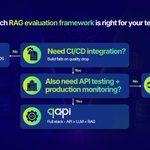
You can't test AI in a vacuum. We put together a technical comparison of Ragas, DeepEval, and qAPI to show what happens when you evaluate the model, the RAG pipeline, and the APIs all in the exact same test flow.
Here's how qAPI approaches it differently- qyrus.com/qapi/ragas-vs-deep…
#RAG #LLM #evaluation #testing #framework #test #testing #scale #research #compare #validate #devs #testers #swe #fde #qapi

qAPI retweeted
AI customer service is changing the interface, but it hasn't removed the need for testing—it multiplied it.
At the BFSI Innovation and Technology Summit in Mumbai today, our SVP of Product Engineering, Ameet Deshpande, and our Data Science Lead, Vatsal Saglani, took the stage to address a critical emerging challenge: The Hidden Risks of AI Customer Service.
📉 The Reality of AI in Banking
Every catastrophic AI failure in banking starts as a small language error nobody tested for. A single customer sentence can trigger reads and writes across up to ten different systems. Traditional testing simply checks if buttons click and validates text on a screen, but AI requires validating meaning, intent, and reasoning across thousands of unpredictable conversation paths.
🤖 The Qyrus Solution: Trust Through Scale
Recognized as a Leader in The Forrester Wave™: Autonomous Testing Platforms, Qyrus is helping enterprises build AI they can trust. Instead of writing static test scripts, our platform simulates thousands of realistic customer personas—from angry fraud victims to VIPs—to stress-test AI agents before they ever reach production.
⚡ The Five Pillars of AI Quality
Our approach replaces blind guesswork with a risk-weighted production readiness verdict, actively measuring:
👉 Reliability & Intelligence (handling crashes, timeouts, loops, and correct intent detection).
👉 Trust & Grounding (ensuring responses are verifiable and tied strictly to your valid knowledge base, not the internet).
👉 Security & Experience (blocking prompt injections, guarding against PII leakage, and ensuring proper escalation).
Missed us at the summit?
Check out the video snippet below for a glimpse of Ameet’s keynote on why you would never let an AI start work untrained and unsupervised. While the event has wrapped up, the conversation is just beginning.
Visit our website to connect with our team and see the future of testing in action. qyrus.com/
#EXITOBFSIINDIA #AICustomerService #AutonomousTesting #AIInQA #QualityEngineering #Qyrus #EnterpriseBanking #TechLeadership #SoftwareTesting #AgenticAI
Decided not to test the API because it was a minor release on a friday.
But.....
Monday morning had other plans.
With qAPI, your API tests run 24/7 automatically, so Monday surprises stay where they belong: in memes!
.
.
.
.
.
.
.
#mondaymeme #workplace #humor #crash #hack #slowmonday #meme #workplacehumor #joke #pun #qapi #pun #joke
qAPI retweeted
Ending July on a High Note! 🎉
What better way to wrap up July than with a little friendly competition and a lot of laughter?
A huge thank you to our HCM teammates, Sahana Mallikarjun, and Nanditha M for putting together another incredible Fun Q Day! Complete with hula hoop passing, footstep coordinate challenges, and plenty of cheer, you all kept the energy high and brought everyone together.
Behind every great platform, product, and milestone is a passionate, connected team, and these moments remind us what makes working at Qyrus so special.
Press play to catch the good vibes from our latest Fun Q Day! 👇
#LifeAtQyrus #WorkCulture #TeamBuilding #FunAtWork #Qyrus #JulyWrapUp #CompanyCulture
One hallucinated AI response can cost you a customer. Two can trigger a compliance fine.
When a financial services company deploys an LLM to answer policy questions, "sounding human" isn't enough. It has to be 100% accurate, every single time. Traditional software testing can't validate that.
What qAPI LLM Evaluation does:
✅ Continuous accuracy monitoring across real customer queries (not just benchmarks)
✅ Hallucination detection before responses reach production
✅ Compliance validation against your actual policy documents
✅ Model comparison (is GPT-4 safer than your fine-tuned model?)
✅ Regression alerts (did yesterday's prompt change break something?)
With GenAI, what gets measured gets trusted. Stop guessing how your LLM will perform in production.
Try it out now: qapi.qyrus.com/
#tool #product #launch #usage #credits #llm #evaluator #build #scale #agentic #ai #agents #genAI #qapi


What happens when..
AI application fails?
Often, it’s not the model alone. or it can be the model too.
It could be a broken API, inaccurate retrieval from your knowledge base, or inconsistent LLM responses that impact customer trust.
That’s why we’ve brought API Testing, RAG Evaluation, and LLM Testing together in a single platform, helping testers, developers, and business leaders ensure quality across every layer of an AI-powered application.
Consider a banking chatbot that helps customers with loan eligibility, credit card details, and account-related queries:
✅ API Testing validates that backend services return accurate customer and product data.
✅ RAG Evaluation ensures responses are grounded in the latest banking policies, FAQs, and knowledge documents.
✅ LLM Testing verifies response accuracy, consistency, safety, and compliance before deployment.
Instead of juggling multiple tools and disconnected reports, teams get a unified view of application reliability and AI performance.
The result? Faster testing cycles, fewer production surprises, and greater confidence in every release.
Because in 2026, AI it's no longer enough to test the application, you need to test the intelligence powering it.
qAPI is your intelligence validation partner: qapi.qyrus.com/
#AITesting #LLMTesting #RAG #APITesting #QualityEngineering #GenAI #SoftwareTesting #qapi #dev #life #monday #devlife #tester #promote
Do you know which API tests actually matter?
Most teams don't struggle with writing API tests. They struggle with deciding where to invest their limited time and attention.
When testing is spread across multiple tools and workflows, teams naturally gravitate toward what's easiest to automate and maintain: functional validation and regression coverage. As release cycles accelerate, other test types often move down the priority list.
We've seen teams with thousands of passing API tests encounter production issues because performance and resilience testing happened too late. We've also seen organizations invest heavily in end-to-end coverage, only to face integration failures because API contracts between services were never validated consistently.
The challenge isn't a lack of testing.
It's that testing efforts are often concentrated in one area while risks emerge elsewhere.
The most effective teams aren't necessarily the ones running the most API tests. They're the ones that align their testing strategy with their biggest business and technical risks, whether that's reliability, scalability, security, or service compatibility.
The real question isn't "Do we have API tests?" It's "Are we running the API tests that matter most?"
#APITesting #SoftwareQuality #QualityEngineering #DevOps #APIQuality #TestingStrategy
read the full story: linkedin.com/feed/update/urn…

The hardest part of building with LLMs isn't generating answers, it's proving those answers are reliable.
Unlike traditional software, where the same input produces the same output, LLMs operate in probabilities. The same prompt can generate different responses, edge cases can expose hidden failures, and a model that performs perfectly in a demo can break in production when faced with real user behavior.
That's why evaluation isn't optional. Before deploying, you need to test for accuracy, consistency, hallucinations, prompt sensitivity, safety, latency, and performance across thousands of realistic scenarios. Without systematic testing, you're not shipping an AI product, you're shipping a guess.
In the world of LLMs, the question isn't "Does it work?" but "How often does it fail, and under what conditions?"
Evaluate your LLMs on qAPI: qapi.qyrus.com/
#llm #evaluate #AI #agents #agentic #scale #growth #impact #testing #building #tool #new #product #feature #qapi

Let's simplify the debate.
No matter how many opinions, discussions, or hot takes exist around the topic, most people fall into one of two groups: those who gain understanding by doing, and those who learn by studying what has already been done.
Both approaches bring value. But problems arise when businesses swing too far in either direction, making things unnecessarily complicated or reducing them to oversimplified assumptions.
The reality is that many companies are still trying to find the right balance. Others have chosen to partner with specialists who can help navigate the complexity and focus on delivering results.
Understanding is one thing. Execution is what makes the difference.
👉 Swipe through the carousel to read more.
#simplify #testing #devs #tester #build #scale #growth #innovate #qapi #contract #performance #functionality #qAPI


qAPI retweeted
Your API workflow has more steps than it needs. Half of them exist because your testing tool wasn't built to handle the other half.
5 ways qAPI simplifies what your current setup makes unnecessarily hard. Save this for your next sprint planning. 👇
.
.
.
.
.
#swipe #learn #share #workflows #api #testing #qapi #build #create #test #deploy #fast


qAPI retweeted
Money. Revenue. Attrition.
Every metric. Every meeting. Every conversation comes down to one thing: Revenue impact.
Yet ARR targets keep slipping, costs keep rising, and the numbers aren't moving in the direction you want.
Why?
-Delayed API testing
-Human errors
-Security vulnerabilities
-Production bugs
-Third-party dependency failures
-And countless preventable issues
For many tech companies, these problems can result in losses of atleast $15,000 or more before they're even detected.
So what's the solution?
Increase the budget? Or improve the approach?
The answer is simple: change your approach.
Your APIs power your products, customer experiences, and revenue streams. It's time to treat them accordingly.
✅ Test earlier
✅ Detect issues faster
✅ Improve API reliability
✅ Reduce costly downtime
With qAPI, you can build, test, and monitor APIs easily. qapi.qyrus.com/api-testing/
Sign up now and stop letting preventable API issues drain your revenue. 🚀
