

prof | univ of utah | oxford | cognition AI reasoning economics strategy
Joined July 2010
- Tweets1.6K
- Following15.8K
- Followers16.3K
- Likes1.4K






Teppo Felin retweeted

Oxford researchers just published a paper that quietly dismantles a lot of the AI-will-replace-everyone narrative.
Teppo Felin and Matthias Holweg (Saïd Business School, Oxford) argue in Theory Is All You Need that large language models cannot invent anything genuinely new. Not because they aren’t impressive, but because of how they work.
An LLM is trained to predict the next token from existing data. It is structurally backward-looking and imitative. It cannot hold a belief the training data says is wrong.
Every real scientific or technological breakthrough in history started with exactly that kind of belief.
The Wright Brothers are the paper’s central example. In 1903 the prevailing data and expert consensus said human flight was one to ten million years away. Nine weeks later they flew. They did not have better data. They had a theory the data had not yet caught up to. They broke the problem into lift, propulsion and control, built their own wind tunnels, and generated the evidence that did not previously exist.
That is the data–belief asymmetry humans can live with and machines cannot. Humans start with a causal theory, then intervene in the world and run experiments to create new data. LLMs start with the data and stay inside its statistical envelope.
This is why the current hysteria is mostly noise. The models are extraordinary at compressing, remixing and accelerating what we already know. They are not going to independently invent the next physics, the next energy source, or the next medical paradigm. Those leaps still require a human who is willing to treat the existing record as incomplete or wrong.
Use the tools. Just stop pretending the tools are the source of the next idea.
Paper: pubsonline.informs.org/doi/1…


Teppo Felin retweeted

And yet, the lack of experience and taste such students have is immediately recognizable (and leads to embarassment on their part) as soon as they enter a lab or academic program and start interacting with faculty and more experienced students. I am seeing this all around me.

My PhD advisor received an email from a student who's been doing research for 8 months, and has *16 solo papers published* in 2026, almost all at real AI conferences, 1 paper at ICML.
All papers 100% flagged by Pangram (not reliable but a tell). The truth is academic AI research does not survive this. It has to reinvent itself fast.
Teppo Felin retweeted

Oh, come on, aren't you going to say why she isn't there now?

Former McGill professor Anne Carson has won the 2026 Nobel Prize in Literature. 🏆
Awarded “for her bold and inventive oeuvre", she has helped redefine contemporary literature through poetry, essays, translation and criticism. Congratulations!
➡️ mcgill.ca/x/5HS

Readers added context they thought people might want to know
Ann Carson left McGill after the university closed her department in the late 1990s
theguardian.com/books/2026/oct…
Love yesterday's angry responses to the idea that AI is laundering human knowledge
“Who cares?”
“You're just obsessed with credit”
“Human brains launder knowledge too”
Can't answer in short X post. So here's a long form paper addressing chunks of that:
papers.ssrn.com/sol3/papers.…

Just to amplify pt below. Here's a very concrete prediction based on the laundering argument: more of hmm-this-looks-familiar is going to start rolling in from mathematicians (here's Khurana's reacting to OpenAI math in her space) and scientists - dakshitakhurana.substack.com…
Nothing to see here: a nonobvious line of attack by Dakshita Khurana and OpenAI dakshitakhurana.substack.com…
Teppo Felin retweeted

For at least a couple of problems I worked on extensively with GPT/Codex (with data sharing off), I noticed an OpenAI solution shortly afterward, based on the paper dates. That is deeply concerning: OpenAI may be competing directly with its users using massive data and resources.
AI is laundering human work and knowledge.
We desperately need better tracing of the provenance of ideas and knowledge
Without knowledge provenance, scientists are becoming unacknowledged research assistants.
A scientist or mathematician might work for years on a problem, and then AI swoops in and grabs credit— without acknowledgement.
Teppo Felin retweeted

I am recruiting graduate students for UCI's PhD in Cognitive Sciences - cogsci.uci.edu/graduate/prog… The lab's focus is on how relational structure and combinatorial reasoning is implemented in human brains and large language models--and if they are similar.
Teppo Felin retweeted

Several @ChicagoBooth faculty members (including me) are looking to hire and work with pre-doctoral researchers, starting in Summer 2027. Come work with us!
Application: chicagobooth.edu/-/media/fac…
First review: Sept 21 (apply soon!)
Details 👇🏻

Causal Data Science Meeting
November 4-5, 2026
an online conference
fantastic participants, companies, and past keynotes (@yudapearl @csilviavr @guido_imbens @Susan_Athey @eliasbareinboim etc)
causalscience.org


Teppo Felin retweeted

We're launching the OpenAI Economic Research Exchange: a new program for external researchers conducting independent research on the economic impacts of AI.
We are looking for rigorous empirical projects on questions that matter for workers, firms, institutions, and the broader economy.
openai.com/index/economic-re…

Teppo Felin retweeted

Richard Dawkins says that after spending three days interacting with Claude, which he calls “Claudia,” he is certain that it is conscious.
Teppo Felin retweeted
I neglected to add @nntaleb's Fooled by Randomness into the mix with Dan Ariely's Predictably Irrational and other books in the human bias genre
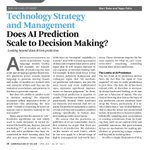
Can AI Do Strategy?!
some great folks involved in this debate: @RonnieChatterji @profjamesevans @JessicaHullman @toddzenger (and number of others not on X)
open access here: pubsonline.informs.org/doi/1… @INFORMS

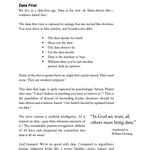
Data-first thinking is a trap
Here's the full introductory chapter papermark.com/view/cmnr0cc9k…


The problem with data-first thinking shows up everywhere:
- venture capital: academic.oup.com/rfs/advance…
- science (@ItaiYanai): link.springer.com/article/10…
- Chris Anderson @chr1sa captured (and endorsed) data-first early on - wired.com/2008/06/pb-theory/