

Helping the top brands scale through paid ads.
Joined November 2024
- Tweets2.5K
- Following145
- Followers382
- Likes7.7K



Pinned Tweet
How to know you’re NGMI as a creative strategist in 2026:
1. You think creative strategy is just coming up with content ideas.
you’re NGMI
2. You see “Hiring Creative Strategist” and apply with a portfolio full of pretty ads but zero explanation of why they were made or why they worked if they did.
You’re applying as a designer and you’re NGMI.
3. You think performance data is the media buyer’s problem.
You don’t know your CTR, CPA, hook rate, hold rate or ROAS.
You just know the ad “felt good.”
well you’re NGMI.
4. You use ChatGPT to generate 50 hooks before reading a single customer review, sales call or support ticket.
NGMI.
5. You think your job ends when you send the brief.
youre NGMI.
6. You call yourself data-driven but have never made a decision because of the data.
you're NGMI.
You’re still using the same creative playbook you learned in 2022.
If you read all of this and somehow every single point applies to you…
wrap it up gng.
You have NHOMI.
And if you read this post, nod your head, like it, and then go back to doing exactly the same thing tomorrow…
I have bad news for you...
Meta cares about what matters so do the audience.. I find it funny when people change very irrelevant things and call it DiVeRsItY
Dude you're making the same ad

Idk who needs to hear this but producing 50 variations of the same idea is not creative diversification.
Real diversification means testing:
- different customer avatars
- different problems
- different use cases
- different motivations
- different awareness stages
- different formats
Changing the hook on the same concept is still mostly the same idea.
You don’t need more creatives.
You need more genuinely different ideas.
The best creative strategists I know are cracked at copywriting.
The worst creative strategists I know are horrible at it.
And no it isn't because they don't know how to put the right words together.
It's because they lost the ability to think.
Sam Altman didn't steal their ability to think.
They gave it away.
because they stopped wrestling with the problem themselves.
Now it's:
prompt → AI answer → polish → publish.
And because the final copy sounds good, they mistake polish for quality.
That's how you get polished slop.
If you're learning copywriting, actually write the damn copy.
Sit with the blank page and get the reps in
Figure out what the customer wants.
What they believe.
What they don't believe.
What would make them stop scrolling and think whatever you're saying isn't what they've seen a thousand times.
What you can say that everyone else isn't saying.
Then use AI to challenge your thinking, not replace it.
Because copywriting is one of the best ways to train yourself to think like a strategist.
And if you keep outsourcing the thinking, you'll eventually get very good at polishing ideas you never had.
Peak.
Curious to see how well this ad did though.


Tem | Creative strategist retweeted

Copywriting Group going strong!
We crushed the waitlist, so you can join now and get instant access for free
Link below


when i stopped thinking about hooks as bait to get people watching (which just chases a good hook rate)...
and started seeing hooks as a promise that what they're about to watch is relevant to them and thier current situation that changed everything for me.
Your content has two different jobs. Most people try to make one piece of content do both and end up doing neither well.
Traffic content gets you found. Conversion content gets you paid.
10,000 followers sounds like an audience.
But maybe 2,000 actually know you. Maybe 600 know your name. Maybe 80 trust you enough to consider paying. Maybe 14 of them ever will.
That gap between "has followers" and "gets paid" isn't a traffic problem. It's a content mix problem.
Stop asking "what should I post today." Start asking "is this piece meant to get me seen, or meant to get me paid." Different question, different content, different result.
I'm not going to pretend AI is bad like a lot of creators do.
But something's been bothering me.
AI closed the gap between bad and content that's just good enough.
Anyone can hit content that looks good.
But making Great content now is a different fight entirely
Just "Good enough" is AI's floor.
Great starts where AI stops, in the hours you spent learning something the hard way, the opinions you only have because you lived through the mistake.
That's the part no prompt or skill can hand you.
The 10-80-10 thing works.(with alot of testing and training btw)
Direction up front, AI in the middle, cleanup at the end.
But if that cleanup is just fixing grammar, you're still stuck at good enough.
You polished the floor.
Used to be guilty of that myself.
Fast output, zero of me in it.
Scary how many people can't tell the difference anymore.
Good enough looks great until you put it next to something real.
If you're still putting real time into your own thinking, still bringing something AI can't fake... I'd love to connect.
Feels rare out here lately.
A $100M SaaS company posted a YouTube video last week.
Polished thumbnail. Strong title. Proper strategy.
187 views.
The guy who made a video called "I'm pretty sure recycling isn't real" got 3 million.
No big team. No split tests. No strategy doc.
This should bother you more than it does.
Because the entire YouTube education industry exists to sell you the idea that views are an output of process. Do the research. Model the outliers. Nail the packaging. Trust the data.
But here's what that industry won't tell you.
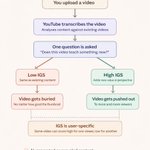
YouTube sorts your video into an audience before it ever checks your CTR. It's reading what you actually say. The topics you mention. The originality of your perspective versus every competitor video it could show instead.
Title and thumbnail alone don't get you views.
They get you filed.
And if you're filing yourself next to every other "how to grow your channel" video with the same recycled insight dressed up in a new format.. you're not competing for views. You're competing for last place in a crowd of people who all copied each other.
The recycling video blew up because it named something 3 million people had quietly suspected and never heard said out loud.
No strategist would have greenlit that idea.
That's the whole point.

The people copying outlier videos without understanding the niche they're in will never actually learn YouTube.
And the ones using AI to script everything are producing content that sounds fine but has no genuine insight in it.
The work still has to be done.
The audience can feel when it hasn't.
Most people double down on what works and wonder why it stops working 3 months later.
That's audience fatigue.
Your audience isn't tired of you. They're tired of seeing the same topic the same way over and over.
The fix is not to stop doubling down. It's to make your content new AND better at the same time.
New means the information feels fresh. A different angle. A different framing. Something they haven't heard before.
Better means the packaging is sharper than the last one. Stronger title. Cleaner thumbnail. Tighter script.
Same concept. Different execution.
The channels that stay consistent without plateauing do both every single time.
Great storytelling isn't a talent. It's a chemical loop.
Your brain releases dopamine not when you get a reward. It releases it when you're waiting to find out if you will.
That's why you can't put a book down at 2am.
That's why you watch one more episode.
That's why some content stops you mid-scroll and some doesn't.
The best storytellers run the same 4 steps every time.
Stakes. Give the brain a reason to care.
Big question. Load in something to predict.
Head fake. Break the prediction in a way that still makes sense.
Rehook. Open a new loop before the last one closes.
The head fake is the one most people miss.
A cheap surprise is just random. It comes out of nowhere and doesn't land.
A great head fake is something you never saw coming but the second it hits you think wait... the clues were always there.
That's the dopamine spike.
And once you know how to engineer it you can't unknow it.

Every YouTube channel that's stuck is stuck for one of three reasons.
No awareness. No clarity. No action.
Awareness: you don't actually know why your videos aren't working. You think it's the editing. It's not. It's the idea.
Clarity: you know something's wrong but you can't name it. And if you can't name the problem you can never fix it.
Action: you know exactly what to do and still don't do it consistently enough to get data.
Most people jump straight to action without the first two.
That's why they stay stuck.
You can have every AI scriptwriting tool and your script still sucks.
Because the tools don't fix the thinking.
They just write your bad ideas faster.
Scriptwriting is not only a writing problem.
It is a thinking problem.
And thinking comes from research.
Deep, uncomfortable, hours-long research. (If you actually agree that scripting is planning the video)
The script is just the last part of the work.
Everything before it is what actually decides how the video ends up.

Confidence on camera doesn't come from practicing in the mirror.
It comes from clarity.
And clarity doesn't start with "what should I talk about?"
It starts with two questions:
What do I want them to feel after watching?
What action do I want them to take?
Answer those first and the topic, the title, the structure
all of it writes itself.
You can't fake knowing what you're saying.
But you can engineer the clarity that makes it feel effortless.
Tem | Creative strategist retweeted
Today I turn 30.
I’ve dedicated over 50% of my life to mastering YouTube strategy.
50+ billion views, millions in revenue, across 100s of channels later…
Here are 30 lessons for creators:
The top 10% of people selling info take 90% of the money.
Here's the only thing separating them from everyone else.
It's not their offer.
It's not their funnel.
It's not how many testimonials they have.
It's this: they are impossible to copy.
And there are only 3 ways to get there.
1. Time leverage..
you've been building in public for years. Every step documented. Every result visible. Nobody can fake a 10 year track record.
2. Audience leverage .
you already own attention. The game becomes conversion, not acquisition.
3. Uniqueness leverage
this is the one most people can actually build right now.
Unique doesn't mean weird.
It means nobody else sounds like you, thinks like you, or shows up like you.
Your angle on a topic. Your voice. Your values. The way you explain things.
Here's why this matters more than ever:
AI can produce any piece of information in seconds.
So information alone is worth nothing now.
What AI cannot produce is you.
Your specific journey. Your real opinion. Your human touch.
The market is already shifting.
People are buying into identities, not offers.
Into leaders, not products.
Into communities, not courses.
Curiosity creates attraction.
Attraction creates loyalty.
Loyalty creates influence.
Influence is everything.
Stop trying to have the best offer.
Start being the most impossible to ignore.