

Build credibility. Raise funds. CEO, The AmplifiedX. Building Meridian, the AI layer for executive influence. Writing on AI, trust and capital.
Dubai
Joined January 2014
- Tweets1.3K
- Following1.4K
- Followers5.8K
- Likes128






One wrong decision can wreck a life.
One right one can rebuild it. Stop only guarding against the first. Hunt for the second.

The U.S. is spending $5B+ a month on data centers, heading toward 3.6% of GDP a year through 2032.
But 47 major projects have been delayed, cancelled or blocked this year over power, permits, costs and local opposition. AI demand isn't the problem. Building for it is.
Success isn't a finish line. It's a subscription.
Nobody "makes it." You just keep paying for your seat, every day. Pay it with pride.

Harsh truth nobody told you about success:
Rent is due every single day.
You never really make it. And coasting isn’t an option. Every single day, you have to fight to keep your seat at the table. Because the day you stop doing the work is the day things start to fall apart.
There's an old saying that I love:
Every morning in the savannah, the gazelle wakes up and knows it must outrun the lion or be killed. The lion wakes up and knows it must outrun the gazelle or starve. Whether you're the gazelle or the lion, when you wake up in the morning, you'd better start running.
Rent is due daily. Pay it with pride.
As agents get more autonomy, "the model will behave" stops being a security strategy.
Continuous risk assessment, adaptive permissions, and containment are the new baseline.

I recently wrote about why we need to treat models as insider risks, with security controls sitting outside the model itself.
Today, we're putting that principle into practice by expanding Project Perception with new capabilities to help continuously assess agent risk, adapt permissions, and contain threats.
blogs.microsoft.com/blog/202…

Most people think AI's biggest roadblock is the tech.
The survey says otherwise. The #1 obstacle named: customers preferring a human (41%). "AI isn't reliable enough" came in at just 27%.
The bottleneck is trust, not capability.

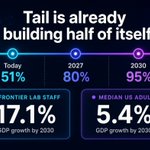
Anthropic staff say AI does 51% of the work of building frontier models today, and 95% by 2030.
Their answers imply 17.1% GDP growth. The median US adult's? 5.4%.
🤖 Made with AI

What will slow AI at work? The public's top answer isn't tech:
📌 41% say customers prefer humans
📌 37% say data privacy
📌 27% say AI isn't reliable enough
People who actually use AI at work flip the order and rank privacy first.
🤖 Made with AI

Unemployment forecasts follow one rule:
Workers who expect AI to do 80%+ of their own job predict 12.2% unemployment by 2030, higher than the 2008 crisis peak.
Anthropic staff and regular.
🤖 Made with AI

Anthropic staff think AI will do 75% of their own job by 2030.
US workers? 28%. Only 1 in 20 say 80%+.
Yet 95% of staff expect Anthropic to keep hiring. The median guess is +66% headcount in 12 months. Automating tasks ≠ cutting jobs.

The AI expectations gap is wild 👀
By 2030, 91% of Anthropic staff expect AI to make a Nobel-level discovery. Only 39% of US adults agree.
And 19–40% of the public say AI will never do certain tasks. Among staff, it's 2% at most.

Tesla and SpaceX just showed a car that flips, flies and lands. Production is still years away, but the demo changed what people think is possible.

Most AI debates are about models and capability. Chamath is pointing at the layer underneath: debt and rates. If financing gets expensive, only the giants with balance sheets can hold the line.

Chamath Explains the AI Boom’s Achilles Heel
“Doesn't matter what you do, doesn't matter what you claim to do, you're going to get run over. You're going to be roadkill.
If the bond market walks the 10-year up to 5.5 and 6%, which has nothing to do with AI, it has everything to do with debt to GDP and a bunch of other factors in broad-based Western economies, any business model that thrives on a financing spread gets cornholed.
Any and every, all of them. It will not matter when the 10-year’s at 6%. It won't matter.
As long as we can keep that from happening, we're going to be fine.
So what's the most important way, I guess, post these midterms to keep the party going?
You have to really start to focus on deficits, and you have to find a fair trade where the bond market backs off.
And I think you can see it in the tape, meaning if we start proposing huge spending programs, they're going to walk the 10-year up.
That then has a negative cascade to everything.
If, however, the posture becomes much more about keeping everything calm and like, ‘Let's just tone things down and let's find the waste in the system and squeeze it all out,’ I think people will respond very favorably.
The last thing I will say is these are like Achilles' heels, meaning all of the asset value that's getting built up, but just like the great warriors, you just slice the Achilles tendon and they just crumble to the knees.
I just want to point out, this is that thing. There is no other thing.
Meaning, all this other stuff is complete goodness, but the fact that you need to finance these things in a variable rate model as a spread to the risk-free rate is the big problem in these businesses.
And you need to essentially have Microsoft, Google, Meta, and Nvidia backstop all of this in a worst case scenario because that's the only way you can withstand a one or two-year correction in this market.”
Not the right fit” usually means “I didn’t feel it.” Treat investor feedback as a signal only when you hear it three times.

Every heavy Claude user has checked their usage limit five times a day. One dev turned that annoyance into a free widget. Underserved daily friction is where the best small tools come from.

This guy on Reddit built a free widget that watches your Claude usage limits for you
It shows your current session, weekly and plan limits, updating every minute, and it spends zero tokens doing it
It also shows which of your Claude Code sessions are working, which are waiting for you, and which are idle
The best part is the mascot. A small pixel character lives in the widget and reacts to your usage
It sleeps when nothing is running. It runs while a session works. It sweats when you get close to the limit
At 100 percent, it lies on its back
He built the whole thing with Claude Code, and it is free and open source
One person solving the small daily annoyance of every heavy Claude user

Every CEO is being told to "adopt AI." Very few can name one workflow it improved by 2x. That gap is the biggest opportunity in the space right now.

Reliability is a career skill. Do what you said, when you said it, and you're already ahead of most people.

Structure keeps you moving. Flexibility keeps you sane. The routines that last leave room for life to happen.
Nobody tells you this: Routines have a dark side.
When your routines become too rigid and complicated, they become a source of stress.
Routines meant to serve you can start to feel like they own you.
I try to follow a 90-10 rule:
- 90% disciplined compliance
- 10% open flexibility
That means 90% of the time, I'm locked in with my structure, but 10% of the time, I give myself the space to let life happen freely.
It's directional more than exact. Just a rough compass in the back of my mind.
I used to struggle a lot with being too dogmatic in my routines. I’d get routine anxiety.
My 90-10 rule changed that for me.
The 90% keeps me structured and in flow. The 10% gives me the space to embrace serendipitous opportunities and adapt to random chaos of life.
Routines should serve your life. Not own it.
Highly recommend adopting a 90-10 approach.
The best book nobody's heard of earns nothing. Marketing isn't selling out, it's how your work finds its readers.
