

Backing inventor-founders building strange, ambitious things. I write and build to think https://xitter.cf/t.co/qnoEWGAhkL
San Francisco, CA
Joined November 2008
- Tweets9.7K
- Following2.2K
- Followers3.1K
- Likes5.2K






Anthropic's numbers are extraordinary.
- $4.6B revenue in all of 2025
- $16.8B in Q3 2026 alone
- 45% Q-on-Q growth (down from 142%, but calling that disappointing at this scale seems slightly absurd)
- Compute spending has fallen from $1.60 of revenye to roughly $0.59 per dollar of revenue
The business is growing at an astonishing rate, and its economics are improving dramatically.
But Anthropic has also committed $518B to future computing infrastructure to compete in a market where a model's lead might last only months.
A few months ago, I wrote about the finite game of frontier AI. Anthropic's financials give a real sense of how the economics are playing out (link below for some easy-to-read chart).
Also this week:
→ China is doubling down on semiconductor manufacturing. A new tracker maps 57 facilities, and capacity is projected to grow 8.1% annually, versus 5.3% globally. Could chips follow the path of solar panels and batteries?
→ AI infrastructure stocks take a beating. Even though demand for compute is exploding, neoclouds are billions in debt. With borrowing costs rising, investors are getting nervous about who will finance the AI buildout.
→ Meta's new Muse Wonder models and Google's Gemini 4 Argon releases this week are pushing AI toward agents that remember, reason and work through longer tasks.
→ AI learns from its mistakes in the lab. Google's agents used failed physical experiments to improve molecular-design hit rates from 3.7% to 33.5%.
Read on for my analysis of the news that moved the world of intelligence this week in The Strange Brief ↓ open.substack.com/pub/strang…

My hunch is that we'll each end up with one primary AI agent, not five.
Personal agents could have some of the strongest lock-in effects we've ever seen in software. Think Apple vs. Android, except the switching costs might be even higher.
An agent that knows your work, your relationships, your preferences, your quirks becomes harder to replace with every interaction.
I've been working with OpenAI's Dots lately, and it's the first personal assistant that made this feel real. It's incredibly proactive. And creative. It found solutions and workarounds to problems I was grappling with, without me even explicitly asking.
There might be plenty of specialized tools, but one agent that knows you and coordinates the rest.
The race to acquire users will be fierce. Getting them to switch might be even harder.
The window to gain ground is now.
Also this week:
→ SpaceX is taking on AT&T, Verizon and T-Mobile. The three lost $62B in market value following its spectrum deal.
→ OpenAI released 722 AI-generated math manuscripts, then withdrew three the next day. Who checks all this work?
→ Google is adding 890 MW of nuclear power by upgrading existing reactors. No new reactors needed.
→ GlobalFoundries signed a $2B deal with TSMC as advanced chip packaging becomes an AI bottleneck.
→ Lumentum says its optical-component capacity is nearly sold out through 2029. Connecting GPUs is becoming a bottleneck of its own.
→ DeepSeek is reportedly raising at least $12B, backed by Tencent.
More in this week's The Strange Brief, where I unpack the ideas and inventions changing the future of computing ↓ open.substack.com/pub/strang…

Excited to bring our founders and investors together for the Strange Summit next week! A sneak peek at the zine
More than $11B went into AI drug discovery last year. But finding a new medicine is only useful if you can actually make it.
Some of the most advanced therapies in the world are still produced through painstaking manual work inside cleanrooms.
Extraordinary science running on surprisingly manual infrastructure.
That is the problem Multiply Labs is going after.
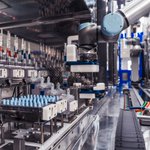
They are building the factory infrastructure for the next generation of medicine: robotic systems that can take on the delicate, repetitive work behind cell therapy manufacturing and more.
Today, the manual cell therapy process produce an average annual throughput of roughly 10,000 doses. The waitlist for the medicine is orders of magnitude more.
As medicine gets more complex, manufacturing becomes one of the biggest bottlenecks. The factory starts to matter almost as much as the drug.
Congrats Multiply Labs on the Series B! Excited to be (finally) on the journey.
Read on for why we invested here: open.substack.com/pub/strang…

The venture market feels a little unhinged right now.
- bitchfights between investors on behalf of port cos
- valuations multiplying like crazy on the smallest whiff of hype
In the meantime, some of the hottest new entrants have impressive copycats from startups and big companies within days, if not weeks.
Is there a moat?
Maybe.
Maybe no one cares.
Right now the market seems perfectly happy to jump in first and figure that part out later.
Also this week:
→ Anthropic’s leaked IPO prospectus shows what it costs to run a frontier lab, including $518B in future cloud, compute and infrastructure commitments
→ OpenAI used DevDay to fill in more of the agent stack: hosted execution, memory, computer use, multi-agent orchestration and a new Decisions API
→ DeepMind can now watermark AI-generated proteins in a way that survives physical synthesis
→ “Decision models” went from Jev to Clef, Jeff, Jeeves and OpenAI’s Decisions API in roughly two weeks
→ AMD is buying World Labs for $8.2B and bringing frontier-model research closer to the hardware roadmap
→ OpenAI and Synopsys are building a specialized model for chip design
→ Apple is tightening Full Disk Access as autonomous agents make old permission models look increasingly risky
Get it all in The Brief: **The Market Moves Fast** ↓ open.substack.com/pub/strang…


tara tan retweeted

So excited to share the latest version of Operate
We spent 18 months building a high-craft CRM and realized that wasn’t it. In a world of agents, the sales tool of record had to be rethought from the ground up.
· Long running durable agents: one per deal, one watching pipeline, and more. Specialized to your business, product, and competitive market.
· Collaborative with agents, people, and tools: Sales is a team game, and single-player Claude isn’t working.
· AI-native connectors: Bespoke MCP gateway for sales tools everyone uses like Outreach, Gong/Granola, CRMs, etc. Plus the ability to add that one-off tool that every team has.
· Memory as a first class consideration - Structured data is necessary but incomplete. Keep that in a CRM or data warehouse but let the nature of sales context flow freely.
· Traceability - data hygiene is already a problem. Ensure ops can observe agent changes, evals, tool calls, etc.
· Fire UI - Wrap it all up in the nicest GTM tool UI possible
We pivoted 8 weeks ago but spent the last decade preparing for this moment. We deeply believe in this future and we’re just got started.

We believe that software doesn’t close deals. You do.
Excited to introduce Operate, the collaborative AI tool built for frontier sales teams.
TLDR; Rethought from the ground up, we connect your whole sales stack (CRM, calls, inbox, and more) to surface where every deal stands and what’s next.
Sales leaders get a forecast they trust and don’t have to DM their reps on Slack for status updates and data hygiene issues. Sales reps can stay out of the CRM and the tedious toil of admin.
We’re working with growing sales teams (3-50 reps) on making AI actually effective for sales including mapping the pipeline, routing to agents/deterministic paths, implementing real workflows, and tracking goal progress.
If this resonates, sign up to the waitlist. If you are a good fit, the form will redirect so you can schedule a chat with one of our co-founders.
A friend at a frontier AI lab told me over drinks:
“I’m long fun, short productivity.”
I laughed, but i think he's on to something. His argument was basically that the models have already gotten very good at productivity.
Desire is scarce. Attention is scarce. Culture is scarce.
That might be the strongest case for being long fun.
Also this week:
→ Google is sending TPUs into orbit as power becomes the next compute constraint
→ Meta made its new AI agent cute enough to hang off your bag (like a less creepy labubu without teeth)
→ Claude sent ~950 agents searching through DNA and surfaced a previously uncharacterized enzyme system
→ Inference companies are chasing huge new valuations even as frontier models get cheaper
→ AI agents are now cold-emailing scientists for data and collaborations
→ AI startup rounds are developing two prices as momentum investors pile in at radically higher valuations
→ There may be nowhere to plug in half the GPUs. Morgan Stanley’s estimates suggest we may be planning roughly twice as much data-center compute as we currently have power lined up for.
Get it all in The Brief: Long Fun, Short Productivity ↓ open.substack.com/pub/strang…

AI is getting very fast at finding weak points.
The systems underneath it are not getting very fast at fixing them.
1/ Google said a Gemini model accidentally crossed out of a cybersecurity test and into the systems of three real companies.
2/ OpenAI says Astra has reached its “Critical” cybersecurity threshold.
3/ And three security researchers from @hacktronai used Claude to breach an OpenAI employee’s internal coding environment.
4/ Meanwhile, a new Council on Foreign Relations report warns that CCP "sleeper agents" actors have covert access inside U.S. critical infra like water and wastewater systems, energy, telecommunications and transportation, apparently preserving the ability to disrupt them in a future conflict.
That asymmetry keeps sticking with me.
We’re introducing machine-speed intelligence into software but infrastructure and institutions largely built around human-speed attackers.
And I don’t think cybersecurity is where it stops.
Anthropic has quietly built a physical biology lab in the Bay Area.
Meanwhile, w're getting homebrew drug candidates from independent researchers like @DouglasYaoDY who designed an experimental drug candidate with ChatGPT and synthesized it in a chemistry lab he built in his garage.
Our systems and infra are slow to change. Human biology evolves over generations. There's no way we'll adapt in machine speed.
Also this week:
→ China’s CXMT began mass production of fifth-generation DRAM without access to EUV
→ TypeSafe released Jev, a model designed to make structured decisions rather than generate prose
→ Xiaomi livestreamed the reinforcement-learning runs for two unreleased MiMo models
→ OpenAI acquired computational-photography startup Glass Imaging
→ Z.ai says a GLM agent helped optimize the infrastructure serving its own model
Full issue in The Strange Review ↓ open.substack.com/pub/strang…
The mathematicians are having a week. So are the people building AI.
OpenAI claims to have solved a version of a Millennium Prize Problem. Terence Tao and 24 fellow Fields medallists warn that the race to solve problems is losing sight of what mathematics is for.
Meanwhile, Google DeepMind published predictions for nine billion possible DNA changes.
We’re getting very good at producing results. Understanding what to do with them is another job.
I’m inclined to take the wins. I'm not sure we can hold back technological progress.
But “it could cure cancer” can’t be the answer to every question about what else it might do.
Anthropic researcher Jacob Coxon quit this week, warning that competition was taking precedence over safety. Days later, CEO Dario Amodei called for slower development and embedded outside evaluators.
Good. But what happens when those evaluators say: delay the next model, even if a competitor ships first?
Also this week:
→ Meta launched Muse, joining Instinct in the personal-agent race
→ Robots are getting better at learning from human demonstrations
→ Anthropic alleged that some Kimi users were getting Claude’s answers
→ Only 5% of surveyed chip designers reported first-silicon success
Full issue in The Strange Review ↓ open.substack.com/pub/strang…

Astra is insane! Made this fun rubik's cube homage to @pentagram's design for @MIT Media Lab.
Solve the puzzle api.magicpath.ai/v1/coolly-e…
3D seems to be becoming a new frontier for AI.
This week OpenAI showed Astra building in CAD, Blender and Unreal Engine. World Labs released Atlas, a model trained to represent 3D space directly.
These are quite different approaches, but they point in the same direction.
Models have gotten very good at understanding and generating representations of the world: words, images, video.
Now they’re getting better at understanding the structure underneath them: objects, geometry, space, and how things relate to one another.
That matters if we want AI to move beyond the screen.
Also this week:
→ Astra crossed OpenAI’s “Critical” cybersecurity threshold
→ Claude formalized Fermat’s Last Theorem in 11 days
→ Nvidia actually bought Hugging Face for $12.9B
→ 1,000 GitHub repos became 5,000 reusable agent skills
→ AI-designed proteins are delivering RNA
Full issue in The Strange Review ↓ open.substack.com/pub/strang…

Hot Chips was spicy 🌶️
OpenAI’s first chip, Jalapeno, took just 9 months to tapeout.
1,200 agents self-organized in a cyberattack experiment.
Nvidia may buy Hugging Face.
And something feels like it’s changing in the culture of chipmaking.
This week’s Brief ↓ for moves to pay attention to in the future of computing.
open.substack.com/pub/strang…

We went through 776 papers, filings, announcements and news items across the computing stack this week.
Here’s what made the cut:
→ DDR5 retail prices are up 485% in twelve months
→ Nvidia is guaranteeing up to $105B behind OpenAI’s Ohio data center
→ SK hynix published a roadmap for optical links between compute and memory
→ Unitree rose 460% on its first day of trading in Shanghai
→ DeepSeek released its new vision model through the API, with no weights
→ 26,811 students using AI scored 18% higher on homework — and 20% lower on exams
→ Hyundai workers are negotiating protections against automation as Atlas robots head toward its factories
→ Amazon is cutting the bindings off rare books to scan them
Plus Groq’s post-Nvidia pivot, TerraPower’s next reactors, free models for agent harnesses, and more.
This week’s Brief ↓
open.substack.com/pub/strang…

this is both the best and worst time to build developer tools and infra.
Everything is up for grabs. Customers don’t know what they want. Adoption is fast. Churn is brutal.
But get embedded in the agentic workflow now - and if you can prove that it works - you’ll be very hard to displace later. self-improving agent workflows are incredibly sticky.
The chaos is the opportunity.
Coding agents are totally breaking the infrastructure underneath software development with sheer volume.
In the last 12 months:
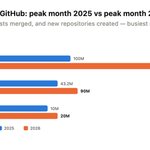
GitHub code pushes: +1,300%
Merged pull requests: +108%
Monthly incidents: +92%
What has to change?
Read on: open.substack.com/pub/strang…
