

Complex Human. Evolutionary Theory ❤️. Dad. He/him.
Pale blue dot
Joined October 2009
- Tweets10K
- Following1.3K
- Followers3.4K
- Likes45.2K





Pinned Tweet
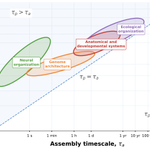
Very excited to share our @Trends_Ecol_Evo review paper on #punctuated_evolution: a pattern of long-term stability interrupted by dramatic changes. A thread on the origins of rapid change, from large #extinctions to socio-technological #disruption.🌍🧬🛠 doi.org/10.1016/j.tree.2024.…

Sergi Valverde🌍(under a blue sky) retweeted

The expensive tissue hypothesis. Note bi-directional influence of ‘more complex foraging behaviour’. (b) Bio-cultural feedback loop between culture and brain structure.


The co-evolution of hominins and Stone Age culture royalsocietypublishing.org/r…

Sergi Valverde🌍(under a blue sky) retweeted
Species are real, not social constructs. Consider the baboon genus Papio, where genome-scale data show broad variation within species and clear separation among species.
biorxiv.org/content/10.1101/…


Sergi Valverde🌍(under a blue sky) retweeted

Interesting what exactly constrains the body size distribution of any given taxon? Also, which factors determine the time scales of this equilibration?
CC: @svalver @PalaeoPhilo @CoelhoPre

Fishes had reached the modern mean and diversity of adult body sizes with placoderms during the Devonian c. 400 mya. It's just been a zig zag within this range ever since.
link.springer.com/article/10…

Sergi Valverde🌍(under a blue sky) retweeted
👌 path dependence, and the contingency of the Wonderful Life.
S.J. Gould forever
CC: @niles_eldredge @svalver @BlaiVidiella @PalaeoPhilo @CoelhoPre


Sergi Valverde🌍(under a blue sky) retweeted
A new study by @AndriiRozhok @niles_eldredge and James DeGregori which presents a novel population genetic mechanism of evolution—the directional selection (of deviating forms) also selects, as a dynamic spandrel, higher mutation rate forms!
@PalaeoPhilo
doi.org/10.1093/jeb/voag105

Sergi Valverde🌍(under a blue sky) retweeted

Clickbait headlines are catchy but often false. This paper shows there's no unified primate aggression, not that violence isn't hardwired (whatever that means) Here's the actual paper: academic.oup.com/evlett/arti…

Humans may not be as hardwired for violence as we thought sciencedaily.com/releases/20…

Sergi Valverde🌍(under a blue sky) retweeted
Interesting article on the diversity of patterns of hierarchical reasoning inside and across species 👇
CC: @niles_eldredge @svalver @PalaeoPhilo @CoelhoPre

Hierarchical reasoning varies across humans (adults vs children, English speakers vs Tsimane speakers) and species (monkeys, crows), rather than operating as an all-or-none capability
sciencedirect.com/science/ar…

Sergi Valverde🌍(under a blue sky) retweeted

Tough day to be Ed Boyden. Another casualty of the academic hierarchy.
Obviously Karl and Ed worked together, but it's pretty clear that the idea was Ed's. He came up with it 5 years before the Nature Neuroscience paper was eventually published!
"... in May 2000 I e-mailed the opsin pioneer Janos Lanyi, asking for a clone of the N. pharaonis halorhodopsin, for the purpose of actively controlling neurons with optogenetics. Janos kindly asked his collaborator Richard Needleman to send it to me. But the reality of graduate school was setting in: unfortunately, I had already left Stanford for the summer to take a neuroscience class at the Marine Biology Laboratory in Woods Hole. I asked Richard to send the clone to Karl."
Karl wanted to try a magnetic bead-based stimulation system, but Ed realised that optogenetics could be the way after Nagel et al. published their 2003 PNAS paper.
Ed was the one to propose the idea to Karl. Karl, being higher up the hierarchy than Ed, was the one to then email Nagel asking for the constructs.
Karl then optimised the expression of the constructs, but it was Ed who did the actual experiment showing optogenetics in neurons for the first time:
"Late at night, around 1 a.m. on August 4, 2004, I went into the lab, put a dish of cultured neurons expressing ChR2 into the microscope, patch-clamped a glowing neuron, and triggered the program that I had written to pulse blue light at the neurons. To my amazement, the very first neuron I patched fired precise action potentials in response to optogenetic stimulation with blue light."
Karl did a lot of the work pushing it to in vivo imaging, but what is the prize actually for? In my opinion, the prizes should go to actual discoverers: people who conceive of ideas.
This one could have gone to four people (at least), but if I had to drop one person, I'd probably drop Nagel and give it to Deisseroth, Boyden, and Hegemann. Hegemann had the radical hypothesis that a channel was directly gated by light—Nagel only got involved because Hegemann contacted him to use his tools/methods.
But yeah when the Nobel committee are weighing up a corresponding author (Deisseroth) and a PhD student first-author (Boyden), they're obviously going to go with the senior author. Sad!

BREAKING NEWS
The 2026 #NobelPrize in Physiology or Medicine has been awarded to Karl Deisseroth, Peter Hegemann and Georg Nagel “for their discoveries concerning light-gated ion channels and optogenetics.”

Sergi Valverde🌍(under a blue sky) retweeted
Ever wonder how the gorgeous Balinese rice terraces function? We actually know thanks to amazing work in complex systems and anthropology! pnas.org/doi/full/10.1073/pn…

Sergi Valverde🌍(under a blue sky) retweeted
A very "Vrba'ian" approach in understanding mammalian evolution connecting morphology, phylogeny, and the development 👇
"the earliest...evidence of the African buffalo lineage and highlight the role of conserved allometry and heterochrony in the evolutionary history of Syncerus"


Faysal BIBI & Jean-Renaud BOISSERIE (2026)
A new fossil buffalo from the Shungura Formation (Ethiopia) reveals the role of heterochrony in the evolution of Syncerus Hodgson, 1847,
Comptes Rendus Palevol 25 (18): 319-356
doi: doi.org/10.5852/cr-palevol20…
sciencepress.mnhn.fr/en/peri…
Sergi Valverde🌍(under a blue sky) retweeted
Shorter branches have stronger impact on estimated ancestral conditions using Brownian Motion to model trait evolution. But extinct clades are also on shorter branches.
Fossils are critical to studying the evolution of traits and biogeographic distributions.

'Our results highlight the limits of using extant, species-depauperate lineages to infer deep ancestors & the importance of fossils & other evidence that more directly sample early evolutionary history' Early-diverging lineages provide little information about ancestors academic.oup.com/sysbio/arti…

Sergi Valverde🌍(under a blue sky) retweeted

RASHEVSKY’S DREAM: A physico-mathematical foundation of history and culture, w @svalver is now available @metode_esp (doi.org/10.7203/metode.13.21…) In it we discuss recent and historical trends in #cliodynamics through 3 sci & scifi authors, Raskevsky, Asimov and @Peter_Turchin

Sergi Valverde🌍(under a blue sky) retweeted
Check our new work on #Lichens from the lab! nature.com/articles/s41598-0…
#Symbiosis between fungi🍄 and photobionts🌱 provides new traits for both partners to thrive in a wider range of environments, including anthropogenic #ecosystems and is a major source of biological #diversity

Sergi Valverde🌍(under a blue sky) retweeted
Great seeing our blood sweat and tears in @netsci2023 As per usual, a treat seeing @svalver present any topic. Great discussion afterwards as well!

Sergi Valverde🌍(under a blue sky) retweeted

I don't particularly like the idea of introducing AI early to my kids. It just feels damaging. I believe that "education should recapitulate civilization" in that the brain most naturally makes sense of the universe the same way human civilization did. Moving through the same forms in miniature, with the most recent advances in technology last, as kinds of stages of development. Kind of like the old "ontogeny recapitulates phylogeny" - which yes, isn't literally true (but even human embryos do have a tail that shyly retreats).


I'm interviewed in this article by The New Yorker yesterday on the pro-human movement (they bless my "impressive beard," but my friends say that's overhype).
The hardest issue with AI for me is my kids. So today, I wrote: How do I tell my kids about AI? theintrinsicperspective.com/…

Sergi Valverde🌍(under a blue sky) retweeted

Awesome paper! I would love to see this applied to pathological conditions (e.g. mental or language disorders) and particularly to more social issues (e.g. is also a language a ship of Theseus, since it persists in time while their individual components are changing continually)?

The Ship of Theseus paradox: if every part of a ship is continuously replaced, is it still the same ship?
Living systems do this all the time: their components change, yet their organization persists.
How is that possible? 🧵

Very happy to share this work with @BlaiVidiella , @gnicoletti09, @Rosamygale, @AndrejSpiridon4 , @asanchez_lab & @t_shumon !
Read the paper: “Higher-order assembly and emergent persistence in biology” (@COSB_CRSB)
sciencedirect.com/science/ar…