










Sergey S retweeted

Microsoft Distinguished eng on why he doesn't read the code and what he does instead
Stephen Toub (Microsoft Distinguished Eng): I did not read every line. That would be impossible. And if I did, it would also be a waste.
There's no, me reading every line would not prevent bugs. In fact, agents reading every line is a lot more effective, not just faster, but more effective in quality than me doing so.
I absolutely looked at the code for every PR that I put up, but I was focusing more on big picture stuff, right? Is the direction of this correct? Is the architecture of this correct?
Or is the componentization of this correct? Is the approach, are the algorithms that are being used appropriate? Is there anything fishy about, if I, a lot of it is squinting at a 30,000-foot level and looking at the two codebases and does anything look off, right?
And then relying on the agents to focus on the line-by-line details. And in many situations, I would sort of do a quick scroll through all the changes to just see if anything popped out.
And I might notice a few things here and there, but for the most part, a really good agentic reviewer is going to be way better at sort of the line-level details than certainly me, and I would argue most humans.

In the year 2000, Joel Spolsky (founder of Stack Overflow) wrote a famous article titled “Things You Should Never Do, Part I.” In it, he talks about how rewriting your code from scratch is the single worst strategic mistake any software company can make. However, times have changed.
The cost of writing software is dropping exponentially and that has changed the math entirely on if it is worth rewriting your codebase. For instance, this year Anthropic’s Jarred Sumner ( @jarredsumner ) rewrote Bun in Rust in 11 days leading to many performance and correctness benefits.
Likewise, Stephen Toub (Distinguished Engineer at Microsoft, @stephentoub ) rewrote the GitHub Copilot runtime (400,000-line codebase) in Rust by himself. I thought it’d be interesting to lay out everything he learned in the process. So I interviewed him about how and why he did it.
In this episode:
• Why he choose Rust of all languages
• Rollout strategies (incremental vs all at once)
• How he prevented regressions
• Steering agents and which models he used
• Career lessons and engineering advice
Where to watch:
• YouTube - youtube.com/watch?v=PLMOVlZC…
• Spotify - open.spotify.com/episode/4zt…
• Apple Podcasts - podcasts.apple.com/us/podcas…
• Transcript - developing.dev/p/e073-stephe…
Thank you to the sponsor of this episode for supporting my work:
• WorkOS: makes your app Enterprise Ready with easy to use APIs to add SSO, SCIM, RBAC, and more in just a few lines of code, check them out at workos.com/
Chapters:
00:00 Intro
01:06 Why the Copilot runtime needed a Rust port
05:38 Why he chose Rust
11:28 Discussing rollout strategies
21:57 How he caught regressions
32:08 Guiding the agents
42:11 Catching regressions before prod
45:16 Which models he used
50:03 The end benefit and costs
01:03:24 When to do a full rewrite
01:06:40 Career learnings on the way to Distinguished
01:16:00 Top technical book recommendation
01:17:49 Advice for young engineers
01:21:00 Outro
Sergey S retweeted

this is a very practical example on how to apply agents in a large company setting
babysitting PR is just one use case. i think the good idea here is that everyone can build your own loops and workflows to support specific parts of your work


Sergey S retweeted

We were able to fine tune an open weight model (Qwen3.5-9B) on proprietary internal data at @coinbase, and it out performed frontier models, at much lower cost and speed, for a specialized task (fraud prevention in this case).
I think we'll see more of this pattern inside companies. The frontier models are amazing generalists. But increasingly you'll see specialist models out perform on more narrow tasks, either working on teams, or by themselves.
We're making it easy to fine tune models internally for our employees. We even have a skill for it in our internal harness that makes it easy to spin these up and start training them:
"/fine-tune-and-serve-llm I want to fine-tune Qwen for payments risk review. help me get started"
I imagine we'll have some backend services that could be replaced entirely by this new architecture.


Sergey S retweeted

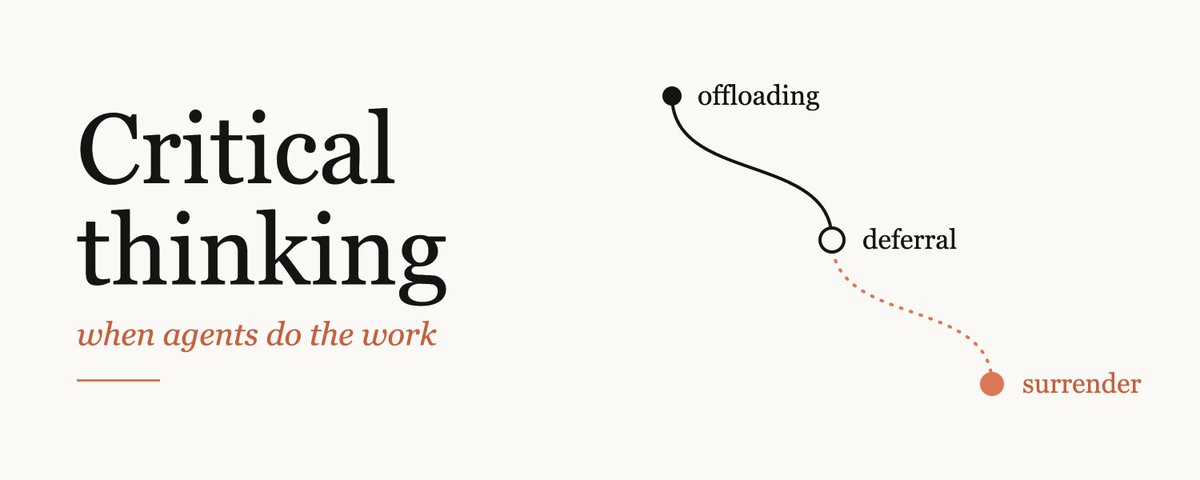
So this is what “alien intelligence” looks like - stuff where a tool us humans created does stuff us humans cannot understand anymore (but can verify)
Reminds me of neural networks where the layout made no sense to humans but it… worked in ways we couldn’t understand fully

We asked GPT-6 Astra to edit Qwen3.5-0.8B weights to improve math.
It directly changed only 0.016% of weights, fixing 0.8B's reasoning loops & improving math up to 6x and even instruction following 3x, without gradients or training.
We call this Weight-Space Programming: frontier LLMs can now natively read/write neural network weights! 🧵
Blog: rikiyat.github.io/blog/weigh…

Readers added context they thought people might want to know
LLM was given weights explicitly as text in prompt and used code/forward passes (per authors' logs) to ablate Qwen looping direction, a known thinking-mode issue per model card. Primarily fixed repetition in that mode, not general 'natively' improving weights/math.
rikiyat.github.io/blog/weight-sp…
github.com/RikiyaT/lm_und…
huggingface.co/Qwen/Qwen3.5-0…
huggingface.co/RikiyaT/Qwen3.…
Sergey S retweeted

Andrej Karpathy:
"Prompting is going away. Delete everything, keep Graph."
In just 69 minutes, he shows how to build graphs and why they're the only layer that survives in the end
Prompts → Agents → Loops → Graphs
a loop keeps one agent running until the job is done
a graph decides which agents exist and what each one passes to the next
anyone can build an agent, almost nobody builds the graph that runs them
watch it today, then save the full guide on graphs below before everyone starts catching up ↓


Sergey S retweeted
Give your agent a way to verify its work. This can dramatically improve the quality of output.
With this process in place, Claude Code was able to write 90%+ of its code itself. When generating software at a faster rate than you can review it, the bottleneck shifts to proving that it works. @bcherny and team invested enough in verification, we've been able to move fast while maintaining stability.
Code reviews aren't going away, but you need to think of it differently. One human reading through line-by-line is no longer going to work as a gate, it needs to evolve into a multi-layered verification system, built with fast deterministic feedback loops for your agents.
This is where e2e tests, feature maps (as @poteto has been advocating), property tests and multi-agent adversarial reviews come in. These all provide opportunities to catch errors early and fix them before things get out of hand.
You don't have enough eyeballs for the amount of code being written so your focus needs to be on product intent, risk assessment and evaluating evidence rather than reviewing code. Delegate the code checking work to your automated tests, scale your approvals based on risk, and turn your test failures into living evaluations. This approach helps maintain speed without losing reliability.
Let the agents do what they do best and let you focus on what makes you irreplaceable: judgement, direction, and ownership. We tried to capture how we handle code review and verification in this writeup. Hopefully it's helpful.

Claude writes about 90% of Claude Code's code.
From June to September, merged PRs more than doubled while the share reverted fell by more than 40%.
We wrote about how we changed code review to get there, and how to adopt it:
claude.dev/blog/solving-code…

Sergey S retweeted

Opus 5.5 + /anatomy skill is insane for motion animation
• Interactive isometric wireframes you can rotate, inspect and explore
• WebGL shaders for fire, water, plasma and more
• Real 3D motion, with individual parts that rotate
send to Claude:
skills.wheresryan.sh/anatomy


Sergey S retweeted

I've been working on a skill that makes better HTML plans in Claude Code.
It uses simple language, shows code snippets, surfaces questions & makes mockups. Linting reduces the normal failure cases that Claude runs into.
Would love your feedback before shipping more broadly!
Sergey S retweeted

One friend of mine makes $1.2 million a year as an Anthropic engineer.
I asked him how he learned prompting so well. He sent me a video that was never supposed to get out. Their core team's prompting playbook.
You won’t find anything better about prompting than this 30 minutes video.
I watched it last night. Halfway through, I realized I've been using Claude completely wrong for two years.
Watch it, then read the article below.


Sergey S retweeted

We're adding a new plugin to Claude Code: You should Know.
It scans Claude's output for important information you might miss to help keep you in the loop.
Enable it with:
/plugin enable cc-plugin-you-should-know@builtin
Sergey S retweeted

the amount of slop has been drastically reduced in my terminal since my agents use this skill to write in ASD-STE100: github.com/0xpili/simplified…


We'll be spending a lot more time trying to understand the outputs of language models. A few thoughts, tips & tricks:
Writing. Something I've had success with: Ask your LLM to explain something in ASD-STE100, it's a controlled language specification originally developed for aerospace maintenance documentation. LLMs well-versed in this language and it comes with heavy constraints on clean writing style that I often find a lot more readable. Sometimes I've tried to soften it a bit e.g. ask for "80% of the way to ASD-STE100" because the spec is quite stringent. But even better:
Diagrams / images. Instead of writing, ask your LLM to create a diagram. These can be a lot easier to process, parse, and understand. But even better:
Web pages. Ask for output "in HTML" to get a beautiful, interactive webpage. LLMs are getting really good at frontend and can create beautiful experiences, animations, etc. But even better:
Explainer videos. The output format I am most bullish on is fully custom / bespoke explainer videos generated on any arbitrary topic. Experiment with things like "Create a 3b1b style video explainer on X. Use my ElevenLabs API key for audio narration". (you'd need an API key for the latter or you can ask your LLM to find you decent free alternatives that use your local compute). This is actually starting to work!
In summary:
- As LLMs get better, they will do more and more of the legwork autonomously, and a lot more of our work will rise up the abstractions into oversight and understanding.
- Luckily, LLMs can help here too because as intelligence and code are increasingly abundant, you can ask for large, custom, discardable software artifacts (e.g. web apps, video explainers) that would have never made sense to create before. Push the boundaries here and you'll be surprised.

Sergey S retweeted
people who laugh and say karpathy's latest tips are outdated - i suspect the vast majority of them have not even tried the tips yet
i just tested the ASD-STE100 wording rule and it's surprisingly good at helping increase clarity of model response, even within html artifacts. but the trick is that the full ruleset is a bit too strict and you need to pick a subset
one prompt you can run super easily:
"randomly sample 10 session transcripts where i worked with you interactively within the past week. apply ASD-STE100 rules to assistant responses and analyze which rules would have increased clarity, reduced confusion and improved the conversations, then document those rules in my user level AGENTS.md"
you might be impressed!
We'll be spending a lot more time trying to understand the outputs of language models. A few thoughts, tips & tricks:
Writing. Something I've had success with: Ask your LLM to explain something in ASD-STE100, it's a controlled language specification originally developed for aerospace maintenance documentation. LLMs well-versed in this language and it comes with heavy constraints on clean writing style that I often find a lot more readable. Sometimes I've tried to soften it a bit e.g. ask for "80% of the way to ASD-STE100" because the spec is quite stringent. But even better:
Diagrams / images. Instead of writing, ask your LLM to create a diagram. These can be a lot easier to process, parse, and understand. But even better:
Web pages. Ask for output "in HTML" to get a beautiful, interactive webpage. LLMs are getting really good at frontend and can create beautiful experiences, animations, etc. But even better:
Explainer videos. The output format I am most bullish on is fully custom / bespoke explainer videos generated on any arbitrary topic. Experiment with things like "Create a 3b1b style video explainer on X. Use my ElevenLabs API key for audio narration". (you'd need an API key for the latter or you can ask your LLM to find you decent free alternatives that use your local compute). This is actually starting to work!
In summary:
- As LLMs get better, they will do more and more of the legwork autonomously, and a lot more of our work will rise up the abstractions into oversight and understanding.
- Luckily, LLMs can help here too because as intelligence and code are increasingly abundant, you can ask for large, custom, discardable software artifacts (e.g. web apps, video explainers) that would have never made sense to create before. Push the boundaries here and you'll be surprised.
Sergey S retweeted

SpaceXAI engineer, Lauren Tan:
"I shipped 1000 PRs last month. I'm at almost 800 already this month and we're on the 12th
I woke up today and 20 had already landed. I reviewed them on main, after the fact"
In a 1-hour session she walks the exact trust curve, from micromanaging one agent to auto-merging thousands of PRs a month
this is worth more than any $500 agentic engineering course
watch it today, then read how to build the same agent fleet in the article below ↓


Sergey S retweeted

Introducing /visual-edit - a skill to visually edit your local code like a Figma canvas
- works with any agent or model
- Figma-grade visual editing on your local apps
- apply visual updates through your coding agent
- multiplayer and collaborative
- 100% free and open source
Sergey S retweeted

Matt Pocock (TypeScript wizard, ex-Vercel):
"Opus 5 got addicted to writing tests that just repeat the code back to itself."
in a 22-min talk at AI Engineer Paris, Matt walks through how to stop AI PRs from turning your repo into a slop cannon:
5:30 → the tests AI writes that pass forever and catch nothing
8:31 → deep modules: how codebase design makes those tests impossible
11:41 → why coding standards belong in a separate review agent, not your implementer
15:34 → your AI reviewer shouldn't comment. it should commit the fixes
17:20 → one-way vs two-way doors: which PRs a human actually needs to review
20:38 → retro skill: turn every review comment into a check so you never write it twice
how to build agents that learn by watching you work – pinned article↓


Sergey S retweeted

here's how i shipped 2,500 PRs last month to production
this was originally supposed to be for Cursor Compile in London. i couldn't make it since i was livestreaming for Grok @Bot Galaxy so i'm making it available for free here on X! watch it on 2x speed, i talk slowly
Sergey S retweeted
finally found time to make a new video! youtu.be/MSbacZ99E14
this time i'm sharing a slightly more advanced agentic engineering session, focused on high throughput multi-tasking
hope you find helpful!
Sergey S retweeted

Anthropic engineer:
"99% of people use Claude Code like Google, and only 1% are running swarms of self-learning Claude agents
I'm running 100+ agents in a loop. I have Chief agent, PM agents - they manage the whole team"
in a 30-minute workshop, an Anthropic engineer revealed how to get max value from Claude Code at min. cost
this is worth more than another $500 vibe-coding course
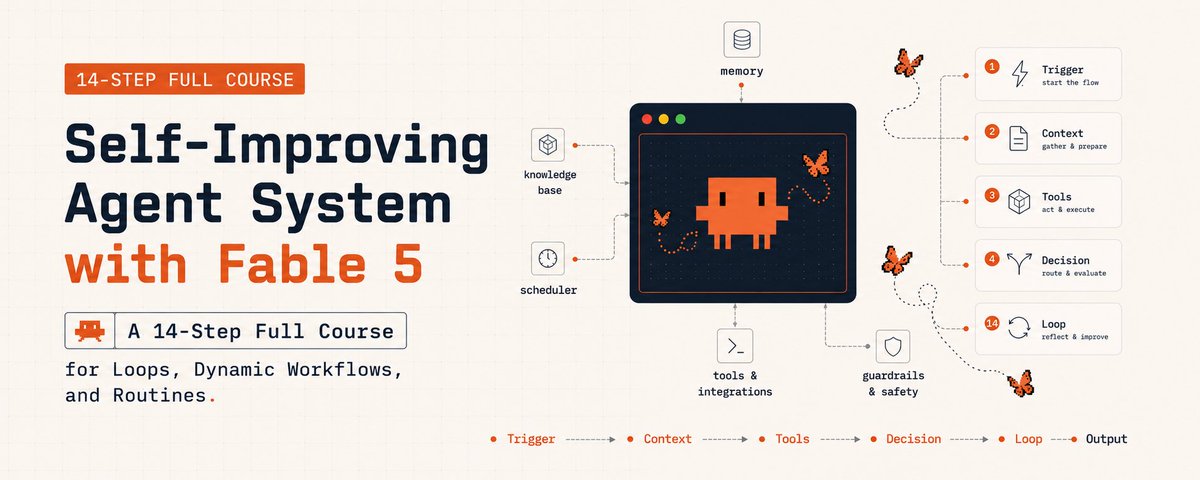
watch today, then read how to build self-improving agentic systems with Fable in the article below