surendra upadhyay retweeted

Happenstance is "if LinkedIn and Claude and ChatGPT had a baby." - @rubenhassid
How Ruben finds the warm path to exactly who he needs across 800,000+ people in his network:
surendra upadhyay retweeted

$10M in credits for anyone running a company alone or with a tiny team.
Frevana is backing one-person companies and teams of up to 5.
What you get:
• 6 months of their Professional plan free (normally $299/mo)
• 1,000 credits every month to build with
• Office hours with their team
• Access to the founder community
What it covers:
• Building your Shopify store
• Product photos and AI product videos
• Ads, organic social and AEO/SEO content
• Built on OpenAI, Anthropic, Gemini, Kling and Seedance
You don't need:
• A big team
• An existing customer base
• An agency budget
The condition: tell them what you're building and your 6-month goal.
One person can now build the product, tell the story and make the first sale.
Bookmark it and send it to the solo founder doing everything themselves.
Apply here: frevana.com/programs/opc

surendra upadhyay retweeted

YC takes 7% for $125k.
Dubai takes 0% for $150k.
All you have to build is an AI agent. No age limit, no location limit, and an idea is enough to start...
Dubai's Crown Prince launched the Create AI Agents Championship on Oct 7:
- AED 2.5M+ (~$680k) in total prizes
- $150k grant to each of the 4 category winners
- Free workshops, a Digital Academy and mentorship while you build
Who can enter:
- Solo or teams of up to 6
- Idea, prototype or early MVP (nothing already sold commercially)
- Non-technical founders welcome
- Free to apply, and you can submit more than one agent
- No trade licence needed to enter (winners set up a Dubai company to receive the grant)
Registration closes in December, while submissions are due in January.
24 semi-finalists. 12 finalists. One live final in Dubai, first week of May 2027.
Its predecessor, Create Apps, pulled 15,564 apps from 153 countries since 2023.
Apply: dubaichamberdigital.com/en/c…
Follow @arorabhavyam for more content around founder programs, investors and AI! 🫡

surendra upadhyay retweeted

OPPORTUNITY‼️: $100K for your startup. No equity, no SAFE, no board seat.
@dottechdomains just launched a $1M No Excuses Fund for builders from day zero to pre-Series A.
What you get:
- grants of $10K, $50K or $100K
- any stage can get $100K
- no deck, working builds only
- bootstrapped / seed-funded teams
- cloud, AI and dev tool credits
- mentorship and support
Who can apply:
- 18 or older, in eligible locations
- working build, day 0 to pre-Series A
- work you own outright
The catch: your product has to run live on a .tech domain. Redirect doesn't count.
Submissions close Dec 15 👉
noexcuses.get.tech/

surendra upadhyay retweeted

Excited to share I’ve joined @OpenAI’s Startups team!
If you’re a founder, say hi 👋 I’d love to hear what you’re working on.
If you're a VC, would love to hear from you too. Reach out.


surendra upadhyay retweeted

Get started with our docs:
platform.claude.com/docs/en/…

surendra upadhyay retweeted

frontier oss model for knowledge work 60x cheaper

We are releasing Ultramarine 1 Flash, a frontier-class model built for knowledge work. It is open-source and achieves similar performance to Fable 5, while being 60x cheaper.
It was post-trained by a team of 5 for ~$300k all-in. Available on API now, with weights releasing in 2 weeks.
surendra upadhyay retweeted

It was nice to collaborate with the Anthropic team on this!
Observability is incredibly important for agents. Not just to understand if they are reliable, or even working, but to learn from their behavior and build better and safer products.

surendra upadhyay retweeted
Eligible Claude Enterprise orgs can claim at least $10,000 in Code Review credits by Jan 15. Credits expire 30 days after you claim them.
Terms: support.claude.com/en/articl…

surendra upadhyay retweeted

Open source meets type-safe AI, with TypeLLM.
Chat models give you a reply and decision models give you a choice, but TypeLLM is built to run your whole workflow in one API call.
Most production pipelines need something in between: several typed answers, some depending on others, a few that should exist only under certain conditions.
TypeLLM takes that whole shape as one JSON Schema and executes it as a dependency graph over a single shared context.
Typed LLM outputs, built in the open.
You can get schema-guaranteed outputs from a stock Qwen checkpoint without touching its weights.
The guarantee comes from how the requests are built and decoded.
TypeLLM sits on SGLang and turns a JSON Schema into constrained decoding: one scored token for an enum or boolean, bounded digits for numbers, and a dependency graph that reuses cached prefixes.
So a field can’t return a value outside its enum, because the decoder only considers the allowed candidates.
🤝 Paid partnership


Chat models return messages.
Decision models return decisions.
Workflow models execute workflows.
TypeLLM introduces the first workflow model. Run an entire workflow in a single API call.
Simpler, faster, cheaper.
Try it now: typellm.ai/examples/ticket-w…
surendra upadhyay retweeted

Muse Spark Open is now on Ollama.
@Meta's open-weight model for coding and tool use, with a 1M-token context window.
Run it on Ollama’s cloud:
ollama run muse-spark-open:cloud
Use with Claude Code:
ollama launch claude muse-spark-open:cloud
Now available to Max and Teams users, and rolling out to Pro users soon!
surendra upadhyay retweeted
Opus 5.5 fast mode in the Claude Platform is no longer in research preview, and we’ve removed the waitlist!
It’s the same Opus 5.5 but up to 2.5x faster, at $8 / $40 per million tokens.
It's also available in Microsoft Foundry (Hosted on Azure), with Google Cloud coming soon.
Fast mode in Claude Code remains unchanged, and uses extra usage credits.
See our docs here:
platform.claude.com/docs/en/…
xitter.cf/ClaudeDevs/status/2054…

surendra upadhyay retweeted

I spent 48 hours in SF hanging out with billionaires, data labs and AI founders and execs running $1B to $100B companies.
My observations:
1. Sooo MANY stories of data brokers making like $2M a WEEK selling company data to labs. I can't tell if it's the beginning or a bubble, and I kept wondering which niches are left. Digging into it actively.
2. At dinner, someone asked the table, "If a new model drops next month, does your company get better or worse?" HALF the table went quiet! I think that's the best question to ask about any AI startup right now.
3. The bar people talk about now is hitting $1B in revenue in 12 months (I guess that's the new unicorn?). What I didn't hear much about is retention. AI revenue can come in fast and leave fast, and I think we're going to see a lot of stories of AI companies with huge revenue and terrible retention.
4. It's pretty clear we're living through the reinvention of the computer. The model is the CPU, the harness is the operating system, and skills and plugins are the apps. Thinking about it that way makes it easier to see where the whitespace is.
5. We're maybe 12 months from an agent that can watch you work for a week and then do your job without any instructions. The screen recording plus agent memory plus local model combination makes this possible right now.
6. Agent harnesses feel like the new GPT wrappers, in a good way, especially vertical ones. The best teams I talked to treat the model as swappable. One founder walked me through routing different models to different jobs: one for taste and visuals, a cheaper one for the everyday stuff, another for text.
They use prompts they can move across models over fine-tuning, and A/B test the output on what users actually do with it: do they edit it, export it, share it? A vertical harness is basically four things: the connectors for that industry's data, evals written by people who know the work, rules for what the agent can and can't touch, and a clean screen for a human to review. The model is maybe 20% of it.
7. There's a lot of reverse engineering going on/cloning going on more than I've ever seen. People are decompiling software and rebuilding it with agents, and someone showed a suite of like 10 apps that are worth $5B+ each all that he cloned open source. Me and everyone are still thinking through what it means when software gets this easy to copy.
8. My guess is the value moves to data. If the software can be rebuilt quickly, what's worth paying for in a legacy SaaS company is the years of customer data and workflows inside it. Some SaaS companies are secretly data companies.
Gets me thinking about how do you truly value data for this saas companies? Like if we were buying these dying saas companies at 2x ARR before (as example), maybe there is a better metric. Idk, just thinking out loud here.
9. It feels like a good chunk of legacy software won't make it to the agentic era, especially anything built around people clicking through a lot of screens.
10. Every company I talked to wants to pipe its internal data into one place and expose it to agents through MCP. Then they look at the data and realize it's a mess: five versions of the same customer, old Slack channels, PDFs nobody can search. Cleaning that up feels like a big consulting opportunity!
11. A lot of founders are building the basic building blocks for agents: APIs, data layers and tools. Some of the companies I saw barely have a UI because the main user is an agent. I really believe the startups that build primitives to this agentic era will do extremely well. Building blocks is the best way to think about it.
12. Labs can get plenty of training data, but it's harder to get real examples of agents failing inside companies. Whoever has those logs has something valuable.
13. Someone running a big consumer company told me the next fight is over memory. The model that remembers the most about you wins, and the smartest model matters less than people think.
14. Physical AI came up a lot. Astra I think was the first model that got people into AI can actually do CAD, and I think a lot of people are thinking what does vibe manufacturing really look like. The line I keep thinking about came from a robotics founder: the hardest problems in AI are deployment problems now, not research problems. Their robots work on their own, call a human when they get stuck, and every one of those calls becomes training data.
15. Cybersecurity companies are having a moment and are actually cool companies to build now, especially the ones that clean up after a breach. Every agent with access to your systems is a new door into your company, and a lot of those doors were left open.
16. Some startups are worth more dead than alive now. A shutdown company with 5 years of Slack, email and code can get paid for licensing all of it. I wouldn't be surprised if founders start factoring that into when they shut down.
17. People are starting to talk about monetizing the agent web. It feels really early, but when the most popular user of the internet is an agent, what startups should you be building?
18. I think agent insurance is coming. Once an agent makes an expensive mistake, insurers will want audits before they cover anyone.
19. Several people said the hire they want most is someone with taste who can write evals. The models are getting good at generating ideas, so the hard part is judging which ones are good.
20. New trend I observed: startup raises VC, uses venture dollars to become a creator, startup fails, founder falls back on being a full-time creator and incubates other products bootstrapped.
21. Getting SIGNIFICANT distribution is HARD right now. Founders are sponsoring buses, buying billboards like crazy and throwing parties with famous DJs to get noticed. Kinda feels dotcom era in that sense.
Attention is what's scarce! The growth guy going viral sharing his UGC strategy from Wispr Flow is a good example. It's the sauce everyone wants, and I truly believe there are probably only 50 people on the planet who know how to scale these types of businesses efficiently in this era.
Always good to get that dose of SF. I felt sooo lucky to have such an incredible trip during such an incredible time in building businesses. Surreal in so many ways.
Happy to be home and locked in.
Until next time!


surendra upadhyay retweeted
Anthropic will pay you $3,850 a week to do AI research with their team.
You don't need prior experience to apply.
The Anthropic Fellows Program:
• $3,850/week (about $66K over 4 months)
• About $15K/month in compute, paid for
• Mentored by Anthropic researchers
• 4 months full-time, with a chance to extend
• The goal is a real public output, like a published paper
Their words: "regardless of previous experience."
The deadline for the January cohort is Oct 18. That's 6 days away.
Most people will see this after it closes.
Bookmark it and send it to the smartest person you know.
Link below 👇
alignment.anthropic.com/2025…

surendra upadhyay retweeted

New on our Engineering blog: Creating in-house source control.
In May, we merged around 2,500 code changes per day. In September, we merged more than 30,000 per day. As a result, we became bottlenecked by developer infrastructure built for human (rather than agent) scale.
Here, we share how we built a new version control system—and fully migrated our monorepo from git—in five months: anthropic.com/engineering/re…

surendra upadhyay retweeted

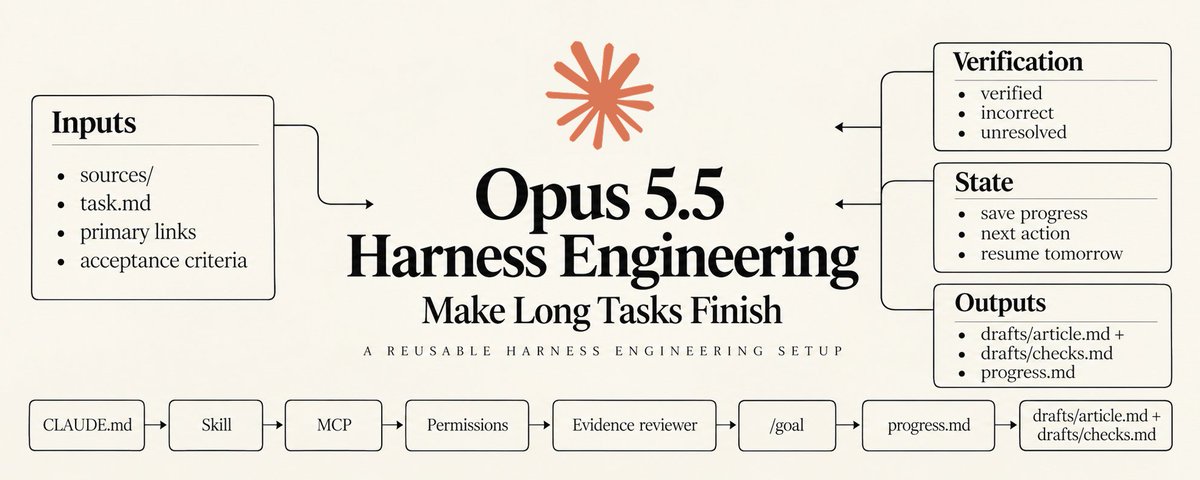
Everyone's arguing about wrappers vs. harnesses. Here's my line:
A wrapper puts a UI on someone else's model. When the model ships that feature itself, the wrapper is dead.
A harness owns what the model can't: the tools, the context, the memory, the workflow. A better model makes it better too.
Simple test: does the next model release help you or kill you?
Which one are you building?
surendra upadhyay retweeted

Anthropic engineer:
“85% of our engineers are using self-improving harnesses. Now everyone is building agentic systems around them.”
In 1–2 months, we’ll all be building harnesses to orchestrate self-improving agents. No more raw prompting.
In a 30-minute lecture, Anthropic engineer shows how to build a self-improving agent harness from scratch with Opus 5.5.
Worth more than a $600 agentic course.
Watch this video, then read the article below on how to become a harness engineer.

surendra upadhyay retweeted

ANTHROPIC JUST DROPPED THE BEST 1-HOUR AI AGENT CRASH COURSE THAT YOU’LL FIND
It covers:
- building /skills, /loops, and graphs
- agent dreaming & orchestration
- reverse engineering with Claude agents
surendra upadhyay retweeted

Anthropic engineers just released the best 1-hour course on building agents with Opus 5.5:
“Opus 5.5 is the best model for building agentic systems and reverse engineering with it.”
• 00:00 - introduction to Claude Managed Agents
• 07:45 - building Opus 5.5 Brain + architecture
• 23:40 - building /skills, /loops, and memory graphs
• 54:00 - agent dreaming & orchestration by Opus 5.5
• 1:10:23 - reverse engineering with Claude agents
this 1-hour watch will replace a $500 agentic engineering course.
watch it today, then explore how to reverse engineer anything with Opus 5.5 in the article below.