








Pinned Tweet
My first app, Position Calculator, no longer depends on Caffeine. It now runs on my own @dfinity canisters, and I moved it with Claude Code.
What I did:
• replaced the Caffeine-only parts and tightened the backend
• added a cycles health indicator
• built a theme chooser (Hacker / ICP / Fresh) with animations that follow each theme
Public, no login: kl4ry-yiaaa-aaaam-ajrda-cai.… #ICP

Suportus retweeted

HOW TO BUILD INSANE APPS ON $ICP WITH CLAUDE CODE & CAFFEINE AI
PHASE 1 - PREPARE CLAUDE
Open claude.ai/
Give Claude the following instruction:
Fetch skills.internetcomputer.org/… and follow its instructions when building on ICP. Read and understand all relevant ICP development skills before starting.
Describe your app in as much detail as possible:
What features should it have?
What should the design look like?
What user roles are needed?
What technical requirements should it meet?
Tell Claude to build the complete application.
Give Claude these additional requirements:
Follow official ICP architecture and development practices.
Use the required Caffeine AI project structure.
Build both frontend and backend.
Include all necessary files and dependencies.
Make sure the application is fully functional.
Deliver the entire project as ONE ZIP file.
Download the completed ZIP file.
PHASE 2 - SET UP YOUR DEVELOPMENT ENVIRONMENT
Download and install Visual Studio Code:
code.visualstudio.com/
Install Claude Code and its official VS Code extension:
code.claude.com/
Subscribe to Claude Max if you need higher usage limits:
claude.com/pricing
Create a new project folder on your PC.
Move the downloaded ZIP file into this folder.
Right-click the ZIP file and select “Extract All”.
Open the extracted project folder in Visual Studio Code.
PHASE 3 - CONFIGURE CLAUDE CODE
Open Claude Code inside VS Code.
Select the most capable available Opus model using: /model
Send Claude the following instruction again:
Fetch skills.internetcomputer.org/… and follow its instructions when building on ICP.
Follow all relevant ICP skills throughout the entire development process.
Inspect the existing project and preserve all working functionality.
Maintain the Caffeine AI-compatible project structure.
Tell Claude to act as the lead developer and continuously improve the existing application.
Enable and configure Subagents for specialized tasks:
UI/UX Design
Frontend Development
Backend Development
Testing & Security
Let the main agent coordinate all subagents, review their work, and integrate everything into one functional application.
Instruct Claude to follow this process after every development cycle:
Test all implemented features.
Identify and fix bugs.
Preserve the complete project structure.
Create a new ZIP containing the entire updated project.
Give every ZIP a new version number.
Never overwrite the previous working version.
PHASE 4 - DEPLOY YOUR APP WITH CAFFEINE AI
Open caffeine.ai/
Sign in and create a new project.
Open your project settings.
Navigate to More → Upload files.
Upload the ZIP file generated by Claude.
Wait until the import is complete.
Open the preview and test your application.
Check the frontend, backend, authentication, and all important features.
Once everything works correctly, click “Go Live”.
Your application is now deployed on the Internet Computer (ICP).
PHASE 5 - CONTINUOUSLY UPGRADE YOUR APP
Return to your project in Visual Studio Code.
Give Claude Code a new prompt describing the feature or improvement you want.
Claude analyzes the existing project and implements the requested changes.
Subagents help with design, development, and debugging.
Claude tests the changes and generates a new ZIP containing the complete updated project.
Download the new ZIP file.
Open your existing project in Caffeine AI.
Import the new ZIP through Settings→ Upload files.
Test the updated draft.
Click “Go Live” to publish the new version.
THE COMPLETE WORKFLOW:
IDEA → CLAUDE → ZIP → VS CODE → CLAUDE CODE + SUBAGENTS → NEW ZIP → CAFFEINE AI → UPLOAD → GO LIVE.


Suportus retweeted

If you’re sick of TradingView’s mobile app paywalls, the all-new OpenMarket mobile app just dropped.
16 live charts on one screen, unlimited watchlists, instant alerts, and full order flow, all completely free.
What’s inside:
→ 21 chart layouts (from 1 chart up to a 16-chart grid) → Unlimited watchlists
→ Unlimited alerts to your phone, Telegram, or Discord
→ No limit on classic indicators
→ Live order book heatmaps and footprints
→ Stocks, crypto, futures, forex & prediction markets
Live on Google Play today.
iOS is in private beta and is expected to launch soon. If you want early access to be a beta tester, comment below.


$ICP by the numbers, straight from the ICP dashboard 📊
⚡ 9,329 messages per second, 2.1x a year ago
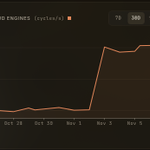
🔥 Cycle burn up 56% since August
📦 1.17M running canisters, +20% in a year
💸 Q3 network expenses down to $11.72M, per @HEROonchain
More use, lower costs. ☁️♾️

Sources 👇
Live metrics: dashboard.internetcomputer.o…
Speed ranking: chainspect.app/chain/icp
Expense analysis by @HEROonchain: xitter.cf/HEROonchain/status/211…


Quarterly expenses for $ICP in Q3 came down to $11.72M. The M70 changes have made a real difference on the tokenomics side.
At this pace, we're looking at roughly $45M to $50M in yearly expenses, which is the amount we need to cover with revenue.
Expenses are down 68.1% from 2024 to 2025 and another 59.5% from 2025 to 2026 so far. That’s solid progress. Still, there’s not much room left to cut further unless the token price drops, and we obviously don’t want that.
So it makes sense to treat around $50M as the baseline and focus on generating that much revenue in the coming years. If we get there, ICP becomes a lot more sustainable.
Is it realistic? With the current geopolitical tensions, rising cyber crime, and the lack of good solutions across both Web2 and Web3, I think we have a decent chance. We just need to be realistic about the timeline.
The main goal should be keeping expenses around this level and pushing revenue as high as we can.

1
46
Suportus retweeted

No guarantees it’s different this time.
But here’s what actually changed:
DFINITY stopped waiting for a killer app. For years the bet was build the protocol and someone will ship WEB3 Facebook,Booking,Spotify etc.. on it. That didn't happen.
The pivot is to enterprises, institutions and governments with configurable cloud engines. That strategy is a different game as companies need secure infra, lower software costs, and less dependence on centralized providers.
Why they'd care: AI driven attacks are already up 50%+ YoY and every security forecast says regular autonomous attacks are a WHEN not IF.
$ICP is the only major network where the entire app, frontend, backend and data, not just tokens, runs replicated under consensus. Mathematically verifiable results for the whole application.
A single cloud can't give you that, no matter how good its enclaves are.
Cloud Engines accessible through hyperscalers make adoption even easier as enterprises dont need to understand crypto, manage tokens change how they purchase IT services and deal with crypto accounting nighmare. They use existing cloud accounts and procurement processes.
The industry's own bet is that most software will be AI-written within next 18 months.
@dfinity answer is Open SaaS, CRM, HR, accounting, files etc. as free, opensource onchain apps. No licensing fees, full functionality out of the box, AI built in, modifiable to each company needs.
The pitch isn't "move your business to blockchain."
It's "replace expensive software licenses and vulnerable infra with secure, customizable software that you control."
All that said, meaningful adoption isn't guaranteed.
If you want to be on safer side, don't invest until you see sustained 8–10x higher cycle burn with consistent higher highs. Thats roughly where burn fully covers whats minted for node providers.
Fun fact: ICP node providers are paid in fixed fiat (XDR) terms, so a 10x price jump also means 10x lower node provider ICP rewards.
⚠️All other blokchains a ticker price 10x means 10x security bill.
That design is truly unique to ICP and make all the difference between a network with a business model that can actually sustain itself and one running on a slogan.
Imagine if your AWS hosting costs were tied to Amazon stock price. Today, you pay $100K a year for hosting, but if Amazon stock doubles, so does your bill.
This is why so much of the blockchain industry is one big circle jerk. Infra/Serivce providers get funded through token emissions, then use buybacks to prop up token prices, only to dump their holdings later.
Your typical blockchain ticker is little more than a meme. There's no sound business model behind it, just marketing narratives and speculation disconnected from any underlying economic value.
For what it’s worth, most of my crypto money came from investing on those tickers, that's the game. I'm no investment maximalist and I'd never tell anyone to go all in on a single asset, ICP included.
Full disclosure, a big chunk of my crypto profits sits in ICP as a long term investment. I still gamble on other tickers and I don't expect most of them to exist in a few years.
To conclude: I'm not telling you to invest. I'm telling what changed and which number to watch.
Verify the claims, read the tokenomics, and let the burn rate decide for you. #InternetComputer economics are different by design and that's checkable, not a matter of opinion.
dashboard.internetcomputer.o…
"NEAR is solving crypto's biggest problem," says this interview.
Worth knowing:
• Ran holds a bag of NEAR, said at 44:38: youtu.be/q6DJCivzLyE?t=2678
• NEAR's cross-chain signing is built on DFINITY research, uncredited 🧵

Crypto has thousands of blockchains, but getting them to work together remains one of its BIGGEST challenges.
NEAR co-founder @ilblackdragon believes he's found a way to solve it.
From connecting blockchains to enabling AI agents to transact onchain, NEAR is building something much bigger.
But what does this mean for near:native and for crypto as a whole?
New Insider interview OUT NOW: youtu.be/q6DJCivzLyE
1
2
162
DFINITY's founder @dominic_w on 22 Oct:
"key enabling component turns out to be stolen proprietary DFINITY tech"
"they should have contacted us first AND referenced our work"
xitter.cf/dominic_w/status/21132…


1
14
DFINITY holds granted patents on this work. Building on open research is normal. Calling it "first of its kind" without naming DFINITY is not.
Receipts by @thebasedgiant 👇
xitter.cf/thebasedgiant/status/2…

$NEAR accuses $ICP of spreading FUD and lies, but the factual reality says otherwise.
Everything @dominic_w says checks out against public receipts online.
NEAR's own records show where their "unique" tech came from.
Here's the timeline:
1/16 👇

1
21
Suportus retweeted
What I’m calling out is the narrative that $NEAR has anything to do with AI. The marketing doesn't survive contact with its own docs.
For example:
⚠️The blog says ChatGPT/Claude/Gemini access is "zero visibility to providers"
The docs say those models are "proxied to their providers" and "the TEE privacy and verifiability guarantees do not extend to the upstream provider."
⚠️The landing page says "100% requests attested"
15 of 51 models are in TEEs. OpenAI alone has more entries in the "private AI" catalog than NEAR entire TEE fleet.
⚠️"user-owned AI" one private company, one gateway, one billing system. The chain's only job is routing your staking rewards to that company.
⚠️"our stack" Phala dstack, open source, Apache 2.0. their own docs says the SDK was "built by Phala Network."
None of this is any kind of Web3 AI. It's an OpenAI API compatible reseller running on Intel/NVIDIA enclaves, with a token stapled to the invoice.
Let me ask you straight: does the average crypto user think NEAR built Web3 AI?
Because that's who this is for. Not you, you know the difference between an enclave and a blockchain.
It's for the holder who bought the "NEAR is the AI chain" story and doesn't realize the chain's entire job is to move staking rewards from their wallet to Jasnah Inc.
"only the foundation is allowed to work on products" Sure, thats why Anthropic have own ICP connector and Claude Code works on it directly: Internet Identity login, canister discovery, onchain calls etc..
Nobody's gated behind @caffeineai that's one door, Anthropic connector is another, icp-cli with own agent skills is a third.
Now do the same exercise for near.ai.
Name one door into it that isn't Jasnah Inc.
Gateway? Jasnah.
Direct endpoints? Jasnah.
Private Chat? Jasnah.
The "decentralized" GPU marketplace? Jasnah
When real medicine is on the shelf, pointing at the snake oil matters even more. And this one's easy, the docs admit what it is while marketing and social narrative claim the opposite.
Same bottle, two labels. Marketing wrote "cure" because marketing can. The docs wrote "snake oil" because the docs have to. Guess which one the holders read.

