

Beautiful Earth
Joined April 2011
- Tweets10.7K
- Following1.2K
- Followers1.2K
- Likes24.2K




Explaining the threshold logic for limit orders on @Fairgroundfi
On Fairground a limit order does not set a traditional limit price. It sets an *execution price threshold* - the worst oracle price you will accept.
The fill is still always at the current oracle price. The threshold only decides whether the order is allowed to fill.
- Long (buy): the order fills only while the oracle is *at or below* your threshold.
- Short (sell): the order fills only while the oracle is *at or above* your threshold.
It does not fill the moment you place it if the condition is not met. It rests until a matching cycle runs where the oracle is inside the threshold. Matching itself only starts when a standard order is placed or a matching transaction is sent. No-rush orders do not trigger it.
Example:
- You want to buy BTC and set a threshold of 95,000.
- Oracle is 96,000 → order sits.
- Next matching cycle the oracle is 94,800 → the order can fill at 94,800 (the oracle, not your 95,000).
If the market is closed (FX or commodities outside underlying hours), the order does not fill even if the threshold would otherwise be met. The price can also gap between close and reopen.
So the threshold is a gate, not the execution price. The oracle is the price. The threshold is only the condition that lets the fill happen.

One price, No mark, No index with @Fairgroundfi
Most perps make you juggle two prices. A mark for liquidations and PnL, an index for funding and the spot reference. Fairground throws that out.
There is one oracle price per market. It is the fill price, the PnL price, the margin price, the liquidation price, and the fee price. No separate mark. No funding rate to manage while you hold.
Every order fills at the oracle price read at the start of its matching cycle. All orders in the same cycle get that same price. The app shows the latest reading, but your fill is the price at the moment matching actually runs. If the price moves between the screen and the cycle, you get the new one.
Limit orders only fill while the oracle is inside their threshold, longs at or below, shorts at or above. Matching runs when a standard order is placed or a matching transaction is sent. Orders do not fill while a market is closed. FX and commodities follow the underlying hours, so the price can gap between close and reopen.
Execution cost is not hidden in the fill. Market and limit orders pay an impact fee (0–5 bps) based on what the same size would cost on major external venues. The fill stays at the oracle; the cost is a separate line. No-rush orders receive that fee instead of paying it.
Bad prices are treated as a halt, not a trade. If a market’s price goes stale past its limit, the market becomes untradeable until a fresh update. A spike that jumps more than a set distance in one update is not published and trading stops (limits vary by market and time of day; this is rolling out before mainnet). A reference cross check compares the primary feed against an independent one. Large moves need a separate hardware-backed signing key so a stolen standard key cannot push an extreme fake price.
The trade off is explicit: a short pause is better than fills or liquidations at a price the real market never saw.
Docs: docs.fairground.fi/trading/p…
@Fairgroundfi is still in testnet. Safeguards are still rolling out before mainnet.


A quick walkthrough video of the @TxFlow_L1 DEX: tab by tab.
Sections covered:
1. Perp/Spot/Prediction trade page: Chart, order book, leverage, Long/Short, estimated liq price & fees, etc
2. Order entry close-up: Margin mode, leverage slider, size, TP/SL, fees
3. Portfolio: Passed to maintain sensitive data
4. Vaults: Protocol Vault (deposit USDC, 100% returns to depositors, lock period)
5. Points: Weekly pool, your points, referral points
6. Referrals: Referral program
7. Rewards Hub: Current and past reward options
8. Explorer and App download
Everything settles on-chain. No VC. Shared liquidity.
On-chain CLOB with price-time priority matching means every order is settled on the L1 - no off-chain matching engine, no hidden book.
Shared liquidity layer (TIP) lets the same capital back Perps, Spot, Prediction Markets, and Vaults without bridging or wrapping.
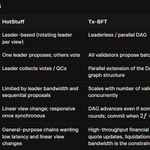
Tx-BFT runs a leaderless DAG so blocks propose in parallel and finalize in ~200ms with irreversible finality once 2f+1 is reached.
Cross or Isolated margin is enforced on-chain with tiered maintenance margins and a clear liquidation flow instead of opaque off-chain risk checks.
Protocol Vault acts as the backstop LP with a 4-day lock and 0% performance fee, so liquidity stays native and visible instead of being rented from external market makers.
@TxFlow_L1 @kaisrr3a
Fairground is still in testnet on Arbitrum Sepolia, and Season 4 is the last window before mainnet. Getting in is simple if you already have access, and referral-only if you do not.
Onboarding is easy:
Returning traders of @Fairgroundfi : connect the same wallet you registered in a previous season. You qualify if you held or filled at least one order back then. New wallets need a referral link from an eligible participant. Each of those participants can invite up to two people. Newly referred traders cannot invite anyone else.
Three steps once you have access:
1. Connect a wallet. Any EVM wallet works: MetaMask, Rabby, WalletConnect, Coinbase Wallet, etc. Or sign up with email, Google, X, Telegram, or Discord and Privy creates an embedded wallet for you. The public address is under the wallet dropdown → copy icon in the Privy pane.
2. Switch to Arbitrum Sepolia. If your wallet does not have it, add:
Name: Arbitrum Sepolia
RPC: sepolia-rollup.arbitrum.io/r…
Chain ID: 421614
Currency: ETH
Explorer: https://sepolia.arbiscan.ioYou can also add it from the footer on sepolia.arbiscan.io.
3. Funds arrive automatically. Enough test ETH for gas and test USDC for collateral. No need to bring your own money.
The daily drip is 2,000 Testnet USDC at 16:00 UTC during the season. Balances stack.
The token is 0x4E1156749dd156D06dCE5baC0f8f5A43792C9EDb.
It cannot be withdrawn or transferred and has no real value. A small amount of test ETH covers gas.
If you came through a referral and got selected, you will get an email from access@fairground.fi with the rest of the instructions. If you think you are eligible but never received the daily USDC, open a Discord ticket and include your registered Fairground wallet address.
Participation asks for an email and wallet address (social handles optional). Wallet age and on-chain activity can be reviewed. User data is kept up to 12 months then deleted.
Once you are in to @Fairgroundfi , the design is thin: one oracle price, fees only when a position changes, no funding rate, and No-rush orders if you want to supply residual liquidity. Season 4 ends November 9 at 16:00 UTC.
If you need a referral, they are limited. Please check X or ask for one in discord. NFA, testnet only for now.
"TxFlow Creator Contest: make a video, top three take home 100U / 50U / 30U + the Creator role."
Entries close November 10, 2026 at 4:00 AM (six days left). Prize is 100U / 50U / 30U for the top three, plus the Creator role if you don’t already have it.
How to enter:
- Post your video on X and tag @TxFlow_L1
- Drop the link in the TxFlow Creator Contest channel
Everything you need is in the docs (docs.txflow.com) or just ask the team. Entries are judged on quality, entertainment value, clarity, depth of research, and authenticity. Substance matters more than production.
Eligibility notes: not open to Restricted Person / Restricted Territory under the Terms of Use. TxFlow has sole discretion to disqualify any participant from participation and/or rewards. Terms and Conditions apply. Winners announced shortly after entries close, with instructions.
If you’ve been trading the on-chain CLOB, digging into the margin engine, or testing the shared liquidity across Channels, this is a clean way to show the work and get paid for it. Six days left. Make the video.
@kaisrr3a @TxFlow_L1
Appreciate if you could use my referral, it gives you 5% off perp, spot fees, and a $50 bonus trading fee credit
Referral Link: app.txflow.com/r/TXSHADOWSP Referral code: TXSHADOWSP

Arbital just rolled out support for TxFlow, so you can now deploy and manage automated strategies on @TxFlow_L1 perps straight from their terminal instead of handling everything manually on the native interface.
TxFlow’s been putting up real volume lately with that fully on-chain order book setup, and the main friction for a lot of people has been the lack of solid external tooling for running strategies without constantly babysitting orders. This makes it easier to treat it more like the other venues people already use for systematic stuff, market making, simple mean reversion, inventory management, whatever, while still trading on TxFlow itself.
Not sure how deep the integration goes yet on the execution side (latency, order types, etc.), but having a YC-backed terminal plug in is a clear step up from pure Discord access code + web UI. More builders getting involved usually means more volume and tighter books over time if the infra holds up.
Congratulations!
Appreciate if you could use my referral, it gives you 5% off perp, spot fees, and a $50 bonus trading fee credit
Referral Link: app.txflow.com/r/TXSHADOWSP Referral code: TXSHADOWSP
@arbital_xyz @TxFlow_L1 @kaisrr3a


Brief on market design of Fairground👇
@Fairgroundfi uses isolated margin only. Each position has its own margin. A liquidation on one market does not touch your other positions.
That is the whole account model. There is no cross-margin mode (For now). One wallet, one position per market. If you want to flip direction you close first. Multiple positions in the same market are not supported yet.
Margin is adjustable after you open. Add margin and the liquidation price moves further away. Remove margin and it moves closer, but only if the resulting leverage stays at or below the market maximum at the current oracle price. Size, entry, and PnL stay the same; only the margin balance changes.
Liquidation is straightforward. The price is set by entry, margin, leverage, and direction. When remaining margin falls below maintenance, anyone can trigger the close. Maintenance margin is half the initial margin required at max leverage at the current oracle (notional ÷ (2 × max leverage)). Once triggered, the protocol’s close order stays open even if price recovers before it fills. If the position is already seized (margin below two-thirds of maintenance), the remaining margin goes to the insurance fund on close. Unused margin above a threshold is returned.
There is one insurance fund for the protocol. Each market gets a fixed-percentage budget of it per close-out. If a liquidation would exceed that budget, or a small further move could push it over, ADL kicks in as the last resort and reduces profitable positions on the other side.
Everything runs off the single oracle price, fills, PnL, margin checks, liquidations, ADL. No separate mark. No funding rate to manage while you hold.
Isolated means your risk is the margin you put on that ticket. Not the rest of the wallet.
@Fairgroundfi @ForteProtocol

Curious on how Funding on TxFlow works?
@TxFlow_L1 keeps perpetual prices anchored to the oracle without an expiry date. It is a periodic payment between longs and shorts.
How it works?
-> Funding settles on a fixed cycle. The default is every hour (some contracts use 4- or 8-hour intervals).
-> The rate is published on-chain by the oracle. It reflects how far the contract trades from the oracle price:
- Contract trading **above** the oracle → positive rate → **longs pay shorts**.
- Contract trading **below** the oracle → negative rate → **shorts pay longs**.
-> The payment is proportional to your position’s notional, valued at the **mark price**:
- funding payment = position notional × funding rate = (size×mark price) × rate
-> For *isolated* positions, the payment adjusts that position’s margin directly.
-> For *cross* positions, it adjusts account equity.
-> Funding accrues from the moment you open (or last change) the position and is booked when the settlement cycle is reached. Only positions open at the exact settlement timestamp pay or receive.
Practical notes for you consider:
-> The funding field in the API is expressed in percent (a value of 0.01 means 0.01%).
-> Current rate, next funding time, and previous funding time are available via `activeAssetCtx` (Info API or WebSocket).
-> A persistent positive rate means the market is paying you to be short (and vice versa). Some traders explicitly trade the funding.
-> Rates are capped (typically around ±0.05% per hour, depending on the contract) to limit extreme costs.
-> Because everything runs inside the on-chain state machine, the funding calculation and settlement are deterministic and identical for every node.
The mark price (not last traded price) is used for the notional in the payment, and the oracle price is what the rate itself is measured against. Both prices come from on-chain oracle transactions submitted by validators.
Join me to try out:
Referral Link: app.txflow.com/r/TXSHADOWSP Referral code: TXSHADOWSP
@kaisrr3a @TxFlow_L1
Fairground is moving to mainnet through Closed Alpha, and they just opened applications.
It will be invite-only and limited. The @Fairgroundfi team are looking at on-chain trading history, depth and consistency of activity, and overall engagement.
The note is explicit: submit with a wallet that actually shows your perps history. An application is not admission.
Apply here if you are in: app.fairground.fi/apply
Testnet XP is expected to carry forward into Closed Alpha whether you get selected or not. They will share more on XP as the mainnet phase starts.
For context, @Fairgroundfi is the Arbitrum perps venue with no periodic funding, one oracle price for fills and liquidations, and the No-rush order type for residual liquidity. Season 4 was the final testnet window. This is the step after that.
If you have been trading the testnet or have real perps history elsewhere, the application is open. Use the wallet that proves it.
How trading on TxFlow works from a trader's point of view?
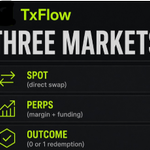
Trading on @TxFlow_L1 covers three markets from one system: spot, perpetuals, and outcome shares. Everything settles on-chain under the same deterministic rules.
Spot is a direct balance swap. Perps are leveraged contracts that track an oracle price and settle through mark-to-market PnL plus funding. Outcome markets are prediction-market shares that redeem to 0 or 1 at resolution.
Perps use USDC margin. Cross mode pools the whole perp account behind all cross positions. Isolated mode locks margin to one position so losses stay contained. You can run One-Way (net long or short) or Hedge (long and short at once). Maintenance margin rate and max leverage are tiered by position size - larger positions sit in stricter tiers. Liquidation triggers when the margin ratio drops below 1.0 (equity no longer covers maintenance margin plus the reserved liquidation fee). Takeover happens at the bankruptcy price. The engine can do partial liquidations on higher tiers. Auto-deleveraging is the backstop if the book cannot absorb the position.
Funding settles on a fixed cycle (default hourly). The rate is published on-chain and reflects how far the contract trades from the oracle. Longs pay when the rate is positive. Payments are notional × rate, valued at the mark price. Mark price drives valuation, unrealized PnL, and liquidation; oracle price is the external reference. Both come from on-chain oracle transactions.
Orders include market (5% slippage band, always taker), limit, and trigger (TP/SL evaluated on mark price). Time-in-force options are GTC, IOC, ALO (post-only), and GTD. Reduce-only and TWAP are available on perps. Matching is price-time priority. Self-trade prevention cancels the resting order and continues matching. Fees are charged per side on fill notional and settle atomically. VIP tiers are based on 14-day rolling weighted volume (perps + spot). Referral codes give a 5% fee discount to the referred trader.
The full book, margin checks, liquidations, and funding all run inside the on-chain state machine. The system is live.
@kaisrr3a @TxFlow_L1
Appreciate if you could use my referral, it gives you 5% off perp and spot fees:
Referral Link: app.txflow.com/r/TXSHADOWSP
Referral code: TXSHADOWSP


Trying to share some key concepts of TxFlow!
TxFlow runs spot, perps, and outcome markets from one Ethereum address with three separate sub-accounts.
The address is created on first deposit. No registration. Spot holds token balances and is fully funded, orders can only use what you already have. Perp holds margin and positions, with cross or isolated margin, tiered maintenance margin, mark-to-market PnL, funding, and liquidation. Outcome holds margin and prediction-market shares that redeem to 0 or 1 at resolution. Cross margin only pools assets inside the perp sub-account. Spot balances do not back perp positions. Vaults sit separately as a leader-follower share model with lock-up.
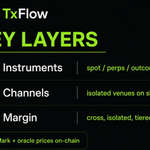
Spot, perps, and outcome markets share one instrument abstraction. Spot settles as an instant balance swap. Perps settle through mark-to-market PnL and funding. Outcome shares redeem to the margin asset at resolution. These markets are grouped into Channels- isolated venues on the same L1 that each control their own listings, fees, and operators while sharing the underlying execution and settlement layer.
Margin modes are cross (whole perp account backs all cross positions) or isolated (each position locks its own margin). Outcome markets are isolated only. You can run One-Way or Hedge position mode. Maintenance margin rate and max leverage are tiered by position size.
Mark price drives valuation, unrealized PnL, and liquidation. Oracle price is the external reference. Both come from on-chain oracle transactions submitted by validators, so every node sees the same prices each block.
Signing is network-separated EIP-712: Mainnet chain ID 869 (TxFlow-Mainnet), Testnet chain ID 2511 (TxFlow-Testnet). Writes go through POST /exchange with signed actions. Reads use POST /info. Real-time data comes over WebSocket.
One account, three funding models, one on-chain book. The system is live.
@kaisrr3a @TxFlow_L1
Appreciate if you could use my referral, it gives you 5% off perp and spot fees:
Referral Link: app.txflow.com/r/TXSHADOWSP
Referral code: TXSHADOWSP

Rebates on @Fairgroundfi only accrue on open interest that came from a No-rush fill. Everything else is just a normal position.
What becomes eligible?
When a No-rush order fills against a standard order, the size it creates is tagged eligible OI. Only that tagged portion can earn rebates. If you later add size with a market or limit order, the new size is not eligible. If you partially close a mixed position, the eligible and non-eligible parts shrink in proportion, so the eligible share gets diluted.
How they accrue?
Rebates accrue continuously while eligible OI stays open. There is no separate funding-style payment schedule.
Each matching cycle builds a pool from:
- trade fees, and
- impact fees paid when two standard orders match each other.
That pool is then shared across the eligible open interest in the market. Your share scales with how much eligible OI you hold relative to total eligible OI, and with how long you hold it. Higher market volume grows the pool; quiet markets grow it less. A placed No-rush order earns nothing until it actually fills and the resulting size remains open through later cycles.
When they pay?
Rebates are paid when you reduce or close the position that holds the eligible OI. They are not paid while the position is still fully open.
What they are not?
They are not funding payments. They do not create a holding cost. They can only add to your balance — there is no negative rebate. The only fees you pay are the normal trade fee (and the impact fee if you used a standard order).
In short:
No-rush fill → eligible OI → continuous accrual while it stays open → payout on reduce/close. Amount depends on size, duration, and how active the market is. Nothing is guaranteed.
@Fairgroundfi @ForteProtocol
Have you tried No-rush Orders yet?
@Fairgroundfi just flagged them again. They are a different way to trade -> you supply liquidity instead of taking it, and the open interest you create can earn rebates.
Standard orders (market and limit) fill first.
No-rush sits in the residual. It only fills what is left after standard orders have matched each other, and it never fills against another no-rush order. You give up execution priority and price control in exchange for the fee treatment.
Every fill still happens at the current oracle price. No-rush has no limit price of its own, so it is always eligible at whatever the oracle is when matching runs.
Placing one does not start a matching cycle, it waits for a standard order or a matching transaction to trigger one. Fee difference is the point. Both sides pay the trade fee (1–5 bps, and no-rush volume can discount it further). Standard orders also pay an impact fee (0–5 bps). No-rush does not pay it. When a no-rush order fills against a standard order, it receives the impact fee the standard side paid. The open interest from that fill is tagged eligible for rebates.
Rebates accrue while the eligible size is open and pay out when you reduce or close. They cannot go negative. Amount depends on market activity, size, and how long you hold and they are not guaranteed.
The trade-off is real. You do not control the price or the timing. Fairground’s own note is that this is for people who can manage and hedge the position that results.
If you have not looked at them, the app is open this weekend: app.fairground.fi/Docs: docs.fairground.fi/trading/o…
Testnet. Rebates vary and are not guaranteed.
@Fairgroundfi @ForteProtocol

This Halloween, want to trade and treat yourself!
Really appreciate @TxFlow_L1 running trade & treat instead of just going quiet. Top 50 get to share up to $20k in fee credits, pool starts at $2k once we hit $20m combined volume, and every friend who does their first perp trade adds 0.1x to your volume multiplier (caps at 2x). Runs till Nov 8.
Treats are better with friends 🎃
Perp taker only, no 1-min positions, no self-refs. the usual.
app.txflow.com/campaign/trad…
Appreciate if you could use mine referral which includes 5% discount on perp and spot fee, etc:
Referral Link: app.txflow.com/r/TXSHADOWSP
Referral code: TXSHADOWSP
@TxFlow_L1 @kaisrr3a

People calling TxFlow a Hyperliquid fork are missing the point.
Hyperliquid never open-sourced their L1, consensus, or matching engine. there is nothing public to fork. the hard parts (matching, margin, liquidations) only exist inside their chain and inside @TxFlow_L1 ’s. most perp DEXes don’t even run their own chain, they’re just apps on someone else’s L1. TxFlow built an L1 specifically so the book and risk engine live inside the state machine instead of some off-chain server that reports results later.
they did reuse Hyperliquid’s bridge. not a secret. it’s already held billions and been battle-tested for years. rewriting custody code from scratch when a proven version exists is usually worse for security. the API is also similar on purpose so builders already integrated with Hyperliquid can plug in without rewriting everything. an API is just an interface. same reason every chain speaks EVM. doesn’t mean the engines underneath are the same.
the part that actually runs the venue is their own. consensus is TxBFT (DAG-based BFT), matching runs inside the deterministic state machine, and liquidations are state transitions, not operator messages. they also run spot, perps, and prediction markets on the same chain with shared liquidity, plus gasless order placement. none of that is free or simple.
On centralization: they currently operate as a trusted operator for the bridge keys and have a small validator set. they’ve said this openly. Hyperliquid itself ran with 4 team-controlled validators and a multisig bridge for a long time before it expanded. the end goal they’ve stated is native USDC issuance on TxEVM so the bridge becomes unnecessary. whether they actually deliver that is the real question, not whether they copied a battle-tested bridge contract today.
Building a purpose-built L1 with a fully onchain order book is hard. most teams don’t even try. using proven pieces where it reduces risk and writing the hard parts yourself is a reasonable engineering choice, not proof the whole thing is a clone. the product either works or it doesn’t. the rest is noise.
@kaisrr3a @TxFlow_L1

a lot of people say we forked hyperliquid. one problem: Hyperliquid’s Layer1 code has never been open sourced. that’s their call, and it means there is nothing to fork. the matching, margin and liquidation logic is the hard part, and it only exists in two places: inside their chain and inside ours.
most perp dexes don’t even run their own l1 at all, they’re apps on someone else’s chain, which is a fine choice, it just means the engine isn’t theirs.
to the people who say you can fork hl with claude or codex over a weekend: would you trade on that engine? we built ours from scratch so that nobody has to answer that question.
What is Fairground you ask? No, its not a playground!
Fairground is a decentralized perps venue on Arbitrum, currently in testnet on Arbitrum Sepolia. One oracle price for fills, PnL, margin, and liquidations. Fees only hit when a position changes, no periodic funding. Experienced LPs can earn rebates with no-rush orders.
Season 4 (the final testnet) runs October 26 - November 9, both ends at 16:00 UTC. Access is limited: previous-season traders connect the wallet they already registered, or new wallets come in through a referral from an eligible participant. Each eligible person can invite up to two people. Newly referred traders cannot invite anyone else.
Getting in takes three steps.
1. Get access. Returning traders just reconnect. New traders need a referral link and register through it.
2. Connect a wallet. Any EVM wallet works (MetaMask, Rabby, WalletConnect, Coinbase Wallet, etc.). Or sign up with email, Google, X, Telegram, or Discord and Privy creates an embedded wallet for you. The public address is under the wallet dropdown → copy icon in the Privy pane.
3. Funds arrive automatically. Once access is granted you get enough testnet ETH for gas and test USDC for collateral. More test USDC lands every day at 16:00 UTC during the season. You do not bring your own money.
If you are using your own wallet you may need to add Arbitrum Sepolia manually:
- Network Name: Arbitrum Sepolia
- RPC: sepolia-rollup.arbitrum.io/r…
- Chain ID: 421614
- Currency: ETH
- Explorer: sepolia.arbiscan.io
Test USDC token: 0x4E1156749dd156D06dCE5baC0f8f5A43792C9EDb.
The design is deliberately thin. No funding rate to manage. One price instead of mark vs index. No-rush orders sit in the residual of the matching cycle, receive the impact fee from the standard flow they fill, and can earn rebates on the open interest they create. Crypto, commodities, and FX markets, with hours that follow the underlying.
If you want to try it before the window closes, you need a referral. Go check discord.
@Fairgroundfi @ForteProtocol
NFA. Testnet only.