

Disclaimer: The views expressed here are solely my own and do not reflect the views of my employer or any organization I am or was affiliated with
Joined August 2017
- Tweets1.3K
- Following974
- Followers814
- Likes44.1K


Suha retweeted

I'm doing an esoteric-PDFs meet up in New York City on Oct 17th.
Printed your most esoteric PDFs and exchange them for other esoteric PDFs. Hit me up for details.
Suha retweeted

The @mozthunderbird team from @mozilla built Thunderbolt: an open-source AI client that gives users control. We're really excited it comes with @TinfoilAI as a built-in option!


Suha retweeted

This was a great, fun conversation with two of the buddies on a whole host of security topics and I've already been enjoying the other @OffensiveAIcon episodes they've put out, so also check those out. Thanks for having me on @ryanaraine and @juanandres_gs !

🔥🎈NEW POD UP to pass weekend chores:
Three Buddy Problem x Offensive AI Con: Umbriel AI’s Aaron Grattafiori breaks down the new offensive-security playbook: using LLMs for patch variant analysis, why the vuln apocalypse hasn’t become an exploit apocalypse, and how the death of security through obscurity puts closed-source binaries and firmware within reach. @dyn___ @juanandres_gs
Plus, we discuss rogue agents escaping sandboxes, the eval-driven loop behind recursive self-improvement, and the brutal cost asymmetry that makes offense cheap and defense almost unaffordable.
Listen everywhere
securityconversations.com/ep…

Suha retweeted

The return of wake-sleep.
Wake-sleep algorithms were introduced by Hinton et al. in 1995 as a means of training neural networks by alternating two phases: a wake phase that learns from real data, and a sleep phase that learns from examples the network dreams up offline.
We're starting to see them come back in a big way in agent-native products. As agents solve increasingly long-horizon, knowledge-intensive tasks, they'll need to learn from their own work, reviewing graded records of what they did offline and turning them into memory they carry into the next task.
Sharing an overview of wake-sleep for legal agents and initial experimental results on Harvey LAB.


Suha retweeted

This goes deeper than any other public writing I've seen on policy engines for agentic tooling in practice!
Shares a lot of similarities with formal.ai's policy engine approach, but at the harness rather than network level. I wonder what the tradeoffs there are..


Thanks Tristan!! I'm a big formal fan. Definitely some trade-offs that made sense for us but stay tuned for more!
Suha retweeted

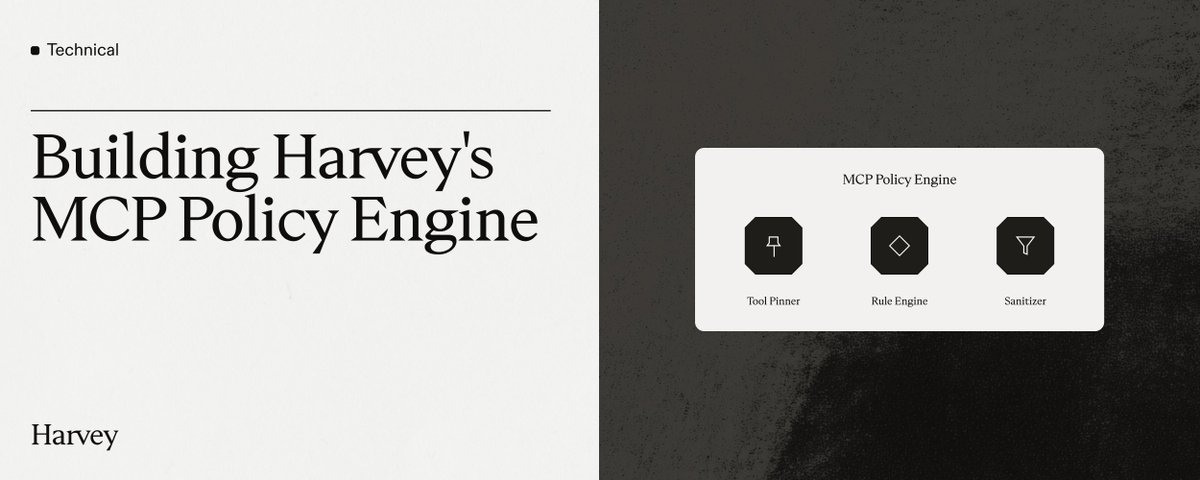
MCP tool use introduces security risks, including tool poisoning and rug-pull attacks, where malicious instructions appear in tool definitions or tools are compromised after approval.
We built Harvey’s MCP Policy Engine to address these risks.
We run security reviews for each integration, examining what its tools can access and where they can send information.
At runtime, the engine flags changes to approved tools and checks proposed actions against what’s happened earlier in the workflow, enforcing policies outside the model.
Our Security team explains how these defenses work, why tools need to be evaluated together as agents work across services, and the trade-offs we’ve encountered in production.
Deep dive on Harvey's MCP Policy Engine by @suhackerr, Nick Gonella, and Divya Sudhakar:


New post! We built the MCP Policy Engine (@harvey ) to govern how agents use MCP tools.
Our approach draws on agent security research and treats prompt injection as an information flow control problem. We enforce policies outside the model based on tool capabilities and agent trajectories.
Read the article for details on how these runtime controls work, what we’ve learned, and what we’re working on next!