
Teacher @ Govt Patshala. Minimalist. PrEcrastinator. Philanthropist. Wishfully Poor. Math Enthralled. Orthodox Programmer+Vim Lover. Views very, very Personal.
Mysore
Joined November 2009
- Tweets6.6K
- Following602
- Followers1.9K
- Likes878





You cannot imagine a medical school without an OPD. Why shouldn’t engineering schools have their own equivalent?
Medical students learn through real patients, real cases, and supervised practice—not just a handful of textbook examples.
Yet, in engineering education, we too often start with toy examples and end with toy examples. The transition to real-world implementation gets left behind.
At the Indian Institute of Technology, Ropar, we are building a different culture through AI Craft—one where learning means spending more time implementing, contributing, and creating.
Our AI Centre of Excellence and Vicharanashala design lab provide the environments for this hands-on learning. Participants work on open-source and closed-source projects, adding useful features to well-developed systems rather than building demos that go no further than a classroom submission.
We also encourage learners to develop their own products—grounded in real needs and built to be shipped, used, and improved.
The goal is not simply to teach people how technology works. It is to help them build something that works in the real world.
Explore AI Craft: samagra.annam.ai

Absolutely @stuartbuck1 This should stop

Trying to read the book Mathematical Foundations of Deep Learning, and already thrown off by how folks in ML/AI reinvent the wheel as to something as basic as linear regression:
arxiv.org/pdf/2603.18387
Relabeling parameters as "weights" and the intercept as "bias" seems quite unnecessary! Also do they really need to redo the famous econometrics estimator for beta-hat by relabeling it as theta-star?


2
278
Sudarshan Iyengar retweeted

MIT FILMED THE LECTURE WHERE THEIR MOST LEGENDARY LINEAR ALGEBRA PROFESSOR EXPLAINS WHY EVERY GPS SIGNAL EVERY MEDICAL SCAN AND EVERY AI MODEL ON EARTH IS SECRETLY SOLVING A PROBLEM THAT HAS NO SOLUTION
This is Gilbert Strang, MIT, 18.06 Linear Algebra, lecture 15. The professor whose textbooks sit in over 3,000 universities across 135 countries and whose course has been watched by millions of engineers and mathematicians worldwide. He opens with one claim - when equations have no solution, you do not give up. You solve the closest problem that can be solved.
He starts with a vector b and a line through a. The projection of b onto that line is the point closest to b that actually lives on the line. The key is a right angle. The error - the gap between b and its projection - must be perpendicular to a. That one geometric fact produces the entire formula. The projection is a times a transpose b divided by a transpose a. One fraction. The numerator is a matrix. The denominator is a number.
Then the projection matrix. Every projection is carried out by a matrix P that multiplies b and lands on the line. That matrix has two properties that define all projections everywhere. First, P transpose equals P - the matrix is symmetric. Second, P squared equals P - project twice and you stay where you are. The first projection moves you onto the line. The second leaves you there.
Then higher dimensions. Instead of projecting onto a line, project onto a plane. Instead of one vector a, you have a matrix A with two columns spanning the plane. The error vector must now be perpendicular to both columns - perpendicular to the entire plane. That condition produces one matrix equation. A transpose times the error equals zero. The error lives in the null space of A transpose, which is exactly perpendicular to the column space of A. The four fundamental subspaces appear without being called.
Then the formula for n dimensions. The projection matrix is A times A transpose A inverse times A transpose. Strang warns the room not to simplify it by canceling A inverse against A - A is not square, it has no inverse, and the formula cannot be pulled apart. The only case where it simplifies to the identity is when A spans the whole space and the projection is b itself.
Watch the moment he applies the formula to fitting a line through three points that no line can pass through. Three equations, two unknowns, no solution. He writes the matrix, writes the right-hand side, and shows that multiplying both sides by A transpose produces an equation that always has a solution. That equation is the foundation of least squares, GPS triangulation, and every regression model trained in 2026.
A data scientist I know rewatched this lecture before building a recommendation system from scratch. Said it was the first time the normal equations felt like geometry rather than a formula someone handed down to memorize.
Free on YouTube, MIT OpenCourseWare, filmed over 20 years ago.
bookmark this and watch later - after this lecture every unsolvable equation you meet will feel like a projection waiting to be found

Sudarshan Iyengar retweeted

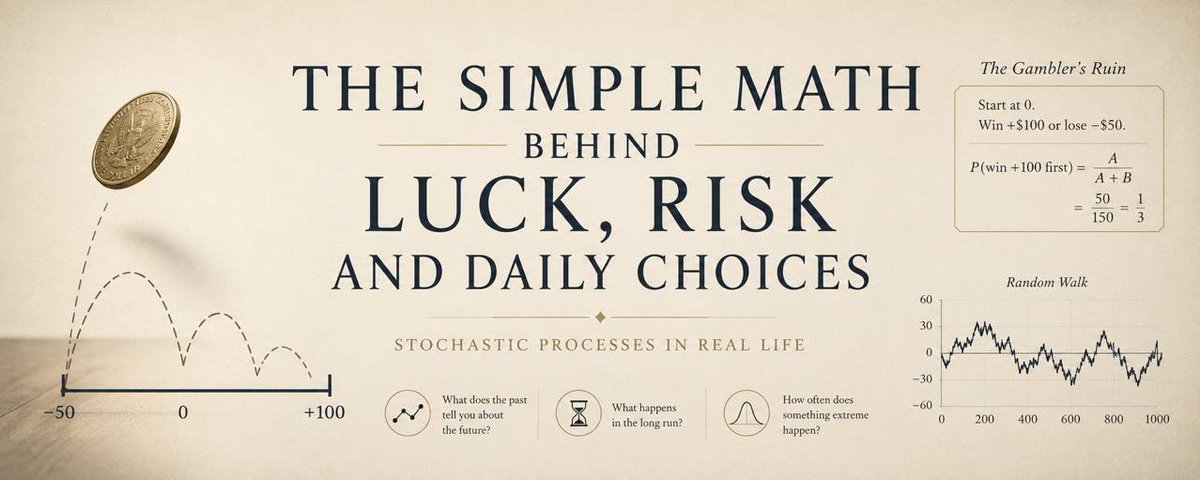
An Indian physicist put the entire secret behind Renaissance's $100 billion on one chalkboard: a coin that barely beats 50/50.
he is V. Balakrishnan, and his lecture went viral years after he recorded it. it has been free the whole time. almost nobody who trades has watched it.
lecture one is the humblest thing in all of finance. a coin that lands your way a little more than half the time. that is the entire edge. that is all Renaissance ever had.
the post above is the one equation for what to do with that coin. not what to bet. how much. bet too little and you die of old age. bet too much and one flip ends you.
that same coin is every trade, every hand, every prediction market. a tiny edge, flipped a million times. the whole machine fits on his board, and he charged nothing for it.
no slides. no notes. one coin and a stick of chalk.
a quant I know says this old Indian lecture taught him probability better than his entire degree.
the coin is free. the equation is free. the discipline to size it is the only thing left to earn.


Math is very similar. It appears like magic until someone opens the cover. xitter.cf/GoodnessUC00/status/20…
Sudarshan Iyengar retweeted

In the 1920s, a Stanford psychologist tracked genius children for 50 years.
Malcolm Gladwell breaks down what he discovered:
Rich families → successful. Poor families → failures.
Not average. Failures. Genius-level IQs that produced nothing.
He spent 60 minutes at Microsoft explaining why we're wrong about success:
The psychologist was named Terman. He gave IQ tests to 250,000 California schoolchildren.
He identified the top 0.1%. Kids with IQs of 140 and above.
His hypothesis: these children would become the leaders of academia, industry, and politics.
He tracked them. And tracked them. For decades.
The results split into three groups:
The top 15% achieved real prominence. The middle group had average, moderately successful professional lives.
And the bottom group? By any measure, failures.
The difference wasn't personality. Wasn't habits. Wasn't work ethic.
It was simple: the successful geniuses came from wealthy households. The failures came from poor families.
Poverty is such a powerful constraint that it can reduce a one-in-a-billion brain to a lifetime of worse than mediocrity.
There's a concept called "capitalization rate."
It asks a simple question: what percentage of people who are capable of doing something actually end up doing that thing?
In inner city Memphis, only 1 in 6 kids with athletic scholarships actually go to college.
If our capitalization rate for sports in the inner city is 16%, imagine how low it must be for everything else.
Here's something stranger.
Gladwell read the birth dates of the 2007 Czech Junior Hockey Team:
January 3rd. January 3rd. January 12th. February 8th. February 10th. February 17th. February 20th. February 24th. March 5th. March 10th. March 26th...
11 of the 20 players were born in January, February, or March.
This isn't unique to the Czechs. Every elite hockey team in the world shows the same pattern. Every elite soccer team too.
Why?
The eligibility cutoff for youth leagues is January 1st.
When you're 10 years old, a kid born in January has 10 months of maturity on a kid born in October. That's 3 or 4 inches of height. The difference between clumsy and coordinated.
So we look at a group of 10 year olds, pick the "best" ones, give them special coaching, extra practice, more games.
We think we're identifying talent. We're just identifying the oldest.
Then we give the oldest more opportunities, and 10 years later they really are the best.
Self-fulfilling prophecy.
The capitalization rate for hockey talent born in the second half of the year? Close to zero.
We're leaving half of all potential hockey players on the table because of an arbitrary date on a calendar.
Kids born in the youngest cohort of their school class are 11% less likely to go to college.
11% of human potential squandered because we organize elementary school without reference to biological maturity.
Now here's the part about math.
Asian kids dramatically outperform Western kids in mathematics. The gap is enormous and consistent across decades of testing.
Some people say it's genetic. It's not.
It's attitudinal.
When Asian kids face a math problem, they believe effort will solve it.
When Western kids face a math problem, they believe the answer depends on innate ability they either have or don't.
Here's the proof.
The international math tests include a 120-question survey. It asks about study habits, parental support, attitudes.
It's so long most kids don't finish it.
A researcher named Erling Boe decided to rank countries by what percentage of survey questions their kids completed.
Then he compared it to the ranking of countries by math performance.
The correlation was 0.98.
In the history of social science, there has never been a correlation that high.
If you want to know how good a country is at math, you don't need to ask any math questions. Just make kids sit down and focus on a task for an extended period of time.
If they can do it, they're good at math.
Why do Asian cultures have this attitude?
Gladwell's theory: rice farming.
His European ancestors in medieval England worked about 1,000 hours a year. Dawn to noon, five days a week. Winters off. Lots of holidays.
A peasant in South China or Japan in the same period worked 3,000 hours a year.
Rice farming isn't just harder than wheat farming. It's a completely different relationship with work.
There's a Chinese proverb: "A man who works dawn to dusk 360 days a year will not go hungry."
His English ancestors would have said: "A man who works 175 days a year, dawn to 11, may or may not be hungry."
If your culture does that for a thousand years, it becomes part of your makeup.
When your kids sit down to face a calculus problem, that legacy of persistence translates perfectly.
Now consider distance running.
In Kenya, there are roughly a million schoolboys between 10 and 17 running 10 to 12 miles a day.
In the United States, that number is probably 5,000.
Our capitalization rate for distance running is less than 1%.
Kenya's is probably 95%.
The difference isn't genetic. The difference is what the culture values and where it spends its attention.
Here's the most fascinating finding.
30% of American entrepreneurs have been diagnosed with a profound learning disability.
Richard Branson is dyslexic. Charles Schwab is dyslexic. John Chambers can barely read his own email.
This isn't coincidence. Their entrepreneurialism is a direct function of their disability.
How do you succeed if you can't read or write from early childhood?
You learn to delegate. You become a great oral communicator. You become a problem solver because your entire life is one big problem. You learn to lead.
80% of dyslexic entrepreneurs were captain of a high school sports team. Versus 30% of non-dyslexic entrepreneurs.
By the time they enter the real world, they've spent their whole life practicing the four skills at the core of entrepreneurial success: delegation, oral communication, problem solving, and leadership.
Ask them what role dyslexia played in their success and they don't say it was an obstacle.
They say it's the reason they succeeded.
A disadvantage that became an advantage.
Here's what Gladwell wants you to understand:
When we see differences in success, our default explanation is differences in ability.
We forget how much poverty, stupidity, and attitude constrain what people can become.
We refuse to admit that our own arbitrary rules are leaving talent on the table.
We cling to naive beliefs that our meritocracies are fair.
The capitalization argument is liberating.
It says you don't look at a struggling group and conclude they're incapable. It says problems that look genetic or innate are often just failures of exploitation.
It says we can make a profound difference in how well people turn out.
If we choose to pay attention.
Bang! In the middle of a big screen display at the airport comes a Windows update message. We need more B.Des courses than B.Tech courses. :-)


2
293
Sudarshan Iyengar retweeted

Never confuse education with intelligence, you can have a PhD and still be an idiot.
— Richard Feynman

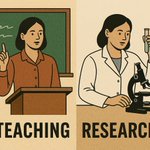
On the left, is the Math teachers protesting calculator use in 1988
On the right is our modern teachers protesting modern tools for learning.
(Second image credits : AI)

9
321
Isn’t this an overkill? One can simply put a mobile stand on the trolley and provide an app which does the same.


Brilliant advice by @svembu from industries to students :
Don’t wait to achieve expertise before doing things. “Learn on the fly”.
Indian tech should chant this like anthem.
Sudarshan Iyengar retweeted

IIT Ropar is emerging as a leading Centre of Excellence in advanced Research, Artificial Intelligence Innovation, and Student Entrepreneurship.
The Institute’s recent Faculty Achievements include Dr. Shweta Jain, Assistant Professor, Department of Computer Science and Engineering, receiving the prestigious Google Research Award 2024 with a USD 20,000 unrestricted grant; Dr. Anupam Bandyopadhyay, Assistant Professor, Department of Chemistry, being honoured with the IPS Young Scientist Award 2025; Dr. Soumyajit Das, Assistant Professor, Department of Chemistry, receiving the Thieme Chemistry Journals Award 2025; and Dr. Durba Pal, Associate Professor, Department of Biomedical Engineering, being recognized under “Women in Immunology” by the Indian Immunological Society on the International Day for Women and Girls in Science.
The Technology and Innovation Foundation – iHub AWaDH (Agriculture and Water Technology Development Hub) is advancing priorities in Agriculture & Allied Sectors, Human Skilling, Technology Development, and Startup & Entrepreneurship growth.
Strengthening Agri-Tech leadership further, @iitrpr has been designated as the Centre of Excellence in AI for Agriculture (Annam AI) under the Ministry of Education, Government of India, with a ₹300 Crore Project integrating AI for enhanced Agricultural productivity and Sustainability. Driving a vibrant Startup ecosystem, the Technology Business Incubator Foundation (TBIF) hosted IIT Ropar’s first E-Summit.
A standout TBIF-incubated Startup, an AI-based Recruitment Platform founded by B.Tech students Deepanshu Sharma and Kartik Yadav has secured ₹3.5 Crore in funding.
With such milestones, IIT Ropar continues its rise as a National leader in Innovation, powering India’s pursuit of a Technology-driven future.
To know more, visit: iitrpr.ac.in/

The big problem with our IIT/IIM/IISc or any other top university super stars. They don’t get over their knowledge ego. While I would be least bothered how much it is going to cost them, what bothers me is the cost to the country in creating the ego filled, self-obsessed, non-collaborative souls. Out of these, 1 in 100 do attempt the Seva Manobhav and they create the Hulk-Smash-Impact 👏in the society 🫡. I wish more of our highly competitive students/academicians are taught the importance of serving through a low ego and high collaboration mindset. World will get exponentially better with days and years.


“You must first learn C before starting Python. There are many fundamental ideas of programming that are taken for granted in Python.”
That’s like saying:
“You should first learn to ride a bullock cart before moving to a Mercedes Benz.”
Join the live session of our distinguished Professor from IISc & IIT Madras:
Prof. Pandurangan's Grand master session on how to teach Computer science. He is teaching algorithms illustrated. Amazing examples, anecdotes, stories and inspirational quotes. A perfect exemplery lecture on how a lecture should go. Just join and enjoy it like you would a dance number, whether or not you have the required pre-requisites. Please join:
zoom.us/j/98484494197?pwd=Qz…
(Live upto 10 pm today)

5
35
1,829