


Pinned Tweet
After 30 months of metrological rigor on PV001, the truth emerges with surgical precision: Mark Qvist's π and φ² ratios hold up under CT-scan scrutiny (0.05-0.17% error), while his Radial Traversal Pattern collapses.
arcsci.org/articles/revisiti…
But the real story isn't the math - it's the misconduct. Artifact Foundation's systematic data manipulation, plagiarism of draft reports, fabricated museum policies, and legal threats reveal how "ancient precision" claims evaporate when integrity fails.
PV001 remains a unicorn - exceeding industrial CNC precision with RMSD of 22μm - but its flawless surface shows zero wear. The probability of three interlocking ratios occurring by chance? 0.004%. The probability of two such "ancient" vessels belonging to the same collector? Statistically obscene.
My conclusion: This isn't 5,000 years old. More likely off by a factor of ~1,000.
When researchers present incorrect data as ancient marvels while threatening critics, they've crossed from questionable scholarship into scientific theater. Extraordinary precision claims require extraordinary evidence - not extraordinary evasion of peer review.
Data > Dogma. Always.
I came into this project hoping to find solid evidence that could be used to ascertain the existence of a lost civilization, instead I found a noisy dataset (both physically and morally). If the community really wishes to rewrite history by documenting a so far unknown civilization, we need to stay rigorous and true.
@UnchartedX1 @MBeallX @markqvist @ArtifactFNDN @karolypoka @DrDavidMiano @BrightInsight6 @DeDunkingPast @TonyTrupp @SnkBrs @DrHughT @megaminutiae @alexandertolano @ChrisWithRobots @FoMaHun @Apkalluu @goob_the57373 @oligodynamick @ET_Iconoclasta @Bastet545169547 @adancingferret @JosephAPWilson1 @outofspace2 @occamsrazor22 @AncientEpoch @PortantIssues @uapcappa

Egyptian stone vessel precision debate resolved: Museum-held Predynastic artifacts statistically indistinguishable from modern handmade replicas. Four validated metrics confirm ancient artisans operated within hand-guided craftsmanship limits.
arcsci.org/articles/comparat…
The Artifact Foundation's "Geometric Mean" metric? A mathematical chimera: dimensionally incoherent, median-suppressed, and alignment-sensitive (0.05° rotation alters scores by 17%). Its "top precision" claims collapse under scrutiny.
Real data shows museum/handmade clusters overlapping while private specimens remain anomalous outliers. When metrics require rotational tweaks to manufacture rankings, follow the polynomials, not the hype.
Stay tuned - I have an even more interesting article coming up next. Data > dogma.

Data provenance and collection methodology
A description of the collections analyzed in this study.
- Museum vessels (MV): Scans sourced from both Max Fomitchev-Zamilov and Karoly Poka's scanning of vessels from the collection of the Petrie Museum in London. Where overlaps of scanned vessels occur, Fomitchev's datasets are prioritized due to superior interior surface capture and overall scan data quality.
- Handmade vessels (HV): Nine soft-stone vases meticulously crafted using traditional techniques without modern tools by Egyptian artisans, replicating old techniques. The vases was obtained specifically for this study by Max Fomitchev-Zamilov and scanned with his Keyence VL-500 3D scanner (10-micron accuracy).
- Industrial reproductions (IV): Nineteen vases produced using modern lathes from both soft and hard stone, primarily scanned by Max with Keyence VL-500 (with IV001-IV003 CT-scanned by Matt Beall for complete interior/exterior analysis).
- Private collection (PV): Scans provided by the Artifact Foundation, including PV001 and PV003 owned by Adam Young (head of the Artifact Foundation) and CT-scanned at Zeiss facilities.
3
735
I'm going to post a bit of statistics here. Previously I replied to a good question by @TonyTrupp going through the statistical data - That question was deleted and so was my replies, I'm going to re-post them here instead.
xitter.cf/stinegerdes/status/196…

I will encourage you to read my linked article, everything is explained in statistical terms - Just looking at one chart can be deceiving.
I am arguing that the group of MV (Petrie Museum vessels) and HV (Handmade egyptian vases) are indistinguishable from each other in statistical terms. Still high precision outliers exists in the MV group (MV008 and MV005) showing impressive precision, but that does not change the solid distribution overlap. The article goes into details with this aspect.
PV (Private collection) artifacts are an outlier group - Comparable or even better than IV (Industrial lathe made vases).
Attached see the KDE plot of the distributions

But one statistical test must never stand alone, I have also added the Cohen's d Effect Size results:
Cohen's d Effect Size: The "How Big is the Difference?" Measure
Statistical significance tells us if a difference exists, but effect size tells us how meaningful that difference is. Imagine two bakers-one makes loaves 1cm taller than the other. Statistically, this might be significant with enough measurements, but practically, it doesn't matter for your sandwich.
What it tells us: The practical importance of differences between groups, measured in standard deviation units
How to read it:
- Small effect (|d| < 0.5): A statistically detectable difference that may not matter practically
- Medium effect (0.5 ≤ |d| < 0.8): A clear, noticeable difference
- Large effect (|d| ≥ 0.8): A substantial, meaningful difference
In our study: The large effect size in Geometric Mean for interior surfaces revealed a meaningful pattern related to ancient manufacturing techniques, while small effects between MV and HV in other metrics confirmed their practical similarity.
How to read our actual data: For exterior surfaces, three of five metrics show small effect sizes below 0.5, confirming that museum and handmade artifacts operate within the same practical precision range. The Precision Score shows a medium effect (0.44), while Quality Score surprisingly shows a large effect (1.09) despite non-significant p-values - highlighting how effect size and statistical significance provide complementary insights.
The interior surfaces tell a more nuanced story: All metrics except Quality Score show large effects (0.86-1.14), indicating museum artisans achieved significantly better interior precision. Geometric Mean shows the largest effect size (1.14), confirming its particular sensitivity to axis alignment differences between groups - although it should be kept in mind that the Geometric Mean metric is fundamentally invalid, and only included here in the interest of comparison and statistical illustration.
_________
Now I will not paste any more arguments here, please go and read the actual article, there is many insights to be had!

2
362
Mann-Whitney U Test between category "MV" and "IV"
What the MV (Museum vessels) / IV (Industrial lathe vases) comparison reveals: When we compare museum artifacts to industrial benchmarks, the story changes dramatically. For exterior surfaces, all metrics show extremely low p-values (as low as 0.0003), meaning there's less than a 0.07% chance these differences occurred randomly - virtually confirming they represent fundamentally different manufacturing processes. This is exactly what we'd expect: handcrafted ancient artifacts should be less precise than modern machine-made objects.
The interior surfaces show more nuanced results, with some metrics (like Quality Score) still showing highly significant differences (p=0.0050), while others approach or exceed the threshold of statistical significance.
- Again, I would encourage anyone interested to read the actual article which goes into more dept and exposes the fraud and manipulative metrics used by other research groups.

2
302
Mann-Whitney U Test: The "Real Difference" Detector
Imagine comparing two jars of marbles-one from museum artifacts, one from handmade reproductions. If you mixed them together and couldn't tell which came from which jar, the difference might be random. The Mann-Whitney U test answers: "How likely is it that these two groups actually come from different manufacturing processes?"
- What it tells us: Whether the precision differences between groups (like museum vs. handmade) are likely real or just random variation
- How to read it: A p-value below 0.05 means there's less than a 5% chance the observed difference happened by random chance alone
- In our study: When comparing museum (MV) and handmade (HV) artifacts, most metrics showed p-values above 0.05, confirming these groups are non-separable, and operate within the same hand-guided precision limits
Attached image is showing the Mann-Whitney U Test between category "MV" and "HV".
How to read our actual data: For most metrics, the p-values for exterior surfaces are well above 0.05 (like 0.6366 for Precision Score), meaning there's a 63.66% chance the observed differences between museum and handmade artifacts occurred randomly - too high to conclude they represent different manufacturing processes. The only exception is Geometric Mean for interior surfaces (p=0.0434), which dips just below the 0.05 threshold, again demonstrating the unreliability of this metric.
Interestingly, while the combined Quality Score analysis shows statistical significance (p=0.0242), neither the exterior (p=0.0667) nor interior (p=0.2614) surfaces individually reach significance. This pattern suggests that while there may be subtle differences between museum and handmade artifacts when considering both surfaces together, these differences aren't consistently apparent when examining surfaces separately - a nuance that reinforces our conclusion that both groups operate within the same fundamental precision framework.
This overall pattern confirms that museum-held Predynastic vessels consistently align with hand-guided craftsmanship and use of rudimentary tools across all four of the validated metrics, with only minor, surface-specific variations that reflect natural manufacturing nuances rather than fundamentally different production methods.

3
625
High-resolution 3D metrology reveals new insights into Predynastic Egyptian stoneworking. The first article from this analysis is now published at arcsci.org/articles/metrolog…, presenting detailed geometric evaluation of hardstone vessels from the Petrie Museum.
Key findings:
• Exceptional interior precision — some cavities show peak-to-valley deviations under 0.5 mm (0.02 inches) across the cavity of the scanned surface. Visualization in post.
• Repositioning events during fabrication, detectable through coaxial analysis. Image in thread.
• Non-circular (elliptical) exterior forms in several basalt vessels, with median peak-to-valley deviation of 0.362 mm (0.014 inches) when fitted to a principal axis. Image in thread.
These results challenge assumptions about symmetry, tool control, and intent in ancient craftsmanship.
Many more studies to follow.
Special thanks to @DrZamilov (Max Fomitchev-Zamilov) for acquiring and openly sharing high-quality 3D scans of the Petrie collection. His work makes this research possible — explore the data and methodology at maximus.energy/index.php/cat….
This study is based on high-resolution 3D scan data from the Petrie Museum collection, primarily acquired and openly shared by Max Fomitchev-Zamilov, with additional scans originally collected by Karoly Poka and shared under agreement for metrological analysis.


Here's an update on my analysis of ancient Egyptian vessel scans.
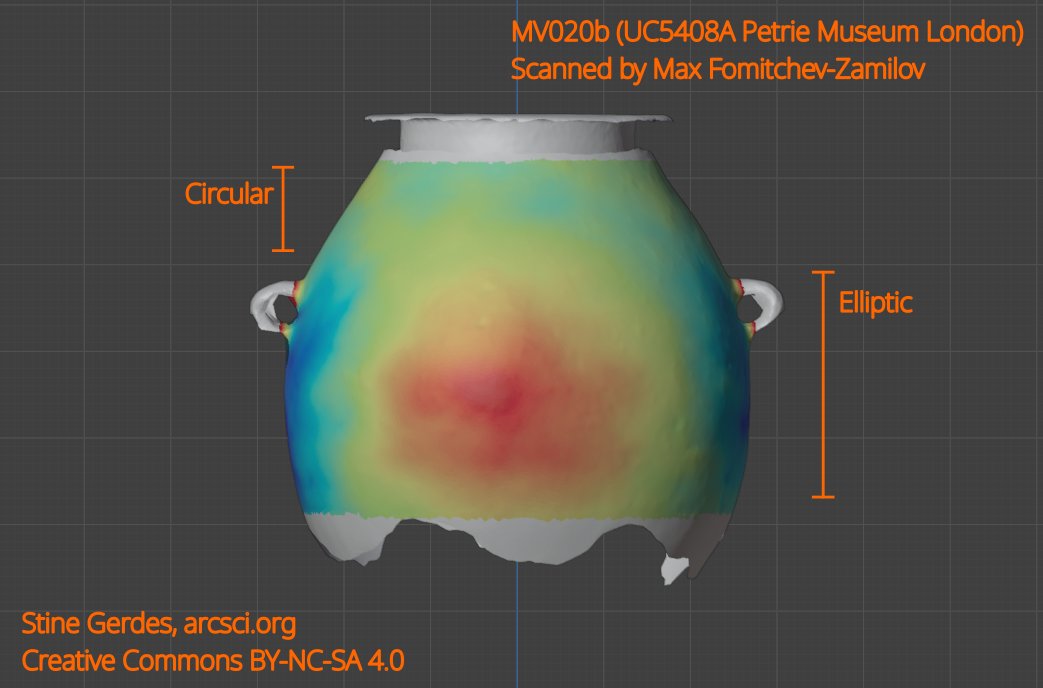
The attached images are of catalouge ID MV024 and MV020b, (UC15581, UC5408A Petrie Museum London). This artifact shows a distinct elliptic shape, resulting in low circularity scores. Both Max and myself are currently diving into the topic of exploration of the elliptic nature of some of the artifacts.
- For now the elliptic shape has only been observed in basalt vessels.
- If I rotate the artifact according to its elliptic shape, the handles are turned in an interesting fashion. Look at the red line (the x-axis) in the image, I'm exploring the possibility that the handles were somehow fixed during the crafting process, influencing the vessel’s shape. This only raises more questions than answers.
- The both artifacts MV024 and MV020 looks to be circular at the upper part and then diverting to an ellipsoid shape from the handles down.
- Measurements on MV024 of the ellipse at the narrowest part of the artifact 137mm / 5.39 in, and at the widest part 143mm / 5.63in.
I will try to put the evaluation of elliptical geometry to the side for a few days to focus on getting the precision reports of the newly scanned artifacts ready for publication. My initial reports will only be analyzing the vessels in regards to circularity, keep in mind that artifacts with elliptic shapes will score very low in these tests. Later my analyse will be expanded to include analysis of the elliptic nature of some artifacts.
As always I publish my work at arcsci.org.
Question: Would you be interested in seeing more of these behind-the-scenes updates on my research? Otherwise I will save the time and stick to only posting when I have something to announce.
Attribution:
_Max Fomitchev-Zamilov, 3D Scans of the Naqada Period Stone Vessels from the Petrie Museum of Egyptian and Sudanese Archeology, 2025._
Thanks again to Max for traveling a very long way with a high quality scanner to obtain these scans.
Max already made all his scans available on his website for anyone interesting in doing some analysis on their own:
maximus.energy/index.php/202…
Note: All findings are provisional; further validation pending.


Here’s the first-ever unfolded scan of the renowned Core No. 7. This scan promised to resolve a long-standing debate: do the markings on this ancient artifact indicate a helical tooling process? Surprisingly, this scan doesn't provide a definitive answer. Here's why:
The scan of Core no. 7 (LDUCE-UC16036) was captured by Károly Póka using a Freescan Combo+ (37µm accuracy).
Despite my extensive analysis of this 3D scan several months ago, no definitive conclusions could be drawn, due to poor visibility of surface tool marks. I wrote an algorithm to flatten the conical artifact for a better visual overview of the tool mark lines, but the analysis failed to resolve if the core are helical or not, which remain undefined.
After analyzing the newly captured scan of the artifact UC4356, by Max Fomitchev-Zamilov using a Keyence VL-500 (10µm accuracy) a critical issue was revealed: the ID label on the artifact on Póka’s scan is poorly resolved, initially misinterpreted as noise. However, the label is visible on the high-accuracy scans captured by Max, highlighting the Freescan’s insufficient detail, despite it't high resolution. Given the Freescan’s inability to accurately capture the ID label, it is highly probable that the subtle tool marks also fall below its resolution threshold, explaining their indistinct appearance. Consequently, the hypothesis of a helical curve in the tool marks cannot be confirmed or refuted based on Póka’s data.
The attached heatmaps visualize surface variability, highlighting the challenges in discerning subtle tool marks on the scan.
The attached images shows a label comparison of artifact UC4356 between the scans captured by Karoly and Max.
I am hopeful that someone with a stationary high quality scanner will travel to the Petrie Museum in London to have a new scan done. The Petrie Museum generously opens it's doors to researchers every Monday, so if you have a scanner and time to spare I encourage a visit to the Petrie Museum.
Acknowledgements:
Max Fomitchev-Zamilov (@MaxZamilov ), 3D Scans of the Naqada Period Stone Vessels from the Petrie Museum of Egyptian and Sudanese Archeology, 2025.
maximus.energy/index.php/202…
Károly Póka, Petrie Museum scans from September 2024 (unfortunately I cannot tag Karoly as he has blocked me).
Find more artifact analysis on my website: arcsci.org


Analysis of new Petrie Museum Vase/Vessel Artifacts: Preliminary Findings
Key Highlights:
- New high-precision scans (10μm accuracy) of 19 artifacts from the Petrie Museum conducted by Max Fomitchev-Zamilov.
- Preliminary analysis finished, charts with precision scores for the artifacts available.
- Elliptic central shapes detected; elliptic fits outperform circular fits significantly, charts below.
Acknowledgment: Max Fomitchev-Zamilov, 3D Scans of the Naqada Period Stone Vessels from the Petrie Museum of Egyptian and Sudanese Archeology, 2025. Sincere gratitude to Max for transporting his advanced scanning equipment across the Atlantic to analyze artifacts at the Petrie Museum, enabling this critical work. Download the scans and see Max’s research at his website: [maximus.energy/index.php/cat…](maximus.energy/index.php/cat…) .
Preliminary Data: Initial results from 19 scans of Naqada Period stone vessels are now ready. Charts below illustrate precision score, see detailed explanation of how this metric is obtained on my website arcsci.org.
Preliminary Technical Insights:
The observed low precision scores in many artifacts are not due to random surface irregularities but stem from systematic deviations in their central regions. A recurring elliptic shape — bulging at the front and back while narrowing at the handles— is present across multiple artifacts. This elliptic morphology significantly reduces the precision scores when evaluated using circular reference models, which are assumed in the artifact analysis. Elliptic fitting, however, achieves markedly higher accuracy, confirming the intentional or structural origin of this form.
The deviation from circular symmetry might arise from the manufacturing method itself, rather than a deliberate design. Further analysis of these patterns are needed before any insights can be had from this discovery.
Additional Resources: See circle and ellipse fitting charts in the thread below.
Next Steps: Comprehensive reports, including full data interpretation, will be published soon at [arcsci.org](arcsci.org) .
Note: All findings are provisional; further validation pending.


Circle fit statistics, of a circle fitted at the center region of the artifact MV024 (with low precision score):
Standard Deviation: 945.06 micrometer
Median Absolute Deviation: 839.81 micrometer

7
327
Ancient Egyptian Hardstone Artifacts
Curious to see how the drill holes in the handles look from the inside? - 🧵with photos of several artifacts showing the lug handles as seen from the inside.
PV001 is currently the artifact with the highest precision score, out of the 24 vessels analyzed so far (see my precision analysis of Egyptian vessels at arcsci.org). On top of the pristine precision in circularity and coaxiality, this artifact also shows a remarkable, near perfect, alignment of the handles (if you want to see pictures of this as well let me know).
Why go to such an extreme to manufacture an object of the highest quality, only to finish off the process by drilling misaligned holes in the handles?
These artifacts currently give rise to more questions than answers.
- Were these artifacts originally created without holes in the lug handles? If so, why were holes drilled in the lug handles of the thousands of artifacts found, stored away, under the Step Pyramid? How many artifacts exists today without these drill holes through the handles?
- Could the artifacts have been cast with artificial stone as @FoMaHun suggests? And the drill holes in the lug handles shows the creators true stone working capabilities? If so, one would still need to produce a very, very precise casting. Further the near perfect coaxiality of the precise artifacts, between the interior and exterior surface area, need to be explained.
- Were they made with ancient high tech?
- How old are these artifacts? How many civilizations have they passed through? How many civilizations have tried to copy the originals?
- Are the high precision artifacts actually modern fakes?
- I could go on and on with these questions...
I hope more collectors of these artifact will find interest in having pieces from their collection scanned and analyzed. We need much more data if we want to start exploring these questions.
The artifact PV001 is from the private collection of Adam Young.


