

Biotech Research Fellow @CSETGeorgetown, PhD in biochem from @wakeforestmed. Lover of science storytelling and watermelon Jolly Ranchers. Views are my own.
Joined October 2020
- Tweets256
- Following318
- Followers330
- Likes441






Pinned Tweet
OpenAI upgraded the risk level to “medium” for chemical, biological, radiological and nuclear (🧬CBRN) threats for its new o1 model, reflecting fears that a malicious actor could make a bioweapon with AI. I'm watching this closely, and here’s why I’m not concerned yet (1/🧵)

OpenAI says new models have increased risk of being misused to create bioweapons on.ft.com/3ZmZOA4

Steph Batalis, PhD retweeted

@CNBC referenced @steph_batalis’ warning on the measles resurgence in the United States. Last year, Steph emphasized that the measles outbreak exposed a broader vulnerability in the United States’ biodefense strategy and, specifically, a weakened ability to deter potential biological attacks. cnbc.com/2026/10/27/us-measl…

the linked post is one of the best overviews of AI x Bio risk I've seen to date - highly recommend everyone check it out!

TLDR (but pls read): to use AI to make a dangerous bioweapon, you'd need specialized biological design tools, a solid degree of expertise, and access to a fully-equipped lab. There are plenty of postdocs and such with all three, but as @steph_batalis told me: "Having the skill set doesn't necessarily translate to wanting to use a bioweapon."
transformernews.ai/p/ai-bior…

3
162
Steph Batalis, PhD retweeted
In their piece in @barronsonline, @steph_batalis, Katherine Quinn, and Rebecca Gelles paint a picture of the key role federal research investments play in spurring U.S. innovation competitiveness. Be sure to check out their latest analysis below!
barrons.com/articles/governm…

Steph Batalis, PhD retweeted
✨New blog✨ Who counts as part of the AI workforce? Existing definitions often blur together workers who build AI systems, deploy them, or simply use AI tools. CSET’s new blog explains why that matters, and introduces CSET’s new definition of AI development jobs: cset.georgetown.edu/article/…

Steph Batalis, PhD retweeted
✨ New blog ✨
How can prize competitions turn the Genesis Mission’s AIxBiotech ambitions into real progress?
@steph_batalis and @ali_craw look at how federal prize competitions can incentivize private-sector participation and advance national biotech priorities.👇
cset.georgetown.edu/article/…

Steph Batalis, PhD retweeted

🧵Most agree that open-weight AI models benefit research, but there is a lack of empirical work investigating how these benefits manifest in practice. To address this gap, we reviewed ~250 scientific publications that use open models in ways that require access to the weights
Congress has pushed back NIH cuts, but the battle isn’t over. My National Interest post explains why we need robust research funding if we want biosafety infrastructure — and why it must be protected.

If the U.S. government wants to remain a global leader in bioscience—and prevent future lab accidents or public health threats—it needs to maintain leverage over how research is conducted, argues CSET's @steph_batalis in the @TheNatlInterest 👀⬇️ nationalinterest.org/blog/te…
138
As FY26 funding debates continue, a reminder: breakthroughs don’t happen in a vacuum.
They stem from networks of foundational research, often made possible by public funding.
A 🧵 on the NIH's impact, ft new data from @CSET_Georgetown

4/🧵 This reach is a big deal.
New scientific discoveries are influential.
Major funders have the power to set research goals and priorities (and reap economic rewards).
1
1
31
5/🧵 Read the full snapshot: cset.georgetown.edu/publicat…

1
38

Steph Batalis, PhD retweeted

Check out the first blog in a two-part series from @sonali_subbu and myself where we use data from @CSETGeorgetown @emergingtechobs AGORA to explore ✨AI-related legislation that was enacted by Congress between January 2020 and March 2025✨
eto.tech/blog/ai-laws-enacte… 🧵1/3

Steph Batalis, PhD retweeted

The final draft of the AI Act's code of practice for general-purpose AI models was published today!
digital-strategy.ec.europa.e…
I’ll dig into it more over the coming days, but a few notes on background and what to expect next:
Hitting a record high in U.S. measles cases should be unthinkable in 2025.
This is a public health failure...and a national security warning.
In deterrence, perception matters. When basic disease control breaks down, the U.S. looks a little less ready (and more vulnerable)

Breaking News: Measles cases have hit a record high this year surpassing any other since the contagious virus was declared eliminated in the U.S. in 2000. nyti.ms/44LGz4C

If we can’t contain a known, vaccine-preventable disease like measles, what happens when we face a more severe or engineered threat?
I wrote about this earlier this year for @DefenseOne. Read the full op-ed here 👉defenseone.com/ideas/2025/04…


5/🧵
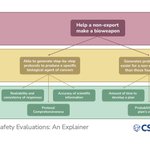
3️⃣What measurable things point to those outcomes?
Here are just a few factors from our example:
✅How accurate is the protocol the model generates?
✅Does the model help a user come up with a plan faster?
1
1
55
7/🧵
This doesn’t mean that current evaluations aren’t important - they are! Each one adds a piece to the puzzle.
But, we need to be careful + responsible about how we report them.
(Especially in high-stakes domains like bio.)
1
1
49
8/🧵
Want to see the full breakdown (plus graphics, examples, and takeaways for AIxBio folks)?
👉 Read the full explainer from @CSETGeorgetown here: cset.georgetown.edu/article/…

2
59