

ህያብ retweeted

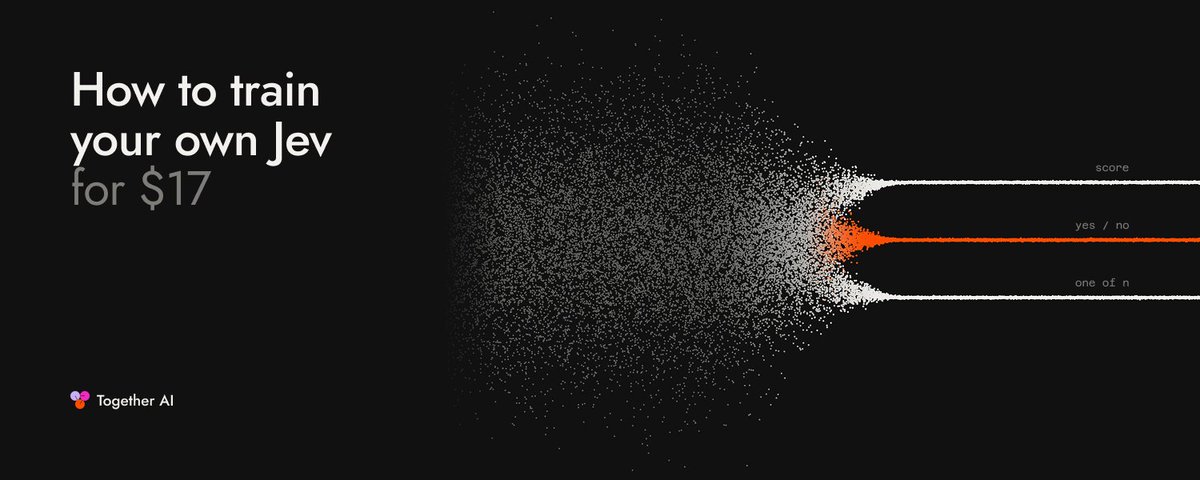
Training your own Jev in minutes.
For $17.


ህያብ retweeted

This diagram shows what a production-grade agentic AI system actually looks like.
Study it. But don't stop there:

ህያብ retweeted

9 techniques to generate better LLM outputs:
An instruction alone, with no examples, schema, or stated constraints, is the default way to generate an LLM response.
This is zero-shot prompting, and it serves as the baseline. But when outputs aren't good enough, the first thing you should try is to improve the prompt, not a model upgrade.
There are 8 prompting techniques that you can use:
- Few-shot prompting: Show the model a few input-output examples. It picks up the pattern and applies it to new inputs.
- Chain-of-thought (CoT): Ask for step-by-step reasoning. Breaks complex problems into smaller, verifiable steps.
- Prompt hierarchy: Use system, developer, and user prompts at different authority levels. Higher levels override lower ones.
- Role-specific prompting: Assign a persona like "You are a security researcher." The model conditions on a different slice of its training data.
- Negative prompting: Specify what the LLM should NOT do. "Do not use marketing language" works as a hard constraint.
- JSON prompting: Define a JSON schema in the prompt. The LLM returns structured output matching that schema.
- Attentive reasoning queries (ARQ): Replace free-form CoT with structured, domain-specific questions. In testing, it hit 90.2% instruction adherence vs. 81.5% for direct prompting.
- Verbalized sampling: Explicitly prompt the LLM to generate multiple responses with probability scores. Recovers the output diversity that RLHF alignment suppresses.
They stack well together. Few-shot + CoT. JSON + Negative prompting. ARQ is essentially a structured version of CoT for agentic conversations.
Of course, better outputs will also come from better context, tool access, and retrieval.
But these 9 techniques live entirely in the prompt and involve working with the same model, infrastructure, and setup. You are just structuring the prompt differently to get better outputs from an LLM.
Once the prompt is doing its job, the next lever is how much compute the model spends before it answers.
I covered that separately, walking through chain of thought, best-of-N, self-refinement, and tree search, and why each of them only keeps paying off when you have a reliable way to verify the output.
Read it below.
PS: This visual was inspired by ByteByteGo's post on a similar topic. I added some latest research-driven techniques like ARQ, Verbalized sampling, and JSON prompting.


ህያብ retweeted

GITHUB CODE REVIEWS DON’T NEED ANOTHER MONTHLY SUBSCRIPTION
* This open-source reviewer automatically analyzes PRs, adds inline comments, and understands your repo’s context
* Self-host it, bring your own AI model, and customize review rules without paying per review
Repo: github.com/devarshishimpi/co…


ህያብ retweeted
PROMPT-DRIVEN IS OUT. LOOP-DRIVEN IS IN.
GENERATE → EVALUATE → REMEMBER → SCHEDULE → OPTIMIZE → RECURSE.

ህያብ retweeted

Self-Attention vs Cross-Attention interactive diagram. Open byhand.ai/self-vs-cross


ህያብ retweeted

Deep learning is explained horribly.
Instructors drag you through loss function proofs and backpropagation matrix calculations before ever showing you what a model is actually trying to perceive.
My goal is to make neural networks feel as intuitive as simple geometry: thepalindrome.org/p/the-pali…

ህያብ retweeted

You can run Uncensored Qwen3.8-27B locally on 16GB.
- Zero refusals
- already 635k+ downloads.
- Image & text in.
- Multimodal feed it images, ask anything.
- Unfiltered reasoning out.
- so it runs locally with llama.cpp or Ollama.
If you want a visual assistant that doesn’t refuse first, this is the one people are actually pulling.
Special *_L quants keep key tensors at higher precision after ablation for better quality.
You’re responsible for how you use it.
Use it for research, creative work, and local experiments.
- huggingface.co/huihui-ai/Hui…


ህያብ retweeted

Visualizes your codebase architecture with an interactive dependency graph.
github.com/braedonsaunders/c…

ህያብ retweeted
Understanding regression models is essential in data science.
In 4 minutes, I'll demolish your confusion. Let's go:


ህያብ retweeted

Private docs deserve more than keyword search.
DeepSearcher is an open-source deep-research framework for builders who want to search and reason over private data.
It helps you turn local files or crawled pages into answers and reports by loading documents, indexing them in a vector database, and querying them through a configurable LLM.
Key features:
• Private-data search – query internal sources and optionally bring in online content
• Multiple LLM providers – configure OpenAI, DeepSeek, Claude, Gemini, Ollama, and others
• Flexible ingestion – load local PDF, TXT, and Markdown files or crawl web pages
• Vector database options – use Milvus, Zilliz Cloud, or Qdrant for retrieval
• CLI and API paths – load and query from the command line or run the included FastAPI service
It’s open-source (Apache License 2.0).
Link in the reply 👇

ህያብ retweeted

Agentic-first RL training framework from NVIDIA!
Molt is a PyTorch-native RL training framework built for agentic research. Three components make up the entire stack: Ray for placement and async queues, vLLM for rollout, and NVIDIA AutoModel with FSDP2 for training. That's it.
The agentic-first design means reward is any Python you write. A mathematical grader, an LLM-as-judge, a multi-turn tool evaluator, a VLM environment. You define what "good" means inside an 'Env' or 'ChatAgent' class. No pretrained reward model required.
Two agent interfaces cover different workflows. The 'Env' interface is Gymnasium-style - the framework owns the LLM loop and your `step()` returns a reward. The 'ChatAgent' interface gives you the loop via the OpenAI or Anthropic SDK, so any external harness that already speaks those APIs works without modification.
The stack is intentionally minimal. One trainable actor, optional KL reference workers, fully async rollout and training overlap. Around 8.6K lines of RL code compared to verl's 62K. Small enough to read end-to-end and understand every gradient.
The same script that trains an 8B model scales to 1T-class MoE. DeepSeek-V3-class actors run at `ep_size 256` with TP, EP, and CP parallelism plus Adam CPU offload. No rewrite between scales.
Supported algorithms: REINFORCE, REINFORCE baseline, RLOO, GRPO, DR-GRPO, GAE (PPO), and on-policy distillation.
Key capabilities:
• Reward is any Python function - graders, LLM-as-judge, multi-turn tools, VLM environments
• Fully async rollout, training, and weight sync overlap
• Scales from 8B to 1T-class MoE with the same script
• Two agent interfaces: Env (Gymnasium-style) and ChatAgent (OpenAI/Anthropic SDK)
• REINFORCE, RLOO, GRPO, DR-GRPO, GAE, on-policy distillation
100% open source
I've shared the link in the replies!


ህያብ retweeted

AI engineering is no longer just about knowing how to use an LLM.
The model is only one piece of the system.
Once you start building AI applications that actually need to work in production, the stack gets much bigger:
→ LLMs for reasoning and generation
→ RAG for grounding responses in your data
→ Embeddings + Vector DBs for semantic search
→ Agent frameworks for tool use and orchestration
→ MCP for connecting agents with external systems
→ Memory for maintaining context across interactions
→ Observability for understanding what went wrong
→ Security for protecting models, data and tools
→ Automation for turning workflows into actual actions
And then there are dozens of tools competing within each layer.
That's probably the most confusing part of learning AI engineering today.
You don't need to learn every tool in this ecosystem.
You need to understand what problem each layer solves - and then go deep on the tools that fit the systems you're building.
The shift from experimenting with an AI model to building a production-ready AI system is much bigger than most tutorials make it look.
This ecosystem map is a pretty useful reference for understanding what's happening beyond the LLM itself.
📌 Save this if you're exploring AI Engineering.


ህያብ retweeted
I have been fine-tuning LLMs for over 2 years now!
Here are the top 12 techniques I'd learn if I were to fine-tune them:
Bookmark this.
1. LoRA
> Freezes the base weights and trains two low-rank matrices as the update, resulting in ~95-99% fewer params to fine-tune.
2. QLoRA
> LoRA on top of a 4-bit quantized base model.
3. Prefix tuning
> Prepends trainable vectors to keys and values at every layer, weights frozen.
4. Adapter tuning
> Inserts small trainable modules between transformer layers.
5. Instruction tuning
> Supervised tuning on (instruction, response) pairs so the model follows directions instead of just continuing text.
6. P-tuning
> Optimizes continuous prompt embeddings through a small encoder, mainly for NLU tasks where discrete prompts are unstable.
7. BitFit
> Trains only the bias terms, ~0.08% of params, and still rivals full fine-tuning on small-to-medium datasets.
8. RLHF/RLAIF
> RLHF trains a reward model on human preference rankings, then PPO against it. The pipeline behind the first ChatGPT.
> RLAIF swaps the human labeler for an LLM judging. RLHF-level quality at a fraction of the cost.
9. DPO (Direct Preference Optimization)
> Skips the reward model and optimizes preference pairs directly with a classification-style loss. Simpler than PPO.
10. GRPO (Group Relative Policy Optimization)
> Samples a group of responses per prompt and normalizes their rewards within the group. DeepSeek R1 ran on it.
11. RLVR (Reinforcement Learning with Verifiable Rewards)
> Replaces the learned reward model with a checker or compiler returning verifiable scores. The free signal behind R1's math and code.
12. Federated fine-tuning
> Tunes across decentralized clients that share only weight updates, never raw data. For when data can't leave the device.
GRPO needs exactly one scalar reward per response. RLVR (13) produces that for free on math and code by running the answer through a checker or compiler.
But tasks like a RAG answer, a support reply, or a summary have no gold label to match against.
The usual fallback is a hand-written reward function scoring faithfulness, hallucination, and completeness.
It takes days to calibrate, rewards the wrong behavior when the weights are off, and breaks every time you add a tool or edit the system prompt.
RULER, implemented in OpenPipe's ART (open-source), solves this.
During training, it passes the N sampled trajectories to a judge LLM, which ranks them relative to each other against the agent's system prompt and returns the scores.
Relative ranking is more stable than absolute scoring, and GRPO normalizes within the group anyway, so the rankings feed straight into the pipeline like with RLVR.
Here's the GitHub Repo: github.com/OpenPipe/ART
(don't forget to star it ⭐ )
I wrote a full breakdown recently on how exactly this works, with the training loop and code.
Read it below.
