Official account for StarDate, the public education & outreach arm of McDonald Observatory, a research unit of @UTAustin. New podcasts & print issues regularly!

Austin, Texas, USA
Joined June 2008
StarDate Radio produces short, daily podcasts covering all things astronomy. Subscribe to get them the day they’re posted, or wait a day and listen for free! As always, StarDate appreciates your support!
3
8
30
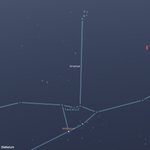
The planet Uranus is in a good position right now. It’s halfway between Aldebaran—the bright eye of the bull—and the Pleiades star cluster. They climb into good view in late evening. Through binoculars, Uranus looks like a faint star.
3
1
18
363
Capricornus (the Sea-goat) is low in the south at nightfall. The constellation isn’t especially bright, likely invisible to light-polluted cities. But under darker skies, you can see the outline of a wide triangle. Tonight, the Moon is near the triangle’s eastern point.
2
8
256
☄️ The Orionid meteor shower is at its best this week! At its peak, it produces a couple of dozen “shooting stars” per hour. Find a dark skywatching site, far from city lights - The best view comes in the wee hours of the morning, after the Moon has set. [Image by James McCue]
5
11
424
An amazing machine is scheduled to buzz through the frigid skies of Saturn’s moon Titan in a few years, and we’ll have details! We’ll also tell you about a sea-goat, the first “dark sky” city, and more. This week — on StarDate! ow.ly/XsTw50ZZ2rB [Image via darksky .org]
3
9
412
The Moon is at first quarter today. It lines up at a right angle to the line between Earth and the Sun, so the Sun illuminates precisely half of the lunar hemisphere that faces our way.
1
2
1
18
384
Pegasus, the flying horse, stretches far across the sky this evening. Its main feature, a wide pattern of four moderately bright stars known as the Great Square, outlines its body. Its nose, the star Enif, stands to the upper right of the square.
8
2
20
543
Tau Ceti, one of the most popular star systems in science fiction, is in the constellation Cetus, the sea monster. The star climbs into view in the east-southeast by about 9 or 9:30 p.m. It is faint, so you need a starchart to help you pick it out.
7
1
17
329
The thick crescent Moon sets about three hours after sunset. On average, the Moon is about a quarter-of-a-million miles from Earth. But the distance is growing by an inch and a half per year! [waxing crescent; NASA]
3
21
416
Antares, the bright star at the heart of Scorpius, huddles quite close to the Moon early this evening. They set not long after the sky gets dark, so there’s not a lot of time to look for them.
1
3
1
10
254
The third-largest galaxy in our neighborhood, M33, is in Triangulum, which is in the east in mid evening. The galaxy is visible through binoculars as a hazy smudge of light not far from the triangle of stars that gives the constellation its name.
2
16
355
StarDate retweeted
CosmicAI Lightning Talk! Yiheng Su @SamSu31415 is a Ph.D. student at the School of Information at @UTAustin Listen to the talk “RELISH: LLM REgression with a Latent Iterative State Head” youtube.com/watch?v=5YvpqHmf…
3
1
3
835
Vesta, the second-largest object in the asteroid belt, lines up opposite the Sun tonight. It is brightest for the year, and it’s in view all night. You need binoculars to spot it, not far below the bright planet Saturn, which is low in the east at nightfall.
2
5
16
442
Big space rocks have pounded the Moon, along with Earth and the other planets, since the birth of the solar system. We’ll have stories of several of those impacts, including one that might have destroyed a planet! All this week — on StarDate! ow.ly/etnX50ZWVik
2
13
259
Messier 10 is a globular cluster—hundreds of thousands of stars packed into a ball a few dozen light-years across. It is in the southwest at nightfall, to the upper right of the Sagittarius teapot. Through binoculars, it looks like a hazy smudge of light.
2
14
440
The star clusters NGC 869 and 884 are in the northeast as night falls, in Perseus. Together, they are known as the Double Cluster. Under dark skies, they are visible to the eye alone as a hazy smudge of light. Binoculars reveal two sparkling balls of stars.
1
3
11
349
Cassiopeia is an easy constellation to pick out. The stars of the queen form a prominent letter M or W, which is visible even through moderate light pollution. It’s in the northeast at nightfall and climbs high across the north during the night.
2
1
17
411
✨The @mcdonaldobs is helping lead a #NASA mission to study the dust between stars! Learn about PUFFINS, and how new clues about tiny dust particles play an important role in how stars and planets form! ow.ly/JxOu50ZVys8
2
12
365
StarDate retweeted
CosmicAI Hybrid Seminar Wed, Oct 14th 1pm-2pm Zoom/in person at UT Austin From astrochemical models to surrogate models (Mélisse Bonfand-Caldeira) Reduced-Order Model for Chemical Kinetics ( Arjun Vijaywargiya) Adaptive approximation (George Biros) cosmicai.org/events/astroche…
2
3
173
The stars of the Summer Triangle remain in good view in the western evening sky. The brightest member of the trio is Vega, which is high in the west in mid evening. Altair stands well to its left, with Deneb highest in the sky.
4
1
13
305