


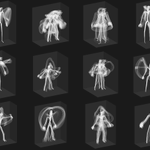
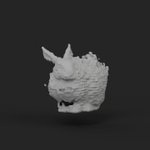


今年の #SESSIONS_Party のCodeGraphicsCompoに投稿した作品、monte carlo法でのgeneralized winding number計算を用いた表現の試みでした
compute.toys/view/2705


ありがとう、お役に立てればぜひ🙏

#SESSIONS_Party で気になっていた作品のメイキングを読んでいたら、自作にも触れていただいていた Glyph Atlas( observablehq.com/@stwind/sou… )、ぜひ僕のpHash、徳井さんのCNNベースの近縁度検索と併せて #unim_app に取り込ませて欲しいです..
zenn.dev/stwind/articles/dbf…

st_ind retweeted

★ Dynamicland's new website documents ten years of progress toward a humane dynamic medium. dynamicland.org

st_ind retweeted

Signed distance functions (SDFs) are an important surface representation, which can be directly visualized via the “sphere tracing” algorithm.
At #SIGGRAPH2024 we showed how to sphere trace a whole new class of surfaces, based on *harmonic functions* rather than SDFs. [1/n]


st_ind retweeted

The @CVPR AI Art Gallery is now live 🤖🎨
Featuring 115+ artworks using or about computer vision😎
View them here: thecvf-art.com
#AIart #CVPR2024


The scene was rendered on @GoogleColab with a T4 GPU, in a standalone notebook. Check out the code if you are interested.
colab.research.google.com/dr…

I took an image from RIT's Spectral Images of the Artist Paintings dataset, which is a spectral image with spectral distribution of 28 bands, ranging from 430 nm to 700 nm. Then project the spectral data to 3d using UMAP and hand it render in #blender. rit.edu/science/studio-scien…

