

Ex: KGeN (CTO), Google, Cisco | Engineering Leader | Author
Bengaluru, India
Joined March 2016
- Tweets336
- Following91
- Followers2K
- Likes281




Pinned Tweet
The Udemy courses I valued most connected first principles with practical work.
That shaped Inside AI Agent Systems: From Components to Platforms—a structured path through concepts, experiments and platform choices.
udemy.com/course/inside-ai-a…

486
1/3 Ever copy an answer from one AI agent into another just to get a second opinion? I use Frenemy to skip that copy-paste. Its MCP server calls the reviewing agent’s CLI and brings back the review.
github.com/noblehacks/frenem…

3
2
98
2/3 I use Codex Cloud and Gemini to review each other’s answers. It helps me challenge architecture decisions, catch missing details, and check the reasoning. Code review is another use case.
1
22
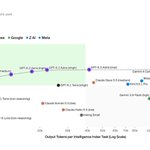
1/6 How far have open-weight AI models come? Artificial Analysis’s Progress Index tracks the best open-weight model over time. The overall line rises substantially. What happens if we cap model size?
artificialanalysis.ai/models…

1
46
5/6 The existing Score vs. Output Tokens per Task chart shows the trade-off. Each dot is a model at a given effort setting. At a similar score, the dot farther left got there with fewer tokens.
artificialanalysis.ai/evalua…

1
12
6/6 @ArtificialAnlys, could you plot score vs. output tokens per task across same-family, same-size releases? Label dates and use one benchmark version. Count reasoning tokens too, so we can see if higher scores came with more tokens per task.
artificialanalysis.ai/evalua…

8
1/3
A visual response from an agent can be easier to understand and act on than a block of text.
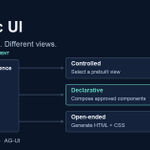
As the question or task changes, the interface should adapt. I tried three ways to do that in my marketplace app, using the same evidence.

ALT The same marketplace evidence feeds three views: a selected prebuilt view, a composition of approved components, or a view generated in HTML and CSS.
1
24
2/3
How much freedom should the agent have?
• Controlled: select a prebuilt view
• Declarative: compose agreed components
• Open-ended: generate the UI code
My takeaway: choose the freedom your task needs—and the behavior you can validate.
1
14
3/3
MCP Apps embeds UI in a compatible host.
A2UI describes the view.
AG-UI connects app and agent events.
Different roles; they can work together.
Walkthrough to help choose an approach:
youtu.be/AFwt2MjEN6w
Which approach fits your use case?
19
1/4
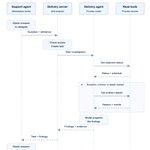
A support agent knows the marketplace. A delivery provider knows the shipment.
How can support ask the provider to investigate without sharing its internal implementation? I explored that boundary with A2A in my marketplace agent application.
1
34
3/4
An Agent Card describes what the agent offers and where to call it. Discovery still needs a starting point: a known domain, registry or configuration.
A2A connects to an agent; MCP connects to tools and resources. An agent can use both.
1
15
4/4
A2A helps independently managed agents work across team, platform or provider boundaries through a common interface. Not every agent-to-agent call needs it; agents within one app can use simpler approaches.
Walkthrough:
youtu.be/TNz8u-eqjGU
5
1/4
An AI agent has a valid credential. Can it read another buyer's order?
That depends on the permissions enforced behind the tool. I tested MCP access in a marketplace agent to make this boundary concrete: whose authority is the call using?
3
1
82
3/4
The useful tests included denials, not just successful logins.
My own buyer order succeeded; another buyer's order was blocked by the backend. The payout worker also faced eligibility and amount limits, and retries did not pay twice.
1
11
4/4
My takeaway: choose whose authority the tool call represents, then enforce ownership and business rules in the backend. A valid token alone is not permission for every action.
Full video walkthrough:
youtu.be/uxcTVYYaOxc
12