

Critical Rationalist, Popperian, Classical Liberal, Socionics Enthusiast (LII)
Willerby, Hull
Joined April 2009
- Tweets5.2K
- Following481
- Followers204
- Likes2.1K







Pinned Tweet
Does time flow? Physicist @DavidDeutschOxf says no: there’s no moving “now”, just moments, each a complete universe of its own.
A free site setting his idea against 2,500 years of thought on time, from Heraclitus to Einstein, with 10 short videos:
philosophyoftime.org.uk

Tim Stephenson retweeted

A reminder that if @andyburnham doesn’t stick with FPTP we will not have decisive failure of candidates such as @ZackPolanski


Tim Stephenson retweeted

The Norman Conquest was a cataclysm for the English people. After 1066, the country was clenched in a mailed fist. Castles, until then a rarity, sprang up everywhere. Many still stand, handsome and crenelated, their geographical situation advertising their grim purpose. For these were not defences against a foreign foe, but instruments of internal repression, from whose arrow-slits new proprietors peered out at a beaten people.
Having put down the North with terrifying savagery, leaving stretches of country depopulated, William began to rule as an absolute monarch. Quite how absolute can be seen from his compilation, some years afterwards, of a comprehensive inventory of the kingdom he now possessed. For there was no question in his mind that England was his to do with as he would. As the Anglo-Saxon Chronicle put it:
“So very thoroughly did he have the inquiry carried out that there was not a single hide of land, not even – it is shameful to record it, but it did not seem shameful to him to do it – not even one ox, nor one cow, nor one pig which escaped notice in his survey.”
The resulting tome became known as the Domesday Book, for it was said that you might as well try to deceive God on the Day of Judgment as hide your goods or chattels from the king’s officers.
William parcelled out almost the entire country among his mercenaries and liegemen. At least 92 per cent of England was owned by men who had been born on the other side of the Channel. Of more than 200 landowners who held their estates directly from the king, only two were Anglo-Saxons: Thorkell of Arden and Colswein of Lincoln.
Equality before the law was forgotten as the new aristocracy settled down to enjoy its privileges. Men were required by law to work on their lord’s estates, and forbidden to leave without his permission.
Englishness became, almost by definition, a badge of subjugation. Human nature being what it is, people soon began to adopt the names and manners of their overlords. On one English farm in 1114, records Peter Ackroyd, the workers were listed as being called Soen, Rainald, Ailwin, Lemar, Godwin, Ordric, Alric, Saroi, Ulviet and Ulfac. By the end of the century all those names had disappeared.
The status of the defeated English is often illustrated with reference to the vocabulary of meat. The Anglophone farmer in the field used plain Saxon words for his livestock: cow, pig, sheep. But by the time these animals found their way onto his Norman master’s plate, they had acquired French-derived names: beef, pork, mutton.
More telling, though, is the political vocabulary introduced under the Normans. Out go witan, folkmoot and folkright. In come fealty and homage, fief and vassal, villein and serf. The progress toward personal liberty, free contract and equal access to the common law was suspended. In the words of the early twelfth-century chronicler, Orderic Vitalis: “The English groaned aloud for their lost liberty and plotted ceaselessly to find some way of shaking off a yoke that was so intolerable and unaccustomed”.
The idea of “throwing off the Norman yoke” was to animate English radicals for the next seven centuries. Civil War Roundheads spoke of struggling against “William’s lieutenants”, meaning that the landowners of their own time were heirs to the men who had expropriated the English.
“Wurðe god se ende þonne God wylle”, says the Anglo-Saxon Chronicle, lamenting the subjugation of 1066: May the end be good when God wills. The seventeenth century struggles may be seen – were seen by the key actors – as a belated reversal of the catastrophe. It is that reversal which truly deserves to be celebrated.


With the release of ChatGPT Work yesterday I produced a philosophical reflection on AI consciousness and whether future artificial minds might have structured information metabolism in a way Socionics Model L can help us think about.
tetratypes.org.uk/blog-chatg…
🤖 Made with AI


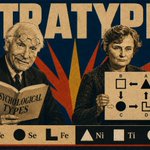
Model L — Kimani White and Aleesha Lowry's monadic element extension of socionics — deserves better online resources. So I built one.
tetratypes.org.uk
Model A at WSS resolution + Model L in depth. Independent resource, unaffiliated.

Model L, Kimani White and Aleesha Lowry's monadic element extension of socionics deserves better online resources. So I built one.
tetratypes.org.uk
Model A at WSS resolution + Model L in depth. Independent resource, unaffiliated.

Updated Socionics Model-L tool created with Claude and Codex. model-l-tool.timstephenson40…

I have created a Socionics Model L Reference app using Anthropic Claude, accessible here: model-l-reference.timstephen…
🤖 Made with AI

Tim Stephenson retweeted

Why determinism is compatible with free will:
No one can predict your decisions without creating a perfect simulation of you that would itself exercise the free will required to make those decisions.
~Conjecture Institute Fellow @maria__violaris

Tim Stephenson retweeted
Dogmatism: there exists a thing (or things) it is impossible to be objectively wrong about.
Relativism: it is impossible to be objectively wrong. (Those are closely related).
Fallibilism: it is always possible to be objectively wrong about reality.
~Conjecture Institute Ambassador @ToKTeacher
If someone says "love is just a word" they don't mean "love" is a word and they don't mean that love is no more than a word, they are usually objecting to people using the word in the absence of other demonstrations that they are showing love, substituting love for using the word

Daniel Dennett on "deepities" the profound-sounding claims that are secretly empty
Philosopher Daniel Dennett has a name for a type of statement that sounds wise but actually says nothing: a deepity.
He explains it this way:
"A deepity is an apparently profound observation that is ambiguous. It has two readings. On one reading it's obviously false, but if it were true it would be very important. And on the other it's trivially true."
The trick is in the ambiguity. When you hear a deepity, part of your brain registers the trivially true reading and thinks yes, that's correct. But another part is reaching for the dramatic, important-sounding reading and that's where the illusion of profundity comes from.
Dennett's favourite example, which he uses when teaching the concept to students:
"Love is just a word."
It sounds deep. Think about it for a moment and it feels like it's gesturing at something real. That love is intangible, constructed, perhaps even illusory.
But Dennett dismantles it immediately:
"Whatever love is, it isn't a word. You can't find love in the dictionary."
That's the "use-mention error" confusing the word love with the thing love refers to. Once you put quotation marks around it properly, the statement collapses into something utterly banal: "love" is just a word. Well, yes. So is "cheeseburger." So is "word."
The deepity survives only because we don't slow down enough to ask which reading we're actually accepting.
Once you have the word "deepity," you start seeing them everywhere: in self-help, in politics, in philosophy.
Tim Stephenson retweeted
As if Popper never existed (again).
A crucial sense in which theory comes first in science is: any data collected will be collected according to pre-existing theories whether anyone acknowledges them or not. Eg: how data collection devices work, theories of uncertainties, etc.

There's a strange myth about science: that theory comes first, and that data cannot show anything new. But anyone who's ever done science knows the truth that there's a long conversation between data & hypotheses. Back & forth.. until the discovery. And if you think about it, it has to be this way!
(Night Science recap, Day 6)

I’ve been thinking about how I actually use Socionics, especially in light of discussions about whether it’s “scientific.”
From a critical rationalist perspective (Popper), I don’t treat Model A as established knowledge or a proven theory of the psyche. At best, it’s a conjecture

4. If I discarded it entirely, I’d lose the tool I’m using to navigate.
But that doesn’t mean I treat it as beyond criticism. I’m fully open, in principle, to the model being wrong, and to replacing it if a better, less ad hoc framework comes along..