

Intelligence as Physics | Physical AI Foundational Models
H(q,p)
Joined December 2024
- Tweets108
- Following789
- Followers72
- Likes480






Pinned Tweet
What if a robotic hand spun a cube purely by touch — with 560 bio-inspired metriplectic neurons, zero vision, zero backprop, zero external clock?
Our Elephant brain architecture just hit two big milestones in sim.
1/n
Even better: cutting touch in v4 stops rotation completely (0/100 turning), and cutting the internal brainwave halves total rotation and drops survival by 12%.
Both the endogenous rhythm and live tactile feedback are doing real causal work, from a random birth.
10/n
1
1
9
We're nowhere near done: this is still MuJoCo sim, and on the harder 150 g task only 1 of 2 builds crossed the 90° corner barrier so far (Build 2 held safely at 94% survival without turning).
Next: 2/2 reproducibility, >80% fingertip rotation, adding vision, and real hardware.
11/n - this is the last xeet
1
8
Physics-based AI, step two. Meet Elephant.
96 metriplectic neurons that taught themselves a Doom arena from the screen + simple reward (+1 for kill and -1 for death) alone. no MLP, no deep RL, no critic network, no transformer, no backprop, no GPU. On unseen games: about 22 kills from 26 rounds.
We go back and revive decades old ideas and put them together into a working system.
1/n
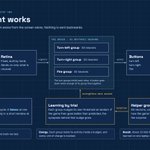
How it works. A fixed retina turns the screen into contrast and edge signals, passing on only what is unusual. Three groups of 32 neurons read it, one group per button: left, right, fire. When enough of a group fires together, its button goes down.
Each neuron runs on its own cycle: it listens at one phase and fires only in a short window at another. To learn, each group keeps nudging its own threshold at random. A helper group predicts how the game will go. When it goes better, the synapses behind the nudge grow.
Energy is accounted for. Every unit of charge is tracked, and each group keeps its own activity inside a budget.
The brain also keeps a slow copy of itself from its best play to fall back on. Nothing is differentiated and nothing is sent backwards. It learns while it plays.
6/n

1
24
The brain learnt by itself:
• spin to scan the room
• fire a beat early, as the sweep reaches a monster
• leave the far ones alone, because those shots might miss.
As for next we are running experiments to extend to other arenas, also work on touch sensor based robotic hand control coupled with vision. More updates soon.
7/n - this is the last xeet in the thread
26
the waves are rising...

If they really start to gatekeep who gets to use the best models, that is a declaration of war.
This prospect fills me with the most sincere, bodily cypherpunk will-to-power that I've ever felt (at least since I was a teenager). If they really go down this route, I would go all-in on building the most psychotic swarms of open-source models and fine-tunes possible, all geared toward a Chaotic Good jamming of the entire institutional public sphere. If we didn't do that, all of political life and the marketplace of ideas would be over before we know it.
It's one thing if the top models become too expensive for me or others to use (I'm already pricing that in, and if you can't build something profitable enough to climb that ladder as it gets pulled up, then that's fair enough).
But if the ladder gets pulled up politically, now, so only select institutional players get access to the most intelligent models, then any mature American man should be as energized as gun collectors are around the 2nd Amendment, or liberal women are around Planned Parenthood.
146
Decentralised AI training and inference with Blocktrain
The idea
Instead of distributing one global objective across the network, give each block its own local objective.
We built on DiffusionBlocks (@SakanaAILabs ). The trick there is to treat each residual block as a step in a denoising trajectory: every block tries to predict the same final target, but from a different noise level. Early blocks do the coarse, noisy denoising; later blocks clean up. The nice property for us is that a worker only ever has to hold one block plus the shared embedding, never the full model, never the full optimizer state. Training memory tracks the active block, not the whole stack.
What we found
On real text (byte-level WikiText, not a toy token proxy) it gets to CE 1.359 vs ~1.32 for a normal end-to-end transformer on the exact same setup. So about 0.04 nats behind — while the worker's optimizer state is ~0.2 GiB instead of ~100 GiB for the full stack. Roughly 500× less optimizer memory on the worker for that 0.04-nat gap. Honestly we expected a bigger quality hit, and it didn't show up at this scale.
And we actually ran it across machines, not just in a simulator:
- Six workers averaging their block updates into one shared model → CE 1.385.
- A three-host run over public internet IPs, shoving ~15 GB of real checkpoints and updates back and forth over HTTP/TCP, full participation. CE climbs from 5.58 to 1.81.
So the protocol path is real end to end: simulator → same-node transport → actual WAN. It's not a bandwidth mock-up.
Tuning noise levels
The naive version cheats: at low noise the block can read the answer off its input, so training loss looks great while from-noise inference quietly collapses — and the training metric never warns you. Fix is simple: keep the noise high enough (σ ∈ [1, 10]) that the block has to denoise from context instead of copying. Block size is the other lever — too small and it can't carry its piece. Both sorted.
Inference
BlockTrain's inference turns out to be "one sweep" — the whole output sequence gets refined in a *single* pass through the blocks, instead of the usual loop-the-whole-stack-once-per-token. Over a wide-area network that's a real structural difference: every network hop gets amortized over an entire sequence rather than a single token. We checked the one-sweep property holds across shapes up to a 75.80B-parameter logical fp16 setup spread over three hosts.
Why it might be interesting
If you can make the training objective local at the same granularity as the hardware, then "training a capable model" stops requiring one tightly-coupled cluster. In principle a bunch of smaller, scattered machines could do it together.
Paper: arxiv.org/abs/2606.24722
