

Founder & CEO @ Plumloom | Building LLM eval & reliability infrastructure | https://xitter.cf/t.co/fOF7ThgLEY | OSS Autoeval
San Francisco
Joined December 2008
- Tweets3.6K
- Following153
- Followers168
- Likes4



Pinned Tweet
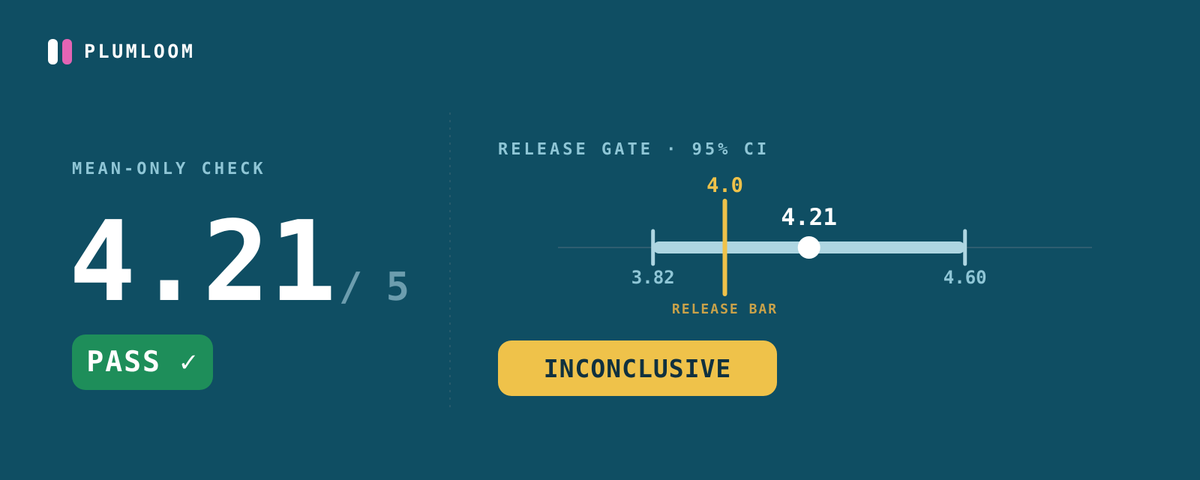
A passing score doesn't tell the whole story. The model can behave differently across trials, and AI judges can disagree.
Here's how Plumloom Autoeval measures eval reliability and uses that evidence to make release decisions.
A little creative experiment at Plumloom.
While designing our free pilot page, we explored retro pixel art inspired by early computing, with chunky pixels, limited colors, and Bayer dithering.
We liked it enough to make it part of Autoeval’s visual identity.
Sharing a few examples. Curious what you think!

SF Tech Week has more than 1,600 events, and LA Tech Week has around 800. Finding a handful that match your interests and schedule can take hours.
We built Tech Week Picks in Lovable, partly to explore what we could build with the platform. The app asks five questions about your role, goals, and interests, then recommends a personalized lineup without scheduling conflicts.
We chose TypeSafe's Jev because we needed fast, structured judgments. Jev classifies events by topic, audience, and format, then helps rerank the strongest matches. The scheduling and ranking rules stay in code.
The next challenge was tuning the recommendations for quality.
We installed Plumloom Autoeval directly in the Lovable development environment with one command:
npm i -g @plumloom/cli
From there, the Lovable coding agent could run evaluations against the actual app outputs, across multiple visitor profiles and trials, and examine relevance and factuality scores.
Autoeval uncovered unsupported explanations, weak recommendations toward the bottom of lineups, and noise in the event data that was producing false matches. The coding agent used those findings to refine the recommendation logic, and we reran the evaluations to check the changes.
This evaluation and tuning took a couple of hours. Manually testing and refining recommendations across those visitor profiles would have taken several days.
The early response has been encouraging. For SF Tech Week, 79% of visitors who started the quiz completed it.
What stood out from this experiment was how quickly we could move from building the app to evaluating and improving its recommendations, using Autoeval directly in the Lovable workflow.
Try Autoeval (open source):
github.com/AlchemyInCode/plu…

Link to the SF tech week: techweek.plumloom.ai/sf
And LA tech week:
techweek.plumloom.ai/ls

Here's the link to LA tech week:
techweek.plumloom.ai/la
And SF Tech week:
techweek.plumloom.ai/sf
“But our evals passed” is a painful explanation when an AI failure reaches customers.
A passing score can hide three different problems: a judge that doesn't reflect your team's standards, inconsistent judge assessments, or application behavior that varies across trials.
Plumloom Autoeval addresses these separately, helping teams build more reliable evaluation evidence and make better release decisions.
We're offering free Autoeval pilots for teams building AI applications and agents.
Bring a workflow you're already testing. We'll help you set up evaluations, review the results, and configure release gates. Hands-on onboarding, evaluation support, and AI model usage are included.
Interested? Sign up using this link:
plumloom.ai/free-pilot/

LA is next.
After seeing a strong signal from the SF Tech Week site,
I’m expanding it to LA Tech Week.
800+ events across the week. Answer a few questions and get a personalized lineup based on what you care about.
Built and evaluated with open source Plumloom Autoeval.
techweek.plumloom.ai/la

ALT Your LA Tech Week Lineup
1,600+ SF Tech Week events is a lot.
Built a small app to help people find the ones that actually fit their interests.
Under the hood: Jev for event classification/reranking, Plumloom Autoeval with an OpenAI GPT-5.6 Terra judge, all built in Lovable.
Private by design. No user info collected.
Here’s mine.
Try yours: techweek.plumloom.ai

A code change can leave an AI agent running while quietly breaking behavior that worked before.
On Sep 30, I’m hosting a webinar showing an eval-first CI workflow for catching those regressions before they ship, using Autoeval with Claude Code, Codex, or DeepSeek Harness.
We’ll cover how to turn agent failures into evals, separate real regressions from eval noise, and use the results as a CI gate.
👉 Register free: plumloom.ai/webinar/catch-ai…

Been looking more closely at Jev. Its scope is quite specific: fast, bounded decisions inside software like classify, route, score, extract or branch.
That works well for things like support routing or workflow decisions. Writing code, talking to customers, research and open-ended agent work are a different class of problem.
For higher-risk AI agents, production shouldn’t be where foreseeable failures are discovered.
Offline evals move known risk earlier. Production reveals what the eval suite missed.
And because both models and judges vary, one eval score is still only one observation.
I wrote out the fuller reasoning here, including where offline evaluation fits and why a single eval result can still be misleading:
lnkd.in/p/gmMZ9x8S
Ganesan Anand retweeted

Claude Code just dropped "Getting Started with Loops"
This is their first official document about Loop Engineering.
Spoiler: prompt engineering didn't survive.
Here's the full guide in one post:
1. Turn-based
Every prompt you send already runs as a loop: Claude gathers context, takes action, checks its own work, and repeats until it decides the task is done or realizes it needs your input.
2. Goal-based
You define what "done" looks like with /goal, and Claude keeps iterating toward it. Every time it tries to stop, a separate evaluator model checks your condition - if it's not met, Claude gets sent back to work until the goal is reached or the turn limit hits.
3. Time-based
This is the /loop command: нou set an interval and a prompt fires on schedule. For example, every 5 minutes Claude checks your PR, addresses review comments, and fixes failing CI.
4. Proactive
Here you set up an event once, and the loop triggers itself whenever that event happens - with zero human input.
Anthropic also shared optimization advice - and this part matters most:
- Loop quality depends on system quality.
- Tokens are the real cost
None of this is magic. It's the same familiar parts - /goal, /loop, Skills, Hooks - composed into systems that run without you.
I built exactly that kind of system in my article:
Loop that wakes up at 6 AM, finds work on its own, reviews itself, and leaves ready PRs for you. Step by step, from SKILL(.)md to cron trigger:


Ganesan Anand retweeted

Andrew Ng just dropped a 3-hour course on how to become an AI Engineer in 2026:
• 00:00 - How to build agentic AI systems
• 04:25 - Future of AI engineering
• 23:38 - AI Prompting full course
• 2:52:17 - Creating an app with AI in 30 minutes
This 3-hour watch could replace 10 AI engineering courses on the internet.
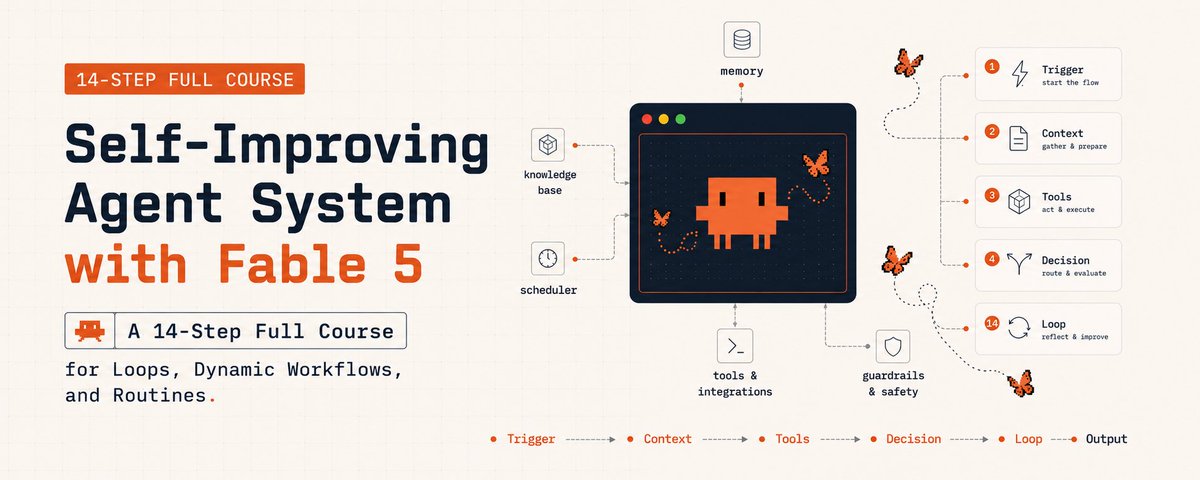
Watch it today, then read how to run a self-improving system in the article below.

Ganesan Anand retweeted

A few patterns we frequently use with Fable 5:
Use Fable 5 as an "advisor."
An executor (Sonnet 5) calls Fable 5 for guidance.
Most tokens are billed at the lower executor rate.

Ganesan Anand retweeted

Anthropic engineer:
"You're not supposed to prompt Claude. You're supposed to build a system that prompts itself."
In 45 minutes she breaks down how Anthropic builds agents that remember, learn from their mistakes, and get smarter with every run.
Worth more than any paid course you'll find on building agents.
Watch the session, then read the guide on building loops below.


Learning JavaScript Native Functions and How to Use Them flip.it/J-lT8

Thanks Microsoft: A Free Deep Learning (aka AI) Toolkit flip.it/L6T_H
Top 10 MongoDB Features in Toad - Part 2 flip.it/jxNsF
CRUD application using AngularJs, NodeJs, MongoDB : Part 3 : implementation of client side flip.it/iwGPh