
@polarisfund crypto observoor
Dubai, United Arab Emirates
Joined February 2021
- Tweets5.6K
- Following6.3K
- Followers12K
- Likes77.6K





sanket retweeted

Connecting TRON with @0xPolygon’s Open Money Stack gives businesses more ways to move USDT across different payment environments.
With more than $94B in USDT circulating on TRON, integrations like this can help connect onchain activity with everyday payments.

LATEST: Polygon Labs added TRON support to Open Money Stack, allowing businesses to offer stablecoin payments and cross-border transfers through a single integration.
The integration also lets businesses move USDT between TRON and supported EVM networks, but it does not eliminate their licensing and regulatory obligations.

sanket retweeted

In the past 7 days, @0xPolygon has had more stablecoin transactions* than Ethereum L1, more than Base and Arbitrum combined. If you're doubting Polygon, you're not paying attention!
* Wallet-to-wallet transactions involving stablecoins, excluding contracts such as DeFi.
Source:
growthepie.com/blockspace/ca…

sanket retweeted

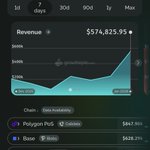
💰 @0xPolygon just crossed $550K in weekly revenue
$556,687 generated over the past 7 days 👀
Polygon is putting up some serious numbers 💸
📊 chainspect.app/chain/polygon…

sanket retweeted

Polygon’s economics are going through a fundamental change.
In March, the problem was obvious.
Polygon was generating real revenue, but the benefits were heavily concentrated.
In the February priority-fee distribution:
89.9% went to the top 20 validators.
Delegators were putting the capital behind Polygon’s security, yet none of that priority-fee revenue reached them directly.
The chain was succeeding.
The economics weren’t sharing that success to all contributors.
That is changing.
Under the new model, every 100 POL in priority fees is roughly split into:
26 POL → block producers
37 POL → validators
37 POL → stakers
And 27.3M POL already accumulated for stakers is now being pushed through the staking system.
This is an important shift.
Stakers are no longer meant to earn only from inflation.
They are starting to earn from real economic activity on the network.
Polygon seems to have figured out something fundamental:
A sustainable economy isn’t just about how much revenue you generate. It’s about how that revenue flows.
Block producers need an incentive to produce blocks.
Validators need an incentive to operate and secure the network.
Stakers need to be rewarded for putting billions of POL behind that security.
Maintainers need resources to keep improving the system.
And now it’s time to continue balancing the economy.
Because there is one final piece:
the reward itself has to keep its value.
Paying everyone more POL means little if the asset they are being paid in continuously loses purchasing power.
That is where the broader economic design matters.
Real usage generates fees.
Some of those fees reward the people securing the network.
Other fees remove POL from supply.
More valuable staking rewards can increase the incentive to own and stake POL.
More POL staked means less liquid supply.
And a stronger asset makes every POL earned by validators, stakers and maintainers worth more.
That creates a very different loop:
real usage → real revenue → rewards + burn → stronger POL economics → more valuable rewards → stronger ecosystem
Polygon already figured out how to generate activity.
Now it is figuring out how to distribute the value that activity creates — while protecting the value of the asset everyone is being paid in.
That is what real economic alignment looks like.
@0xPolygon @0xPolygonFdn @0xPolygonEco @sandeepnailwal


sanket retweeted

I used POLTRACK to calculate how value has been distributed across the Polygon $POL since Jan 1, 2026.
TL;DR: Polygon is already funding every major participant in its economic system:
• POL holders (all ecosystem participants): $15.21M captured through burn
• POL stakers: $7.17M earned (emission rewards)
• Validators: $6.80M earned (priority fees)
• Block producers: $3.27M earned (priority fees)
• Community Treasury: $7.55M earned (emission rewards)
There are two different sources here: real value paid by network users through fees and new POL created through protocol emissions.
Overall, the system looks reasonably balanced. Passive POL holders are roughly at zero dilution in 2026 as burn offsets emissions. Stakers earn ~3% annualized, while validators, block producers and the Community Treasury are all funded.
And the economics should evolve further: part of priority fees is expected to be redistributed to POL stakers.
Polygon is still in its growth stage, so some of the value generated by the network should naturally fund future growth. On top of that, Polygon Labs becoming profitable and reducing its reliance on grants would make the broader ecosystem increasingly self-sustaining.
Track the full value flow live on POLTRACK:
poltrack.tech/polvalue
P.S. The entire POLTRACK design has been updated. Thanks for using POLTRACK - and if you find it useful, help spread the word 💜

sanket retweeted

Came to @binance event in Bhutan. A startup named @BiteyeCN gave me a swag containing playing cards with project tickers on them
Surprisingly(not surprisingly) they still call @0xPolygon token as MATIC
MATIC has still one of the most powerful brand recognitions in the industry. Literally every crypto person I talk, they still call it MATIC

sanket retweeted
As a comparison
Polygon $POL burns $2.5M worth of tokens every month, and has been burning more than it issues for quite a while now.
Yet its FDV is only $0.7B.
No token unlocks. No vesting. No similar overhang. The token has already been circulating for 7 full years.
🤯
h/t @vadim_web3 , havent verified the exacr numbers myself but they seem about right


sanket retweeted

KalqiX Mainnet is now LIVE.
This isn’t just a new DEX.
It’s infrastructure for the next generation of DeFi.
Launch your own CLOB DEX.
Plug into shared liquidity.
Scale seamlessly.
⚡ Sub-10 microsecond execution
🔐 ZK-powered verification
📊 On-chain orderbooks
🛡️ MEV protection by design
The next generation of high-performance DeFi starts now. On KalqiX.
kalqix.com


sanket retweeted
Seeing too much FUD:
Polygon is not a dead chain - let's look at the facts!
Last 7 days - transaction count:
▸ Polygon total: ~63 Million
(Almost as much as Base and Ethereum Mainnet combined)
▸ Excluding Polymarket: ~39.4 Million
(More than 2x Ethereum Mainnet)
As for liquidity, Polygon has over $3.5 billion in stablecoins and $4.4 billion TVS. Yes, Polymarket is a huge app that contributes to the Polygon ecosystem, but let's not spread FUD.
Facts not fud, brought to you by growthepie.


I’m happy @Polymarket is going away from @0xPolygon.
I was discussing with my bro @0xDmitry (huge PM guy), and I see a lot of use cases for conditional DeFi, so trades and more based on outcomes, basically using PM as a on-chain-verified newspaper.
The problem is that Polygon doesn’t have liquidity and volume, looks like a dead chain to me, but if Polymarket will go on ETH or @unichain or @base, I want to build something on top of @Uniswap V4 + Polymarket!
sanket retweeted

Fluid's redemption protocol has processed $400m in collateral swaps for Aave in 2 days
used by some of the largest institutions in crypto
absolutely insane story how they built this in 12hrs
and launching on L2's shortly


Introducing aWETH Redemption Protocol
With ETH utilization at 100% on Aave, many lenders are currently unable to withdraw and face increasing risk if markets move.
aWETH Redemption Protocol allows ETH lenders to:
• Exit into wstETH or weETH
• Regain immediate liquidity
• Reduce exposure to liquidation risk
If you’re just lending ETH — you can fully exit.
If you have ETH collateral and another debt — your collateral is seamlessly swapped into wstETH or weETH while your debt remains the same.
We’re working alongside @LidoFinance , @ether_fi, @0xProject, @1inch,
@KyberNetwork, and other ecosystem partners to:
• Reduce systemic risk in DeFi
• Ease utilization pressure
• Support a healthier DeFi market
Our goal is simple: protect users while reinforcing the foundations of DeFi.
Capacity is initially limited to $1B in ETH.
fluid.io/lite/aave-v3/eth-sw…
sanket retweeted

polygon processing 493m transactions monthly with 17.4m stablecoin holders but trading like a forgotten L2. oobit just enabled 150m visa merchant locations to settle on polygon at $0.01 per transaction vs $2-3 traditional fees. merchants saving 99% on settlement costs don't care about ethereum alignment narratives. base has more stablecoin supply but polygon has 349% more actual holders. the payment infrastructure is live, the repricing isn't.
sanket retweeted

due to market conditions, we now identify as a sidechain

There have recently been some discussions on the ongoing role of L2s in the Ethereum ecosystem, especially in the face of two facts:
* L2s' progress to stage 2 (and, secondarily, on interop) has been far slower and more difficult than originally expected
* L1 itself is scaling, fees are very low, and gaslimits are projected to increase greatly in 2026
Both of these facts, for their own separate reasons, mean that the original vision of L2s and their role in Ethereum no longer makes sense, and we need a new path.
First, let us recap the original vision. Ethereum needs to scale. The definition of "Ethereum scaling" is the existence of large quantities of block space that is backed by the full faith and credit of Ethereum - that is, block space where, if you do things (including with ETH) inside that block space, your activities are guaranteed to be valid, uncensored, unreverted, untouched, as long as Ethereum itself functions. If you create a 10000 TPS EVM where its connection to L1 is mediated by a multisig bridge, then you are not scaling Ethereum.
This vision no longer makes sense. L1 does not need L2s to be "branded shards", because L1 is itself scaling. And L2s are not able or willing to satisfy the properties that a true "branded shard" would require. I've even seen at least one explicitly saying that they may never want to go beyond stage 1, not just for technical reasons around ZK-EVM safety, but also because their customers' regulatory needs require them to have ultimate control. This may be doing the right thing for your customers. But it should be obvious that if you are doing this, then you are not "scaling Ethereum" in the sense meant by the rollup-centric roadmap. But that's fine! it's fine because Ethereum itself is now scaling directly on L1, with large planned increases to its gas limit this year and the years ahead.
We should stop thinking about L2s as literally being "branded shards" of Ethereum, with the social status and responsibilities that this entails. Instead, we can think of L2s as being a full spectrum, which includes both chains backed by the full faith and credit of Ethereum with various unique properties (eg. not just EVM), as well as a whole array of options at different levels of connection to Ethereum, that each person (or bot) is free to care about or not care about depending on their needs.
What would I do today if I were an L2?
* Identify a value add other than "scaling". Examples: (i) non-EVM specialized features/VMs around privacy, (ii) efficiency specialized around a particular application, (iii) truly extreme levels of scaling that even a greatly expanded L1 will not do, (iv) a totally different design for non-financial applications, eg. social, identity, AI, (v) ultra-low-latency and other sequencing properties, (vi) maybe built-in oracles or decentralized dispute resolution or other "non-computationally-verifiable" features
* Be stage 1 at the minimum (otherwise you really are just a separate L1 with a bridge, and you should just call yourself that) if you're doing things with ETH or other ethereum-issued assets
* Support maximum interoperability with Ethereum, though this will differ for each one (eg. what if you're not EVM, or even not financial?)
From Ethereum's side, over the past few months I've become more convinced of the value of the native rollup precompile, particuarly once we have enshrined ZK-EVM proofs that we need anyway to scale L1. This is a precompile that verifies a ZK-EVM proof, and it's "part of Ethereum", so (i) it auto-upgrades along with Ethereum, and (ii) if the precompile has a bug, Ethereum will hard-fork to fix the bug.
The native rollup precompile would make full, security-council-free, EVM verification accessible. We should spend much more time working out how to design it in such a way that if your L2 is "EVM plus other stuff", then the native rollup precompile would verify the EVM, and you only have to bring your own prover for the "other stuff" (eg. Stylus). This might involve a canonical way of exposing a lookup table between contract call inputs and outputs, and letting you provide your own values to the lookup table (that you would prove separately).
This would make it easy to have safe, strong, trustless interoperability with Ethereum. It also enables synchronous composability (see: ethresear.ch/t/combining-pre… and ethresear.ch/t/synchronous-c… ). And from there, it's each L2's choice exactly what they want to build. Don't just "extend L1", figure out something new to add.
This of course means that some will add things that are trust-dependent, or backdoored, or otherwise insecure; this is unavoidable in a permissionless ecosystem where developers have freedom. Our job should make to make it clear to users what guarantees they have, and to build up the strongest Ethereum that we can.

sanket retweeted

Don’t sleep on @0xPolygon: x402 transactions just surged to #2, flipping Base.

