

I write about cool startups, their stories and strategies of visionary founders.
Joined November 2025
- Tweets989
- Following382
- Followers82
- Likes3.3K







Sof retweeted

My company crossed 100 employees.
here are 25 controversial lessons I'd tell my younger self:




Sof retweeted

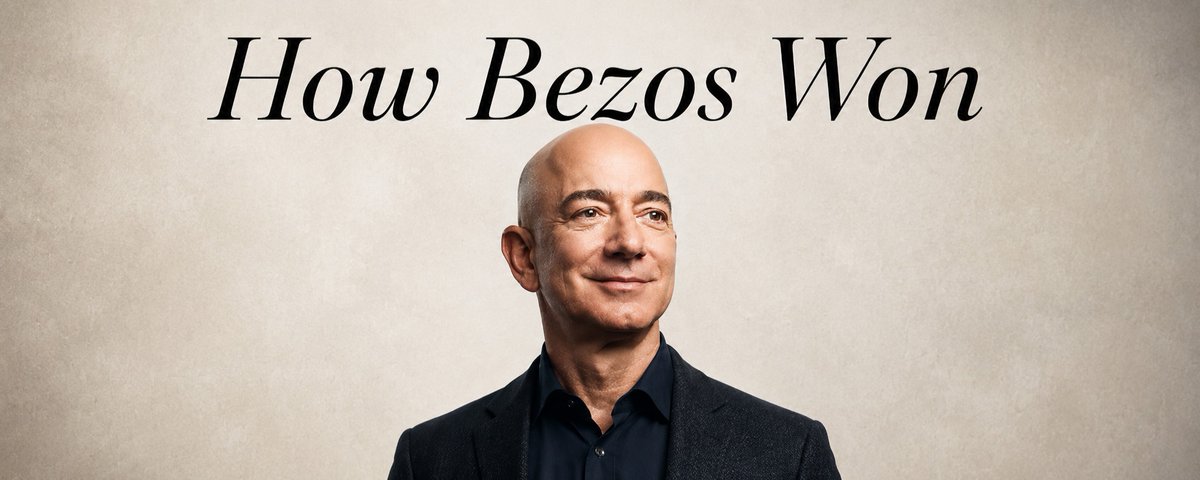
Jeff Bezos literally gave a two minute masterclass on the four principles Amazon runs on, and spent most of it on why the first one beats the obvious alternative.
Four things he teaches:
1. Center the company on customers, not competitors, and be honest that almost nobody actually does. His words: "we talk about it as customer obsession as opposed to competitor obsession. And I have seen over and over again companies talk about that they're customer focused, but really when I pay close attention to them, I believe they are competitor focused." He is not describing a preference here. He is describing a test he applies to other companies and expects them to fail.
2. Competitor obsession stops working the moment you start winning. "Once you're the leader, if your whole culture is competitor obsessed, it's kind of hard to stay energized and motivated if you're out in front." If the thing pulling you forward is someone ahead of you, then passing them removes the engine. Most companies discover this only after they win.
3. Customers never let you arrive, which is exactly why they are the better thing to aim at. "Whereas customers are always unsatisfied. They're always discontent. They always want more. And so no matter how far you get out there in front of your competitors, you're still behind your customers. So they're always pulling you along." He picked customers because they are a source of dissatisfaction that never runs out.
4. The other three are eagerness to invent, long-term thinking, and operational excellence, and he attaches a number to the third. "A lot of our competitors might have two to three year kind of time frames. And we might have more of a five to seven year sort of time frame." On inventing he is blunt about what happens when they copy instead: "whenever we have tried to do something in a kind of me-too fashion, we have failed at it."
He wrote all four of these down in 1997, in his first letter to shareholders, and then attached that same letter to every annual letter for the next 23 years. Twenty one years later he is on a stage in Dallas listing them in the same order without notes. Decide what your company believes early and put it in writing, because otherwise every hard call gets made from scratch and the company slowly turns into something nobody chose.
Jeff Bezos, Bush Center Forum on Leadership, April 2018, interviewed by Kenneth Hersh. @BushCenter

Sof retweeted

Munger: "I don’t go to meetings. Warren doesn’t go to meetings. Put that in your article: There’s practically no meetings in the whole Berkshire culture. There are a few telephone calls and no meetings. I don’t care if you print this. Warren gets a headache if he’s in a big meeting where a lot of other people are saying dumb things. He gets a sick headache. He’s not feigning it. He actually does."
(WSJ - "Charlie Munger, Unplugged" - 2019 wsj.com/articles/charlie-mun…)

Sof retweeted

Peter Thiel on what he doesn’t like about the Lean Startup
Thiel believes there are merits to the Lean Startup, but he thinks founders today may have over-indexed on it:
“I do think we tend to be dominated by a somewhat nihilistic bias where we claim not to know anything. And when you don’t know anything, you end up defaulting too much to the experimental search, A/B testing approach of ‘Let’s ask the customers.’ And I would say the problem with that is that the search space is simply way too big.”
In practice, Thiel argues for a more definite view of the future: “This is an important problem that needs to be solved, and this is the set of things we have to combine in just this way to do it.”
To be fair, Steve Blank—who pioneered the Lean Startup methodology—isn’t necessarily against this approach. Blank just recommends treating your assumptions as “a series of untested hypotheses.”
But there’s clearly a balance between having a definite view of the future and rigorously trying to disprove your assumptions.
As Thiel explains, many of the PayPal founding team’s initial assumptions were wrong:
“At PayPal, our original business plan was to have payments on Palm Pilots, then it was wireless payments, then it was payments linked to email. So we had a few fairly big pivots in the first year. I’m not sure there’s anything especially virtuous about that — if you have a dumb idea, it’s important to change it — but it’s not virtuous to have a really bad idea in the first place.”
Source: @OxfordSBS (May 2015)