

Founder of Nuvo Longevity
Joined July 2014
- Tweets538
- Following472
- Followers267
- Likes1K


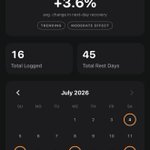



A 90-day streak feels productive.
It doesn’t mean your biological age moved.
Most habit apps optimize for checkmarks. Nuvo ties habits to recovery, sleep, HRV, and blood markers — so you see what actually moves the needle.
2
20
Cold plunge / sauna loop it is. Clean copy:
I track cold plunges and sauna like experiments, not vibes.
Most apps log the habit. Almost none show what it did to HRV, resting heart rate, or bio age the next day.
So I built Nuvo for the closed loop: intervene, measure, see what moves the needle.

23
One bad night tanks HRV. Three in a row moves biological age.
Sleep duration is easy to brag about. Sleep consistency is what actually shows up in the score.
2
24
VO₂ max is one of the strongest predictors of how long you'll stay healthy.
Most apps treat it like a trophy.
Nuvo folds it into your daily biological age with HRV, sleep, and blood markers, so you see if training is moving the whole system.
2
25
Out-of-range ApoB or HbA1c shouldn't live in a PDF you open once a year.
Nuvo folds lab markers into the same daily biological age as your Watch data, then ranks nutrition and supplement protocols by what needs to move.
1
28
Your HbA1c and HRV shouldn't live on someone else's server.
Nuvo doesn't even make you create an account. The coach runs on-device. Encrypted. Nothing sold.
Privacy is the architecture, not a policy.
nuvolongevity.com

1
24
Most health apps dump 40 metrics on you and call it insight.
I wanted one number that actually answers: am I getting younger or not.
Wearable data plus blood biomarkers. One biological age score, every morning. On your phone. Your data stays there.
nuvolongevity.com
21
sleep is the easiest longevity lever to measure and the hardest one to get people to take seriously.
here's what the data actually shows when you track it alongside biological age:
one night under 6 hours moves resting heart rate up and HRV down in ways that take 2–3 days to recover from. not dramatic. just a quiet, compounding drag.
the people whose biological age scores trend downward over time share one pattern more than any other. consistent sleep timing. not duration — timing.
going to bed within a 30-minute window each night does more for recovery scores than most supplements, cold plunges, or breathwork sessions combined.
the biohacking world sells you interventions. the data keeps pointing back to the boring anchor that makes every intervention actually work.
1
36
VO₂ max is the longevity biomarker your doctor has probably never mentioned to you.
it predicts all-cause mortality better than blood pressure, cholesterol, or resting heart rate.
a one-unit increase in VO₂ max is associated with a meaningful drop in cardiovascular risk — across every age group studied.
yet it never shows up on a standard lab panel.
here's why that matters: VO₂ max is trainable. it responds to zone 2 cardio, strength training, and consistent sleep in ways most supplements can't touch.
the problem is most people have no idea what their number actually is — or whether it's moving.
Apple Watch estimates it passively. Garmin does too. the data is already sitting in your wearable.
tracking it alongside your other biomarkers is where it gets interesting — you stop guessing which habits are actually working and start seeing it in the number.
42
cold plunge, sauna, red light, breathwork.
the recovery protocol list keeps growing. and people keep adding interventions without ever asking which one is actually doing anything.
this is where tracked data gets interesting.
when you log every intervention and score your recovery readiness daily, patterns start to emerge that feel counterintuitive.
for a lot of people, the intervention with the weakest individual signal is the one they're most evangelical about. the one with the strongest signal? usually something boring like an earlier bedtime or a shorter training session the day before.
the real problem with the recovery space isn't bad information. it's no feedback loop. you do five things and feel okay the next morning, so all five get credit.
nuvo scores your recovery readiness every day and lets you log exactly what you did. over time you can see what your body actually responds to vs. what you're doing on faith.
nobody wants to hear that their $200/month cold plunge membership matters less than going to bed 45 minutes earlier. but the data will tell you anyway.
25
Love this

I’m incredibly proud & excited to finally share what we’ve been building for the past 3 years…
Lifespan.com is now live 🚀
In a world of conflicting health advice, how can anyone distinguish between what’s supported by science and what’s just opinion?
I wanted to build something new. A place where scientists, engineers, industry leaders, and the public come together, where people can understand what the science actually says, and where we move healthcare beyond treating sickness toward extending healthy lifespan well beyond what’s currently possible.
Explore the new Lifespan Magazine. Watch the Lifespan show. Ask scientists questions. Join a global community. And help support research and the next generation of scientists working to extend healthy human lifespan.
I believe we’re at the beginning of a revolution in our understanding of human aging, and perhaps one day, our ability to change it. I want everyone to be part of it.
Built by scientists. Built for you. Lifespan.com
Life’s too short. Let’s change that, together! 👊
——
Note: The views of Lifespan & its team are their own & do not represent the views of Harvard, Harvard Medical School, or their affiliates✌️
45
most people who care about longevity are incredibly consistent with their habits.
the surprising thing we found building nuvo: consistency isn't the bottleneck. knowing which habits are actually moving your biological age is.
you can have a 90-day strength streak and still see your score stall. usually it's a blood biomarker nobody flagged, or a recovery pattern that looks fine on the surface but erodes over weeks.
the people who make the fastest progress are the ones who treat their data like a feedback loop, not a report card.
log the habit. watch the biomarker. connect the dots.
60
you probably think of creatinine as a kidney number your doctor mentions once a year.
it's also one of the clearest markers of muscle mass loss as you age.
low creatinine paired with a declining VO2 max is a pattern nuvo flags before it becomes a bigger problem.
most trackers ignore it completely.
1
38
you probably think of creatinine as a kidney number your doctor mentions once a year.
it's also one of the clearest markers of muscle mass loss as you age.
low creatinine paired with a declining VO2 max is a pattern nuvo flags before it becomes a bigger problem.
most trackers ignore it completely.
25
HRV is the most misused number in consumer health.
people see it drop and immediately assume overtraining.
sometimes that's true. but HRV also tanks when blood glucose is elevated, when you're under-sleeping by even 45 minutes, or when inflammation markers are creeping up between blood draws.
a single wearable metric without biomarker context is just noise with a dashboard.
this is the actual problem nuvo was built around. your apple watch data and your lab results are telling the same story from different angles. reading them separately is how you miss what's actually aging you faster.
1
19
most people optimizing for longevity are flying blind between blood draws.
you get a panel every 6–12 months. your habits change daily. the gap between those two timelines is where most progress gets lost.
wearable data fills that gap better than people give it credit for. resting HR trends, HRV patterns, VO₂ max trajectory — these are biomarkers moving in real time, reacting to every decision you make.
the reason nuvo combines both is simple: blood gives you the ground truth. wearables give you the feedback loop. neither is complete without the other.
biological age only becomes a useful number when it updates fast enough to be actionable.
38
the longevity space is obsessed with adding more biomarkers.
we went the opposite direction when building nuvo's scoring model.
the question we kept asking wasn't "what can we track?" it was "what actually predicts biological aging?"
that's how you end up with 21 markers instead of 50. HRV, resting HR, VO₂ max, sleep stages, HbA1c, fasting glucose, CRP, HDL, creatinine — each one earned its place by showing up consistently in the aging literature.
cutting a biomarker that sounds impressive but adds noise to your score is harder than adding it. we did that a lot.
more data feels thorough. a precise signal is actually useful.
1
28
privacy in health apps is treated like a legal checkbox.
we built nuvo the other way around — on-device processing, no account required, no data ever leaving your phone.
the decision came with real trade-offs. no server-side model updates. no cross-user learning. harder engineering.
but when someone logs their HbA1c, fasting glucose, and resting heart rate in the same place, that is not data a company should ever hold. full stop.
what surprised me: privacy-first architecture became one of the most common reasons people tell us they switched to nuvo. we assumed it would be a quiet feature. it turned out to be the loudest one.
32
most longevity apps die because they try to coach everyone the same way.
the person with low HRV and high CRP needs completely different advice than the person with great cardio but tanking fasting glucose.
generic recommendations feel helpful. they rarely change anything.
what actually moves biological age is intervention that's matched to your specific out-of-range biomarkers, not a universal protocol someone wrote for a press release.
nuvo's AI coach runs on-device and reads your actual blood and wearable data together before it says anything. the recommendation you get at 47 with high HbA1c looks nothing like what someone else sees.
that specificity is hard to build. it's also the only version worth building.
35
my biological age score sat flat for two weeks straight.
averages take time to shift, even when things are moving underneath.
what moved faster: my weekly trend line. resting heart rate dropping, HRV climbing, recovery scores improving night over night.
that's the value of daily tracking. you see the direction before you see the destination.
quarterly blood panels can't show you that kind of signal.
1
36