




Love how my feed consistently gives me both perspectives on stuff like this
@nikitabier you might be cooking here

Sometimes the simplest solutions are the most effective

LLMs process text from left to right — each token can only look back at what came before it, never forward. This means that when you write a long prompt with context at the beginning and a question at the end, the model answers the question having "seen" the context, but the context tokens were generated without any awareness of what question was coming. This asymmetry is a basic structural property of how these models work.
The paper asks what happens if you just send the prompt twice in a row, so that every part of the input gets a second pass where it can attend to every other part. The answer is that accuracy goes up across seven different benchmarks and seven different models (from the Gemini, ChatGPT, Claude, and DeepSeek series of LLMs), with no increase in the length of the model's output and no meaningful increase in response time — because processing the input is done in parallel by the hardware anyway.
There are no new losses to compute, no finetuning, no clever prompt engineering beyond the repetition itself.
The gap between this technique and doing nothing is sometimes small, sometimes large (one model went from 21% to 97% on a task involving finding a name in a list). If you are thinking about how to get better results from these models without paying for longer outputs or slower responses, that's a fairly concrete and low-effort finding.
Read with AI tutor: chapterpal.com/s/1b15378b/pr…
Get the PDF: arxiv.org/pdf/2512.14982

This is why founder led companies perform so well.
When you bring in someone that doesn’t understand the industry / product or even worse, both
You get outcomes like PayPal ($360B -> $42B)

A few thoughts about PayPal, nearly 12 years after I left.
I woke up this morning to dozens of messages from former PayPal colleagues. It pushed me to finally speak up.
I never spoke publicly about the company after I left. Part of that was loyalty to John Donahoe, who gave me an unlikely opportunity, handing the reins of PayPal to a startup guy who, on paper, had no business running a then 15,000-person organization. But part of it was something else: I had left. I chose not to stay and fight for the changes I believed in. Speaking from the sidelines felt like armchair commentary. Easy opinions without the burden of execution. So I stayed quiet.
But twelve years of silence is long enough. And today's news makes it clear the pattern I've watched unfold isn't self-correcting.
I left PayPal in 2014 because I was deeply frustrated. We had executed a silent turnaround of a company that had lost its soul. We brought back engineering talent, shipped good products quickly, and acquired Braintree and Venmo. The company was on a tear. So much so that Carl Icahn felt compelled to accumulate a position in eBay and push for a PayPal spinoff. At the time, eBay decided to fight Icahn.
It was a difficult period for me, caught between what I felt was right for PayPal and my loyalty to the eBay team.
This is when Mark Zuckerberg approached me to join Facebook. The combination of his conviction that messaging would become foundational, the appeal of going back to building products at scale, and my growing exhaustion with the internal politics at PayPal and eBay eventually convinced me to leave and join one of the best teams in the world, one I had admired for a long time.
In the summer of 2014, I met John in a café in Portola Valley and told him I had decided to leave. During that conversation, he told me that Icahn had effectively won the fight, that PayPal was going to become an independent company, and he tried to convince me to stay on as CEO, but I had already said yes to Mark, and my word is my bond. There was no turning back.
After my departure, the board scrambled to find a replacement, and it took a few months for them to land on Dan Schulman. The leadership style shifted from product-led to financially-led. Over time, product conviction gave way to financial optimization.
Much of the momentum we had created still persisted and carried the company forward, mainly driven by Bill Ready, who came over in the Braintree acquisition and rose to COO. Under his leadership, Venmo grew exponentially, and total payment volume (TPV) accelerated quickly. But the shift under Schulman became more pronounced after Bill's departure at the end of 2019. With him went the product conviction that had defined the post-spinoff momentum. Then, for a period, COVID-fueled online shopping hid a lot of the company's new weaknesses.
During that period, the company made a fundamental miscalculation: it optimized for payment volume instead of margin and differentiation. It leaned into unbranded checkout, where PayPal had the least leverage, instead of branded checkout, where the margin, data, and customer relationship actually lived.
Visa masterfully structured a deal that effectively ended PayPal's ability to steer customers toward bank-funded transactions, which had been a core driver of PayPal's economics. Not long after, PayPal lost a significant portion of eBay's volume. Over time, it saw its share of checkout among its most profitable customers steadily erode as Apple Pay and others continued to execute well.
The same pattern repeated itself across lending, buy-now-pay-later (BNPL), and new rails.
On lending, PayPal missed the opportunity to turn it into a platform weapon. Products like Working Capital were conservative, short-duration, and optimized for loss minimization. Lending never became programmable, never became identity-driven, and never became a reason for merchants or consumers to choose PayPal over something else.
The missed opportunity in BNPL was even more striking. Klarna, Affirm, and Afterpay didn't just offer installment payments, they built consumer finance brands, persistent credit identities, and new shopping behaviors. PayPal saw the BNPL turn, entered the market, and had every advantage: distribution, trust, and merchant relationships. But BNPL was treated as a defensive checkout feature rather than an offensive category. There was no attempt to turn it into a core consumer relationship, no super-app behavior, and no meaningful differentiation for merchants. Others built platforms, PayPal added a feature.
The failure to lean into building and owning new rails followed the same logic. After the spinoff, PayPal had a once-in-a-generation opportunity to build a global, at scale payment network. Instead, the company focused on building on top of existing networks and third-party rails.
More recently, that mindset carried over to PYUSD. Technically, the product was sound. Strategically, it launched without a compelling transactional reason to exist. PYUSD had distribution, but no organic demand. It was not embedded deeply enough into flows to become a true settlement layer, a cross-border merchant rail, or a programmable money primitive. It sat adjacent to the product instead of inside the core of it.
Acquisitions during this period followed a similar pattern. Honey was not a strategic acquisition for PayPal. It added activity, but not leverage. It lived outside the transaction, monetized affiliate economics rather than payment economics, and never meaningfully strengthened PayPal's control of the customer or the checkout moment. Xoom solved a real problem in remittances, but it never compounded PayPal's advantage. It scaled volume without changing the underlying rails, identity graph, or settlement model, and as importantly, it didn’t cater to a high-value, high-margin customer archetype.
None of these were bad companies. They were just a wrong fit for PayPal and became unnecessary distractions.
The board eventually recognized the problem. In 2023, they brought in Alex Chriss, an Intuit veteran with a strong product background, explicitly to restore product conviction. It was the right instinct.
But Alex came from software, not payments. He understood SMB product development. He didn't have the muscle memory for transaction economics, network effects, or settlement infrastructure.
In hindsight, he also made an error: clearing out much of the leadership team that understood payments deeply. Executives with years of institutional knowledge departed within his first year.
This morning, Alex was removed as CEO. Branded checkout grew 1% last quarter. The board tapped another operator, Enrique Lores, the former HP CEO who's been on the PayPal board for five years.
I don’t know Enrique. And he might be a great leader, but on paper at least, he’s a hardware executive. For a payments company.
The common thread through all of this is incentive design. Once PayPal became independent, short/medium-term predictability beat long-term vision and ambition. Stock performance mattered more than platform risk and network opportunity. Financial optimization replaced product conviction.
I'm not claiming I would have made every call differently. Running a public company at scale involves tradeoffs I didn't have to make after I left. But the pattern, choosing predictability over platform risk, again and again, was a choice, not an inevitability.
Over time, the company that had every advantage and could’ve become the most consequential and relevant payments company of our time, lost its mojo, its product edge, and its ability to compete in a market that’s being rewired and reinvented in front of our eyes.
That's the part that's hardest to watch for a company I care so deeply about.
This is insane. You can definitely see that it’s a work in progress by what they don’t show you about some of the scenes, but considering that this is just the beginning… gaming will be so different in just a few years

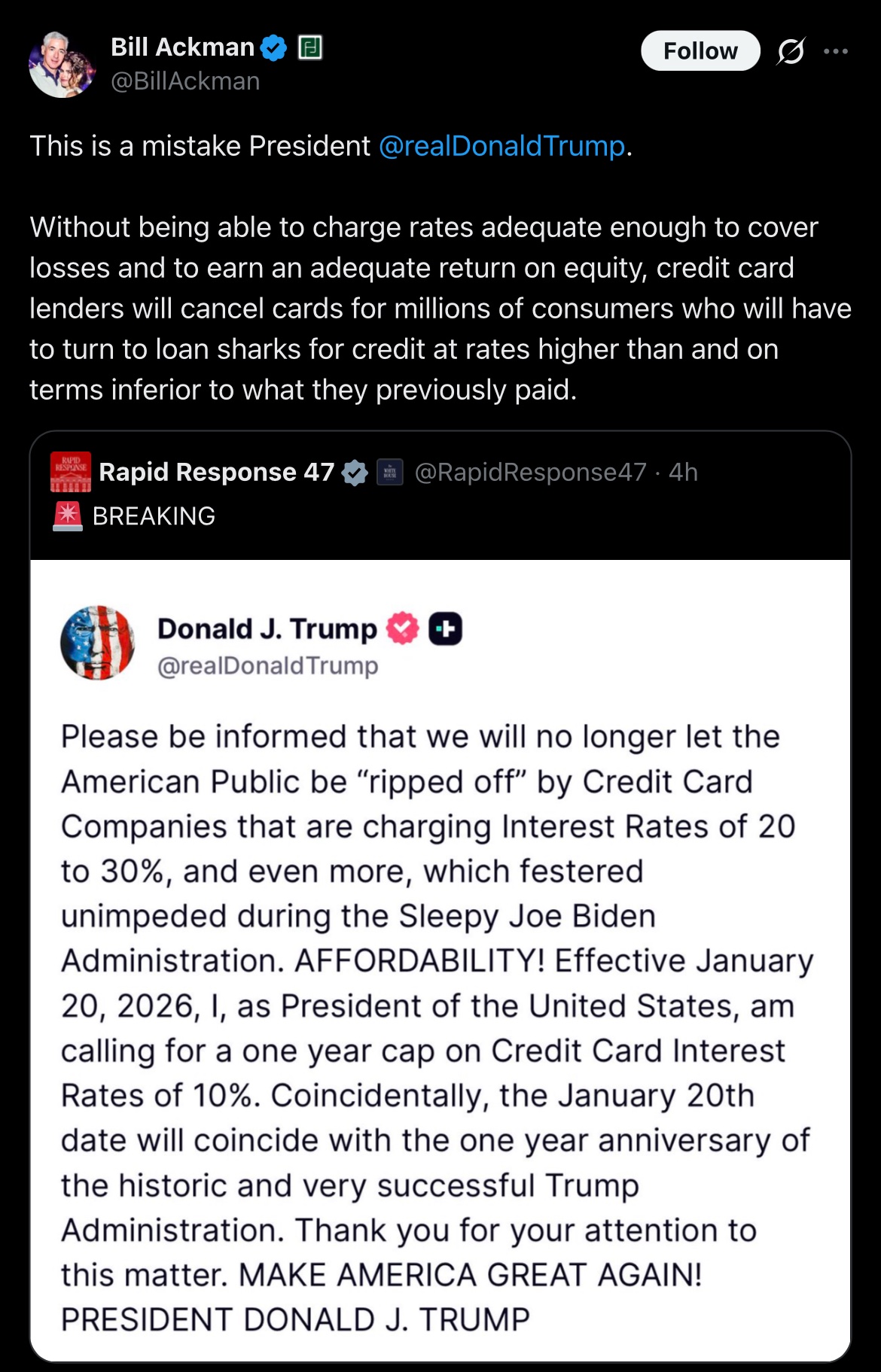
Why are we dunking on Bill when he’s actually protecting consumers in this case??
If the 10% limit goes through banks will NOT just eat the losses… they will lower credit limits and make it so that people that need credit have to pay higher rates when they get money from sharks


this is as delusional as thinking that llms are going to beat stockfish at chess anytime soon btw
complete misunderstanding of the industry

actually the goat of ai

> be demis hassabis
> spawn in london
> age 4, become child chess prodigy
> win chess tournaments
> reach ~2300 elo
> face danish chess champion
> game lasts hours
> position is a forced draw
> too exhausted to see it
> resign
> danish guy laughs and shows the draw
> feel sick to my stomach
> realise something is wrong
> chess is too narrow a problem
> brilliant minds wasting decades on it
> decide not to become a chess pro
> buy a computer with chess winnings
> teach self to program from books
> start hacking on games with friends
> decide to finish school early
> apply to cambridge age 16
> cambridge says you're too young
> forced to take a gap year
> enter a video game coding competition
> win
> get invited to join bullfrog game studio
> too young to be legally employed
> work there anyway
> build ai system inside theme park game
> game becomes a global hit
> turn 17
> offered £1,000,000 to stay and build games
> turn it down
> go to cambridge anyway
> decide games aren't enough
> study computer science
> interested in agi since 2007
> most people laugh at this idea
> realise brain is only form of agi we have
> want to learn more about human brain
> go back to school
> study neuroscience
> realise academia moves too slow
> decide to build a company instead
> start deepmind
> pitch “solve intelligence”
> investors don’t know what that means
> get to meet peter thiel for one minute
> wonder how to convince him
> spend one minute playing chess with him
> pitch "solve intelligence" again
> he invests
> go into total stealth mode for two years
> no website
> secret office
> candidates think it’s a scam
> start to train ai in simulated environments
> train ai with reinforcement learning
> train ai on pong first
> it sucks
> can't win a single point
> keep trying
> wait it won a a point
> wait it's winning every single point
> it actually works
> expand to train on any two-player game
> chess first, then move on to go
> beats world champion at go
> beats pros at starcraft
> games is not enough
> want to push into science
> realise compute is the bottleneck
> know this will take decades
> google offers ~$400m
> not the highest price
> but they offer unlimited compute
> accept
> refuse to become a product team
> stay in research mode
> determined to use ai for good
> need to figure out what's next
> land on protein folding
> 50-year-old unsolved science problem
> many great minds have tried and failed
> "good luck"
> start up alphafold
> try to solve protein folding
> humans take years to find 1 protein structure
> alphafold can find ~5 per day
> submit results, win competition
> not good enough
> hire more scientists
> rebuild it
> go from solving one per day to millions per day
> create invaluable system
> pharma would pay anything
> have to decide what to do with this
> could sell access for usage
> maybe make it a paid service
> remember childhood chess tournament
> remember why we built this
> decide to give it away all away for free
> publish all known protein structures publicly
> win nobel peace prize
> just the beginning towards agi

Ever been so late to a flight that the lady at the gate knows what seat you are before you even say hi
Team offsite was a success!
Some highlights:
- 3 days, 5 people
- no one clocked out before 4am
- shipped 5 product updates across mobile and web
- finished 90% of work for our next HUGE feature
- team workout at planet fitness
- consumed 4 energy drinks / day / person
- introduced our newest hire to tortas


> found a bug with auth
> spend days debugging
> looks like a problem with how supabase handles cookies
> support doesn’t look at our code or try to understand the problem and just responds 3 days later with “have you tried [generic docs]”
> debug a few more days
> tell support again we think the issue is on their side
> support says “nah you’re just dumb, look at [generic docs]”
> give up and hire expert
> “oh yeah i just helped another client with this, the problem is actually with how supabase handles cookies, here’s a hacky workaround until they fix it”
> 🤦♂️
$5B company btw
