

A national, science-led initiative for human–bear interface management & sloth bear conservation, advancing coexistence GoI @moefcc @wii_india
Dehradun, India
Joined April 2026
- Tweets190
- Following20
- Followers44
- Likes2



Project Sloth Bear, led by the Wildlife Institute of India (WII), has entered its systematic field research phase in Kanker Forest Division, Chhattisgarh, beginning with Kanker Range.
Building on preliminary assessments across the division, the team is undertaking both ecological and socio-economic surveys. The study aims to assess sloth bear distribution, status and habitat use, while investigating the patterns and underlying drivers of human-sloth bear interactions and community perception.
By bringing together ecological data and community perspectives, the project team seeks to identify conservation priorities and venerate scientific evidence for targeted conflict mitigation and long-term human-sloth bear coexistence in the landscape.
#ProjectSlothBear #WildlifeInstituteOfIndia #SlothBearResearch #Kanker #Chhattisgarh #WildlifeConservation #HumanWildlifeConflict #FieldResearch #ConservationScience
@moefcc @CentralIfs @NationalCAMPA @wii_india @SACONCoimbatore @wii_eiacp @rameshpandeyifs @GobindsagarBha1 @RuchiBadola2 @CRamesh_WII @BivashPand34733 @Kramesh95 @amitwii @UpmaManral @ashishjangid22 @avinashyadv95 @utkarsh41995 @kaushikforwild @AravindWildie @Sindhoora_2001 @niranjanKv2770 @Kavyak0204 @MitaliJadh34762 @SunnyNama16


2
34
🐻 WHEN GARBAGE BECOMES A FOOD SOURCE
What happens when discarded food and unmanaged waste attract wildlife towards human-use areas?
Prajapati et al. (2026) documented three cases of sloth bears feeding on discarded food waste in human-dominated areas of central Gujarat.
Analysis of 33 scat samples revealed milk pouches, thermocol, plastic bags and cooked food remains, highlighting the potential risks of waste consumption.
The study also highlights how collaboration between forest staff and local communities, along with responsible waste management and awareness, can help reduce repeated bear visits.
Responsible waste disposal is an important step towards protecting wildlife and promoting coexistence.
📖 Prajapati et al. (2026), Ursus, 37, Article e12.
doi.org/10.2192/URSUS-D-25-0…
#WIIProjectSlothBear #SlothBearConservation #WasteManagement #HumanWildlifeConflict #CommunityConservation #WildlifeInstituteOfIndia
@moefcc @CentralIfs @NationalCAMPA @wii_india @SACONCoimbatore @wii_eiacp @rameshpandeyifs @GobindsagarBha1 @RuchiBadola2 @CRamesh_WII @BivashPand34733 @Kramesh95 @amitwii @UpmaManral @ashishjangid22 @avinashyadv95 @utkarsh41995 @kaushikforwild @AravindWildie @Sindhoora_2001 @niranjanKv2770 @Kavyak0204 @MitaliJadh34762 @SunnyNama16


1
76
Little explorers today, nature's protectors tomorrow! 🐾
This Children's Day, let's remind every child that the forest is home to countless wonderful creatures, each with a place and purpose in nature. 🌳
Just like the message of The Bare Necessities from The Jungle Book, nature teaches us to appreciate what we have, take only what we need, and never waste its gifts.
Every little act matters - planting a tree, respecting wildlife, keeping our surroundings clean, or simply learning about the creatures we share this planet with.
May curiosity grow into compassion and childhood adventures inspire a lifelong love for nature.
Happy Children's Day!🐻
#HappyChildrensDay #ProjectSlothBear #WIIProjectSlothBear #NatureConservation #WildlifeProtection #YoungNatureProtectors #barenecessities
@moefcc @CentralIfs @NationalCAMPA @wii_india @SACONCoimbatore @wii_eiacp @rameshpandeyifs @GobindsagarBha1 @RuchiBadola2 @CRamesh_WII @BivashPand34733 @Kramesh95 @amitwii @UpmaManral @ashishjangid22 @avinashyadv95 @utkarsh41995 @kaushikforwild @AravindWildie @Sindhoora_2001 @niranjanKv2770 @Kavyak0204 @MitaliJadh34762 @SunnyNama16

DECODE THE WILD! The Track & Its Maker
The mystery is solved!
From the forest floor to the animal behind each footprint, it's time to reveal the identities of all four track-makers: Bengal Tiger, Sloth Bear, Jungle Cat and Leopard.
Did you identify all four correctly? Swipe through to check your answers!
Thank you to everyone who participated and put their wildlife knowledge to the test.
Guessed them right? Drop a bear emoji in the comments below!
#WIIProjectSlothBear #DecodeTheWild #AnimalTracks #WildlifeQuiz #TrackAndTrace #WildlifeFacts #wildlifeinstituteofindia
@moefcc @CentralIfs @NationalCAMPA @wii_india @SACONCoimbatore @wii_eiacp @rameshpandeyifs @GobindsagarBha1 @RuchiBadola2 @CRamesh_WII @BivashPand34733 @Kramesh95 @amitwii @UpmaManral @ashishjangid22 @avinashyadv95 @utkarsh41995 @kaushikforwild @AravindWildie @Sindhoora_2001 @niranjanKv2770 @Kavyak0204 @MitaliJadh34762 @SunnyNama16


🐾 Decode the Wild! Can You Identify Them?
The forest floor holds clues to the wildlife around us. Animal footprints help researchers and forest staff identify species, understand animal movement, locate wildlife activity and monitor their presence.
🔍 Look closely at these four footprints! The number of toes, footpad shape and claw impressions can help identify the animals.
Can you identify all four? Share your guesses in the comments!
🐻 Stay tuned for the answers tomorrow!
#WIIProjectSlothBear #TrackDetective #AnimalTracks #WildlifeQuiz #WildlifeMonitoring #WildlifeFacts #WildlifeInstituteOfIndia
@moefcc @CentralIfs @NationalCAMPA @wii_india @SACONCoimbatore @wii_eiacp @rameshpandeyifs @GobindsagarBha1 @RuchiBadola2 @CRamesh_WII @BivashPand34733 @Kramesh95 @amitwii @UpmaManral @ashishjangid22 @avinashyadv95 @utkarsh41995 @kaushikforwild @Sindhoora_2001 @niranjanKv2770 @Kavyak0204 @MitaliJadh34762

1
58
Not all bear tails are the same! 🐻
From the giant panda to the sun bear, tail lengths vary across the bear family. While most bears have relatively short tails, the sloth bear stands out with an average tail length of 15–18 cm, making it the longest on average among living bear species.
Take a look at our comparison to discover where each bear stands!
#WIIProjectSlothBear #BearFacts #SlothBear #WildlifeFacts #WildlifeInstituteOfIndia
@moefcc @CentralIfs @NationalCAMPA @wii_india @SACONCoimbatore @wii_eiacp @rameshpandeyifs @GobindsagarBha1 @RuchiBadola2 @CRamesh_WII @BivashPand34733 @Kramesh95 @amitwii @UpmaManral @ashishjangid22 @avinashyadv95 @utkarsh41995 @kaushikforwild @Sindhoora_2001 @niranjanKv2770 @Kavyak0204 @MitaliJadh34762


1
43
Why do bears have short tails? 🐻
Here's a fun old nature myth about a clever fox, a curious bear and a very cold winter day!
According to the story, the bear's tail became short after getting frozen in a pond by a mischievous fox. But what's the science behind it?
Bears' short, stubby tails could be shaped by their evolutionary history and adaptations to their way of life. Unlike animals such as cats and monkeys that use their long tails for balance, agility or movement through their habitats, bears have sturdy, ground-adapted bodies and large paws that provide stability without relying on a long tail. Additionally, in cold-adapted species like polar bears, shorter tails reduce exposed surface area, helping minimise heat loss in freezing environments.
Do all bears have tails of the same length?
Not quite! Tail length varies across different bear species.
Find out where the sloth bear stands in tomorrow's post!
#WIIProjectSlothBear #SlothBear #BearFacts #WildlifeFacts #NatureMyths #WildlifeInstituteOfIndia
@moefcc @CentralIfs @NationalCAMPA @wii_india @SACONCoimbatore @wii_eiacp @rameshpandeyifs @GobindsagarBha1 @RuchiBadola2 @CRamesh_WII @BivashPand34733 @Kramesh95 @amitwii @UpmaManral @ashishjangid22 @avinashyadv95 @utkarsh41995 @kaushikforwild @Sindhoora_2001 @niranjanKv2770 @Kavyak0204 @MitaliJadh34762


1
48
🐾 Not All Sloth Bears Use the Forest the Same Way!
The needs of a mother with raising cubs can differ considerably from those of an adult moving alone. Reproductive status can influence where Sloth Bears live and when they are active.
Chaudhuri et al. (2026) explored these differences in Sloth Bears at Panna Tiger Reserve, Madhya Pradesh.
The study found that lone adult Sloth Bears were more associated with mixed forests and cooler habitats, while females with offspring were more likely to use hotter, rugged terrain and valleys. Further, females with offspring showed greater daytime activity, particularly during winter, compared to lone adults. These differences may reflect ways of reducing competition for resources and potential risks to cubs.
Protecting diverse habitats is essential to support the different ecological needs of Sloth Bears throughout their lives.
Source: Chaudhuri, S., Dutta, S. & Krishnamurthy, R. (2026). Ecology and Evolution
#ProjectSlothBear #WIIProjectSlothBear #SlothBear #WildlifeResearch #WildlifeConservation #EcologyAndEvolution #PannaTigerReserve #HabitatConservation
@moefcc @CentralIfs @NationalCAMPA @wii_india @SACONCoimbatore @wii_eiacp @rameshpandeyifs @GobindsagarBha1 @RuchiBadola2 @CRamesh_WII @BivashPand34733 @Kramesh95 @amitwii @UpmaManral @ashishjangid22 @avinashyadv95 @utkarsh41995 @kaushikforwild @Sindhoora_2001 @niranjanKv2770 @Kavyak0204 @MitaliJadh34762


1
57
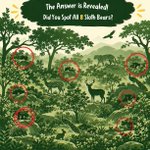
The mystery is solved! 🔎🐾
There were 8 sloth bears hiding in the picture. Did you manage to spot them all?
Thank you to everyone who joined our Sloth Bear Spotter Challenge. We hope you had fun discovering these hidden bears!
Did you guess the correct number? Comment 🐻 if you got it right!
#WIIProjectSlothBear #SpotTheSlothBear #WildlifeQuiz #WildlifeInstituteOfIndia
@moefcc @CentralIfs @NationalCAMPA @wii_india @SACONCoimbatore @wii_eiacp @rameshpandeyifs @GobindsagarBha1 @RuchiBadola2 @CRamesh_WII @BivashPand34733 @Kramesh95 @amitwii @UpmaManral @ashishjangid22 @avinashyadv95 @utkarsh41995 @kaushikforwild @Sindhoora_2001 @niranjanKv2770 @Kavyak0204 @MitaliJadh34762

30
A little wildlife challenge! 🐾 🐻
A closer look might reveal more than you expect!
Hidden among the wildlife of India's forests are some elusive sloth bears. Can you spot them all?
Look carefully, count them, and share your answer in the comments!
We'll pin the correct answer in the comments, so stay tuned!
Let’s see who has the sharpest eyes! 👀
#ProjectSlothBear #WIIProjectSlothBear #SlothBear #WildlifeChallenge #IndianWildlife #WildlifeConservation
@moefcc @CentralIfs @NationalCAMPA @wii_india @SACONCoimbatore @wii_eiacp @rameshpandeyifs @GobindsagarBha1 @RuchiBadola2 @CRamesh_WII @BivashPand34733 @Kramesh95 @amitwii @UpmaManral @ashishjangid22 @avinashyadv95 @utkarsh41995 @kaushikforwild @Sindhoora_2001 @niranjanKv2770 @Kavyak0204 @MitaliJadh34762

The Distinctive Walk of a Sloth bear 🐻
Have you ever noticed how a sloth bear walks?
Sloth bears are plantigrade walkers, meaning they place the soles of their feet on the ground while walking, much like humans. Their broad feet and prominent, long, curved claws give them a distinctive appearance as they move.
Their plantigrade posture allows them to distribute their body weight across the entire foot, providing a stable base while walking. This broad-footed stance is also reflected in their footprints, particularly those of the hind feet, which can sometimes resemble human footprints.
#ProjectSlothBear #SlothBear #WildlifeFacts #BearEcology #WildlifeTracking #WildlifeConservation #WildlifeInstituteOfIndia
📽️ VC: Mukul Sangwan
@moefcc @CentralIfs @NationalCAMPA @wii_india @SACONCoimbatore @wii_eiacp @rameshpandeyifs @GobindsagarBha1 @RuchiBadola2 @CRamesh_WII @BivashPand34733 @Kramesh95 @amitwii @UpmaManral @ashishjangid22 @avinashyadv95 @utkarsh41995 @kaushikforwild @Sindhoora_2001 @niranjanKv2770 @Kavyak0204 @MitaliJadh34762
1
86
🐾 Did you know?
Bears, unlike members of the cat family, cannot retract their claws!
These powerful tools help them dig, climb and forage, while the Sloth Bear’s exceptionally long claws are specially adapted for breaking open termite mounds. 🐻
#ProjectSlothBear #WIIProjectSlothBear #SlothBear #WildlifeFacts #BearAdaptations
@moefcc @CentralIfs @NationalCAMPA @wii_india @SACONCoimbatore @wii_eiacp @rameshpandeyifs @GobindsagarBha1 @RuchiBadola2 @CRamesh_WII @BivashPand34733 @Kramesh95 @amitwii @UpmaManral @ashishjangid22 @avinashyadv95 @utkarsh41995 @kaushikforwild @Sindhoora_2001 @niranjanKv2770 @Kavyak0204 @MitaliJadh34762


🐾 When the Forest Meets the City
During fieldwork in Kanker, our #WIIProjectSlothBear team had an unexpected sighting - a sloth bear roaming through the busy urban area!
As human settlements and infrastructure expand into natural landscapes, the spaces shared by people and wildlife continue to evolve. Wildlife may move through human-dominated areas while navigating the landscape in search of food, water, and suitable habitats, bringing them into closer proximity with people.
The sloth bear can be seen carefully crossing a busy road, as it assesses its surroundings for incoming traffic. A moment later, a scooter rider casually passes next to the bear. Sometimes, an unexpected sighting offers an important reminder: wildlife conservation extends beyond forest boundaries.
#ProjectSlothBear #SlothBear #Kanker #HumanWildlifeConflict #WildlifeConservation #WildlifeInstituteOfIndia
@moefcc @CentralIfs @NationalCAMPA @wii_india @SACONCoimbatore @wii_eiacp @rameshpandeyifs @GobindsagarBha1 @RuchiBadola2 @CRamesh_WII @BivashPand34733 @Kramesh95 @amitwii @UpmaManral @ashishjangid22 @avinashyadv95 @utkarsh41995 @kaushikforwild @Sindhoora_2001 @niranjanKv2770 @Kavyak0204 @MitaliJadh34762
44
The #WIIProjectSlothBear team is coordinating with the Chhattisgarh Forest Department and conducting preliminary field assessments across five ranges in the Kanker Forest Division to identify factors driving human–sloth bear conflict. Along with forest department personnel, the team visits conflict-affected areas, engages with local communities, documents their experiences, analyses bear encounter patterns, and identifies key issues.
In the Kanker area, sloth bears have been entering residential areas in search of food and feeding on food supplies, raising concerns about household safety and the challenges faced by local communities.
The conflict scenario and its impacts are being assessed through field observations, community interactions, and discussions with frontline forest staff. Coordination among the research team, the Forest Department, and local communities is essential to understand the factors contributing to these encounters and identify effective mitigation measures. These preliminary findings will help identify conflict-prone areas, understand local concerns, and guide the development of evidence-based, locally appropriate strategies to reduce human–sloth bear conflict and promote the safety of both communities and wildlife.
#ProjectSlothBear #SlothBear #HumanWildlifeConflict #Kanker #Chhattisgarh #WildlifeConservation #CommunityEngagement #ConflictMitigation #ForestDepartment #HumanWildlifeCoexistence
@moefcc @CentralIfs @NationalCAMPA @wii_india @SACONCoimbatore @wii_eiacp @rameshpandeyifs @GobindsagarBha1 @RuchiBadola2 @CRamesh_WII @BivashPand34733 @Kramesh95 @amitwii @UpmaManral @ashishjangid22 @avinashyadv95 @utkarsh41995 @kaushikforwild @Sindhoora_2001 @niranjanKv2770 @Kavyak0204 @MitaliJadh34762


46
As part of ongoing field activities in Chhattisgarh, the team visited a school in Markatola, Kanker district, near where a recent sloth bear incident occurred.
During the visit, the team interacted with teachers to understand concerns about sloth bear presence in the surrounding landscape and the potential risks to children and school staff. The interaction also helped the team understand the school's proximity to areas frequented by sloth bears and the challenges this may pose for daily activities and student safety.
Schools in forest-fringe areas are important settings for understanding the local dimensions of human-wildlife interactions. Engaging with teachers can help identify awareness needs, understand safety concerns, and explore ways to sensitize children about sloth bears, their behavior, and appropriate responses during wildlife encounters.
These field interactions support Project Sloth Bear's broader efforts to understand human-sloth bear conflict and identify locally relevant approaches to conflict prevention, awareness, and mitigation.
#ProjectSlothBear #SlothBear #HumanWildlifeConflict #WildlifeConservation #Markatola #Kanker #Chhattisgarh #WildlifeAwareness #CommunitySafety #Coexistence
@moefcc @CentralIfs @NationalCAMPA @wii_india @SACONCoimbatore @wii_eiacp @rameshpandeyifs @GobindsagarBha1 @RuchiBadola2 @CRamesh_WII @BivashPand34733 @Kramesh95 @amitwii @UpmaManral @ashishjangid22 @avinashyadv95 @utkarsh41995 @kaushikforwild @Sindhoora_2001 @niranjanKv2770 @Kavyak0204 @MitaliJadh34762


39
🐾 When Garbage Becomes a Foraging Ground
A sloth bear foraging in an open garbage dump, with cattle feeding nearby, offers a glimpse into how improper waste management becomes accessible to both wild and domestic animals.
Unmanaged waste can attract wild animals to human-dominated areas, increasing the chances of encounters and potential human-bear conflict. Access to garbage may also encourage bears to return to these areas in search of food.
Proper waste management is an important step towards reducing these risks. Keeping garbage securely contained and preventing access to waste can help make human settlements safer for both people and wildlife.
Living alongside wildlife begins with responsible waste management.
#ProjectSlothBear #SlothBear #HumanWildlifeConflict #WasteManagement #WildlifeConservation #WildlifeInstituteOfIndia
📽️ @ Rakesh Chauhan
@moefcc @CentralIfs @NationalCAMPA @wii_india @SACONCoimbatore @wii_eiacp @rameshpandeyifs @GobindsagarBha1 @RuchiBadola2 @CRamesh_WII @BivashPand34733 @Kramesh95 @amitwii @UpmaManral @ashishjangid22 @avinashyadv95 @utkarsh41995 @kaushikforwild @Sindhoora_2001 @niranjanKv2770 @Kavyak0204 @MitaliJadh34762
1
1
80
🐻 When Food Brings Bears Closer to People | Mount Abu
At Arbuda Devi Temple in Mount Abu, sloth bears can be seen approaching people to consume food offerings. While this may appear to be a close encounter, repeated access to food provided by people can change a bear’s behaviour over time.
Sloth bears that associate people with food may become habituated to human presence and begin approaching people more frequently in search of food. This can increase the risk of sudden encounters, defensive reactions and human-bear conflict, putting both people and bears at risk.
A kind intention can have unintended consequences. Avoid feeding wild animals and maintain a safe distance. Protecting their natural foraging behaviour is essential for the long-term conservation of sloth bears.
#SlothBear #SlothBearConservation #HumanWildlifeConflict #MountAbu #WildlifeInstituteOfIndia
🎥 @ravi_sindal_mountabu
@moefcc @CentralIfs @NationalCAMPA @wii_india @SACONCoimbatore @wii_eiacp @rameshpandeyifs @GobindsagarBha1 @RuchiBadola2 @CRamesh_WII @BivashPand34733 @Kramesh95 @amitwii @UpmaManral @ashishjangid22 @avinashyadv95 @utkarsh41995 @kaushikforwild @Sindhoora_2001 @niranjanKv2770 @Kavyak0204 @MitaliJadh34762
In response to the increasing incidents of human-sloth bear conflict in Kanker, a team of senior researchers from the Wildlife Institute of India (WII), under Project Sloth Bear, visited Kanker Forest Division to assess the situation and understand the factors contributing to these incidents.
The team met Shri Vivekanand Jha, CCF, Kanker, and Shri K. Sasiganandhan, DFO, Kanker, along with forest range officers and other field personnel. Discussions focused on the prevailing conflict scenario, incident patterns, field-level challenges, and strategies for improving conflict assessment and mitigation.
The team also visited conflict-prone areas within Kanker Range to gain first-hand insights into local conditions and the circumstances surrounding human–sloth bear encounters.
The visit is part of ongoing efforts to strengthen the understanding of human-sloth bear conflict and support the development of evidence-based mitigation strategies tailored to the local context.
#ProjectSlothBear #HumanWildlifeConflict #SlothBearConservation #WildlifeInstituteOfIndia #Kanker #WildlifeConservation
@moefcc @CentralIfs @NationalCAMPA @wii_india @SACONCoimbatore @wii_eiacp @rameshpandeyifs @GobindsagarBha1 @RuchiBadola2 @CRamesh_WII @BivashPand34733 @Kramesh95 @amitwii @UpmaManral @ashishjangid22 @avinashyadv95 @utkarsh41995 @kaushikforwild @Sindhoora_2001 @niranjanKv2770 @Kavyak0204 @MitaliJadh34762


2
80
🐻 A Rare Sound | Appreciation Prize - Ravi Sindhal
Have you ever heard the voice of a sloth bear in the wild? 🐻
Captured by Ravi Sindhal, this rare audio moment offers a glimpse into the lesser-heard world of sloth bears. Beyond their fascinating behaviour, their vocalisations are another intriguing part of their lives in the wild.
🎧 Turn up the volume and listen to the wild!
#ProjectSlothbear #SlothBear #SlothBearConservation #InternationalSlothBearDay2026 #WildlifeInstituteOfIndia #WildlifeSounds
@moefcc @CentralIfs @NationalCAMPA @wii_india @SACONCoimbatore @wii_eiacp @rameshpandeyifs @GobindsagarBha1 @RuchiBadola2 @CRamesh_WII @BivashPand34733 @Kramesh95 @amitwii @UpmaManral @ashishjangid22 @avinashyadv95 @utkarsh41995 @kaushikforwild @Sindhoora_2001 @niranjanKv2770 @Kavyak0204 @MitaliJadh34762
2
58