

Advancing the frontier of efficient AI
Joined November 2025
- Tweets18
- Following18
- Followers93
- Likes6

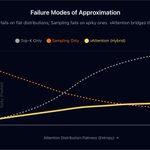




We’ve been assuming that extreme attention sparsity must destroy model quality.
That assumption is now false.
New SkyLight Release: vAttention ⚡️
We added vAttention to the Tier1A leaderboard. The data is striking:
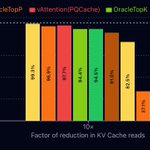
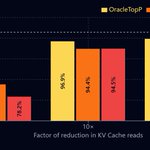
👑 #1 Practical Method: Surpasses the previous lead (PQCache), closing the gap to dense models within 1% at up to 10x sparsity..
👑 Saturates Benchmarks: Dominates the sparsity–quality frontier (w/ oracle top-k).
💡 Introducing Verified-X: A new paradigm for reliable inference-time sparsity.
In this week’s blog, we share an in-depth look at the algorithm and how to run it via SkyLight 👇

Built by @Apd10Desai, @kumarkagrawal, @randwalk0 , @Alex_Cuadron, @luisgschroeder @matei_zaharia, @profjoeyg, @istoica05 at @skylight-org, @BerkeleySky.
📝 Full blog post: sky-light.eecs.berkeley.edu/…
📄 Paper: arxiv.org/abs/2510.05688
💻 Code: github.com/skylight-org/spar…
🏆 Updated SkyLight Tier-1A benchmarks: sky-light.eecs.berkeley.edu/
You can explore vAttention in SkyLight's pytorch research attention framework today using github.com/skylight-org/spar…

Selecting the top-k highest scores is the intuitive standard for sparse attention. However, our latest SkyLight Tier 1A benchmarks show a non-trivial gap between Oracle Top-k and dense baselines at high sparsity.
PQCache currently tops the leaderboard as the strongest practical method, closing the gap between approximate-top-k and oracle-top-k for upto 10x sparsity levels.
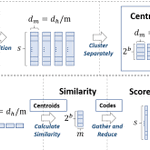
Closing the gap between dense and practical sparse attention methods will clearly require new ideas. In this week’s blog, PQCache authors share an in-depth look at the algorithm, and how to run it via SkyLight 👇

Built by Hailin Zhang, Xiaodong Ji, Yilin Chen, and team at Bin Cui’s Lab.
📝 Full blog post : sky-light.eecs.berkeley.edu/…
📄 Paper: arxiv.org/abs/2407.12820
💻 Original code: github.com/HugoZHL/PQCache
🏆 SkyLight Tier-1A benchmarks: sky-light.eecs.berkeley.edu/
You can explore PQCache in SkyLight's pytorch research attention framework today 👇

1
2
54
Sparse attention offers a viable path to solving the computational and memory issues of long-context LLM serving. However, we observe a surprising gap between the rapid pace of academic research and the reality of open-source adoption.
We identify the core barrier as fragmentation where new methods are published rapidly, but with missing comparative grounding.
Today we’re excited to share SkyLight, where we are building a unified framework designed to bridge this gap. SkyLight standardizes the implementation and evaluation of sparse attention to enable rigorous, controlled benchmarking.
Our first major effort is to understand the frontier of inference time sparse-decoding in LLMs.
1/N 🧵

Despite more than 13,000 papers on sparse attention, real-world adoption in systems like vLLM remains virtually nonexistent.
Looking through several papers published over the last year, we find that while new methods are published rapidly, ther comparison across different approaches is often sparse.
This lack of context and head-to-head comparison prevents the field from forming a clear state-of-the-art and identifying real research bottlenecks, ultimately stalling practical adoption and slowing meaningful progress.
2/N 🧵

1
4
287