

Non-profit science education organization building public resilience against climate misinformation. More at https://xitter.cf/t.co/ctYVbM0Vdv and @SkepticalScienc[email protected]
- Tweets15.6K
- Following348
- Followers20.2K
- Likes892

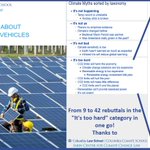







ALT Composite image showing the title page of "Rebutting 33 False Claims About Solar, Wind, and Electric Vehicles" by the Sabin Center for Climate Change Law at Columbia Law School on the left and how our taxonomy increased in the "It's too hard" category by 33 rebuttals on the right side.

ALT Fact Brief #18: Q: Do volcanoes emit more CO2 than humans? A: NO - Volcanoes release CO2, but the amount is minimal compared to human-caused emissions. [..] https://sks.to/gfb-volcano

ALT Screenshot of fact brief #17 Q: Is more CO2 a good thing because it’s plant food? A: NO - While CO2 is necessary for plant growth, the negative impacts of climate change, driven by man-made CO2 emissions, far outweigh short-term productivity gains. [..] Full text: https://sks.to/gfb-plant

ALT Composite image with all 10 versions of the FLICC poster. Highlighted are the two new translations for Russian (https://sks.to/flicc-poster-ru) and Romanian (https://sks.to/flicc-poster-ro)

ALT Screenshot of a part of the Skeptical Science New Research for Week #40 2024, shown are just the first two topics out of these: Included cateogries: - Physical science of climate change, effects - Observations of climate change, effects - Instrumentation & observational methods of climate change, effects - Modeling, simulation & projection of climate change, effects - Advancement of climate & climate effects modeling, simulation & projection - Paleoclimate & paleogeochemistry - Biology & climate change, related geochemistry - GHG sources & sinks, flux, related geochemistry - CO2 capture, sequestration science & engineering - Decarbonization - Geoengineering climate - Black carbon - Aerosols - Climate change communications & cognition - Agronomy, animal husbundry, food production & climate change - Hydrology, hydrometeorology & climate change - Climate change economics - Climate change mitigation public policy research - Climate change adaptation & adaptation public policy research ...

ALT Screenshot from our tribute to John Mason who passed away on September 20, 2024


ALT Screenshots of two fact briefs: Question 1: Is recent global warming part of a natural cycle? Answer: NO - While natural cycles explain some historical periods of climate change, the current one is due to human activity. [...] Question 2: Does manmade CO2 have any detectable fingerprint? Answer: YES - Atmospheric chemistry shows that humans are driving the recent CO2 increase. [...]



ALT Myth rebuttal chart based on the Skeptical Science fixed numbered list of arguments with the 25 myths making an appearance check-marked. Full list is in the blog post.


ALT Fact Brief #12: Q: Are carbon dioxide emissions from human activities enough to affect the climate? A: YES - Neither land nor oceans have been able to adequately absorb the extra CO2 released by our fossil fuel burning, causing atmospheric CO2 to rise and affect our climate. [..]

ALT Screenshot of fact brief #11: Fact Brief #11: Q: Are polar bears endangered? A: YES - Most polar bear populations could become extinct by 2100 if our greenhouse gas emissions continue.[...]

ALT Screenshot of fact brief: Fact Brief #10: Q: Were scientists caught falsifying data in the hacked emails incident dubbed 'climategate'? A: NO - Nine separate investigations found that climate scientists involved in the “climategate” controversy did not falsify data.[...]


ALT Climate Misinformation Mechanics, Cranky Uncle, and Skeptical Science with John Cook. The Environment in Canada Podcast, Ep. 26. Picture of two people having an argument and one reaching out.

ALT Screenshot of the blog post plugging Dr Ella Gilbert's Youtube channel "Dr Gilbz"

ALT Screenshot of the top of the 2024 SkS Weekly Climate Change & Global Warming News Roundup #27