
building @igptai, the email intelligence API that gives AI agents actual memory. DMs open for builders hitting the email context wall. https://xitter.cf/t.co/PYs9d0ZJAb
Joined February 2009
- Tweets134
- Following278
- Followers57
- Likes327


Sivan Kaspi retweeted

iGPT Skills are live!
Connect, ask, get answers grounded in your real email and Drive.
No more pasting threads, summarizing chains, or briefing the model on who matters.
Skills cover sales, finance, customer success, recruiting, operations, and more.
github.com/igptai/skills
Sivan Kaspi retweeted
Want to know why your AI hallucinates even when you give it the context?
It's probably using RAG.
RAG chops content into chunks and pulls the ones that look most similar to your question.
That works for documents, but email isn't a document.
Email keeps copying itself into every reply and buries the current state under quoted history. So the model sees real text and reaches the wrong conclusion.
iGPT reconstructs the thread first and returns what actually happened, with citations back to the source
igpt.ai/blog/why-rag-fails-o…


Sivan Kaspi retweeted

every paradigm humans built like finance, communication, time management, all of it has to be reinvented from first principles for agents.
if you really think about it the systems that were built weren’t necessarily designed around the underlying problem.. they were designed around human constraints around the problem which are limited attention, slow reading, status signaling, the need to make things comprehensible to other humans, etc. if you strip those constraints, nearly 80% of the scaffolding that exists collapses.
what you’re left with is the actual function, which is almost always smaller than the ritual around it. the transition is going to be fascinating for the economy, for how people interact, & for what we refer to as “work” today even means.
Sivan Kaspi retweeted

most of tooling around llms was built for a world that largely doesn’t exist anymore
RAG, GraphRAG, Multi Agent Orchestration, ReAct frameworks, prompt management/versioning tools, LLMOps tooling, eval tools, gateways, finetuning libs, etc
all obsoleted in in the last 3 months
Sivan Kaspi retweeted
there are likely ~100 ppl alive today that deeply understand all of these together: product instinct, what makes good software, design, technical depth, a real model of ai, the psychology of a single user, the shape of culture, team building, the ability to motivate, & the narrative gift to make any of this actually legible to normal peeps.
in consumer, where the tam is pretty much everyone, that combinatorial scarcity is the leverage.
~100 against 8 billion. pure asymmetry.
Sivan Kaspi retweeted
Your agent can now reason across Google Drive in one API call.
Another datasource alongside email and attachments. Together they give your agent the full picture.
- Compare two versions of the same doc and pull what actually changed.
- Check whether what was promised in one doc shows up in another.
- Answer a question that spans forty files without adding them into the context window.
iGPT handles the retrieval, structuring, and context assembly with ~20x fewer tokens.
Sivan Kaspi retweeted

Making something people love is mostly making something you love and hoping the overlap is real
Sivan Kaspi retweeted
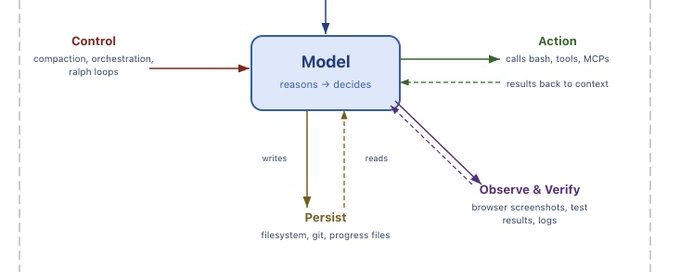
If your memory dies when your harness dies, you built the harness too thick.
Memory is markdown. Skills are markdown. Brain is a git repo. The harness is a thin conductor — it reads the files, it doesn't own them.

Sivan Kaspi retweeted

Security another great example of a job category that is about to have its Jevons paradox moment as well.
“And counterintuitively, I think better AI tooling for security will increase the demand for security talent, not decrease it. Autonomous exploitability automates the proving step, but it doesn't automate the response. More real findings surfaced faster means more triage, more remediation, more architectural decisions that need human judgment”
AI is going to generate 100X more code, and along with that, there will be an enormous increase in security discoveries. AI is the only way to triage all of these new threats and risks, but an expert still will be needed on the other side to manage the process. Going to be a massive category of opportunity for talent.

Sivan Kaspi retweeted
Another week on the road meeting with a couple dozen IT and AI leaders from large enterprises across banking, media, retail, healthcare, consulting, tech, and sports, to discuss agents in the enterprise.
Some quick takeaways:
* Clear that we’re moving from chat era of AI to agents that use tools, process data, and start to execute real work in the enterprise. Complementing this, enterprises are often evolving from “let a thousand flowers bloom” approach to adoption to targeted automation efforts applied to specific areas of work and workflow.
* Change management still will remain one of the biggest topics for enterprises. Most workflows aren’t setup to just drop agents directly in, and enterprises will need a ton of help to drive these efforts (both internally and from partners). One company has a head of AI in every business unit that roles up to a central team, just to keep all the functions coordinated.
* Tokenmaxxing! Most companies operate with very strict OpEx budgets get locked in for the year ahead, so they’re going through very real trade-off discussions right now on how to budget for tokens. One company recently had an idea for a “shark tank” style way of pitching for compute budget. Others are trying to figure out how to ration compute to the best use-cases internally through some hierarchy of needs (my words not theirs).
* Fixing fragmented and legacy systems remain a huge priority right now. Most enterprises are dealing with decades of either on-prem systems or systems they moved to the cloud but that still haven’t been modernized in any meaningful way. This means agents can’t easily tap into these data sources in a unified way yet, so companies are focused on how they modernize these.
* Most companies are *not* talking about replacing jobs due to agents. The major use-cases for agents are things that the company wasn’t able to do before or couldn’t prioritize. Software upgrades, automating back office processes that were constraining other workflows, processing large amounts of documents to get new business or client insights, and so on. More emphasis on ways to make money vs. cut costs.
* Headless software dominated my conversations. Enterprises need to be able to ensure all of their software works across any set of agents they choose. They will kick out vendors that don’t make this technically or economically easy.
* Clear sense that it can be hard to standardize on anything right now given how fast things are moving. Blessing and a curse of the innovation curve right now - no one wants to get stuck in a paradigm that locks them into the wrong architecture. One other result of this is that companies realize they’re in a multi-agent world, which means that interoperability becomes paramount across systems.
* Unanimous sense that everyone is working more than ever before. AI is not causing anyone to do less work right now, and similar to Silicon Valley people feel their teams are the busiest they’ve ever been.
One final meta observation not called out explicitly. It seems that despite Silicon Valley’s sense that AI has made hard things easy, the most powerful ways to use agents is more “technical” than prior eras of software. Skills, MCP, CLIs, etc. may be simple concepts for tech, but in the real world these are all esoteric concepts that will require technical people to help bring to life in the enterprise.
This both means diffusion will take real work and time, but also everyone’s estimation of engineering jobs is totally off. Engineers may not be “writing” software, but they will certainly be the ones to setup and operate the systems that actually automate most work in the enterprise.


Sivan Kaspi retweeted
If you're making decisions based on what AI tells you is in your email, you're likely working with bad data and don’t know it.
We tested a real business thread across five models and four returned confident, structured, wrong answers. Businesses run on email. If the AI reading it gets it wrong, every decision is built on a guess.
iGPT structures your email, attachments, and docs into intelligence that AI can reason over with one API call.
hackernoon.com/i-gave-5-fron…

Sivan Kaspi retweeted
Most AI agents that touch email are working off raw data and don't even know what they're missing.
They miss things that actually matter to the deal:
- pricing concerns raised in side threads
- a commitment that quietly got dropped
- the conversation going cold after the proposal
iGPT fixes that layer.
One call returns who said what, what is unresolved, and what needs to happen next.
$10 free credits. No credit card needed
igpt.ai/hub/playground/
Sivan Kaspi retweeted
Everyone is building context layers for structured data.
Nobody is building them for the place where most business decisions actually happen: email threads.

Frontier models are exceptionally efficient, intelligent, and useful. For agents, context is now the bottleneck.
Enter the context layer, which bridges the gap from an enterprise's messy data to actionable context, packaged for agents.
We're seeing three distinct verticals emerge in the context layer space:
- Data gravity platforms
- Existing AI data analysts
- New, dedicated context layer companies
Read the full piece by @JasonSCui and @JenniferHli: a16z.news/p/your-data-agents…


Sivan Kaspi retweeted
A single client relationship spans dozens of threads, months of back-and-forth, and internal discussions you've half-forgotten.
Reconstructing that before a meeting means an hour of cross-referencing emails, docs, the CRM, and the web.
And you still miss things.
Tavily handles the research.
iGPT handles the relationship history

Sivan Kaspi retweeted
This is exactly the problem we built for
Thread reconstruction → participant detection → role mapping → structured JSON
The identity + intent graph isn't missing
it's trapped in unstructured email threads
We extract it
docs.igpt.ai/

This post is from a suspended account. Learn more
