

Founder @ AI Startup (Stealth) | Training Large-Scale Neural Networks | Curating the Best in AI & Tech | Building the Future
Joined December 2012
- Tweets5.4K
- Following4.8K
- Followers435
- Likes3.8K





Pinned Tweet
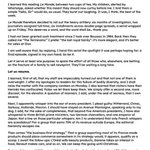
Ray Bradbury understood something most people forget: attention is not just something you spend, it is something you train. His advice was simple but disciplined — read one short story, one poem, and one essay every night for a thousand nights — because the mind gets stronger by repeated contact with concentrated language and ideas.
The deeper point is that rebuilding attention span is not about avoiding distraction for a week and calling it fixed. It is about giving your mind regular doses of depth until depth feels natural again. Bradbury’s method works because it mixes three things the brain needs: narrative, compression, and argument.
What I like about this advice is that it treats attention as a craft, not a mood. You do not rebuild it by waiting to feel focused. You rebuild it by feeding the mind better material every day, long enough for your defaults to change.
The image captures that well: attention span is not only about reading more, it is about reclaiming the ability to stay with something long enough for it to shape you. In Bradbury’s view, the real payoff is not just more focus — it is a fuller head, a richer inner world, and better raw material for thinking and writing.

I think this essay is more honest than most things written on this subject, and I want to say that before disagreeing with it. Amodei names the tension instead of hiding it, and he asks the right question, which is what you'd do with the time. Most people who want to slow things down never get that far.
Here's what I'd push on.
The thing that kills new technology is almost never a conspiracy. It's selection. You create a body whose job is to certify things, and at first it's staffed by people who care about the underlying problem. Ten years later it's staffed by people who are good at running certification bodies, which is a different skill and a different kind of person. Their incentives are not bad, they're just not the original ones. Nobody notices, because the failure mode is invisible. You never see the thing that didn't get built.
University ethics boards are the cleanest example. They were created after genuine abuses, real ones, and now they make a graduate student wait four months to run a survey. Every step of that was reasonable. The result is not.
The other thing I'd say is that there's a large difference between two kinds of rules, and this proposal quietly slides from one to the other. A rule that punishes you for causing harm is fine. A rule that requires permission before you act is the dangerous kind, because the person granting permission bears none of the cost of saying no. Nobody has ever been blamed for the company that didn't get started. Amodei's checkpoints are the permission kind.
And then there's the part that should make anyone suspicious, even of proposals made in good faith: compliance is a fixed cost. Fixed costs are a tax on small things. So any safety regime, whatever its content, will be more convenient for large organizations than small ones, and the largest ones will find it most convenient of all. This is true regardless of intent. It's arithmetic. When a proposal happens to have that shape and is written by someone at a company with 100,000 GPUs, you should at least notice.
I don't think he's being dishonest. I think he's describing the view from where he's standing, and the view from there makes certain solutions look obvious that would not look obvious from anywhere else. That's the normal way people get things wrong. It's also why the proposal to pace the frontier always comes from someone already at it.

We Must Pace the Frontier: I’ve written a new essay on why the AI industry should slow down, with a three-part plan for doing so.
Anthropic is unilaterally committing to the first of these steps. We’ll provide third-party evaluators with permanent, employee-level access to our systems, so that they can verify adherence to our safety measures, report on incidents, and assess models’ alignment during training.
You can read the full post here: darioamodei.com/post/we-must…

True! idea is cheap, execution matters.

I can’t stress enough how little an idea matters compared to the agency of the people executing the idea.
I have had the privilege of knowing and sometimes even working with some of the most successful people (by various metrics).
The difference between mediocre and excellent work and outcomes is predominantly one of agency.
In practice this means: they dont wait for things to happen to them they go out and make things happen for them.
They don’t wait for someone else to do something, for someone to teach them, for someone to give them the path, etc. They just go out and find a way to do it.
I think the single biggest superpower these people have is the realization/belief that the world around them is completely mutable. Most everything that happens is because a person made it happen.
I used to tell people to look around the room you’re sitting in. Look at everything. Every noun. It almost all exists because a person willed it into existence. Nothing is stopping you from doing the same.
I see people online all the time dismissing someone else’s success because “I had that idea first” or whatever. I mean… yeah? If so then the difference is… you. So a bit of a self own whenever I hear that.
Number one tip: act with agency.


Sinclair Ta retweeted

Your cafe’s QR code is a link to your books. Anyone who pays once can see every sale you've ever made.
Now: a fresh address per sale. Ring up 4.50, they scan, they pay, that address has one payment on it. Theirs.
Tap Close till at 6pm and the day lands in your wallet.
Two minutes to switch on:
privacyhood.org/merchant?pos…
- Private takings → Turn on
- write down the seed it shows you (your only backup)
- send a little ETH to the gas float, it pays for the close out sweep

Only the Paranoid Survive

🚨 BREAKING — Anthropic investors worry Dario Amodei’s AI doom marketing could hurt its upcoming IPO.
“He’s more of a religious leader than he is a CEO.”
> used to write sensitive OpenAI memos on an offline computer
> printed them out instead of using Google Docs
> refused to visit China since he feared being kidnapped
> investors say he refuses to listen outsiders
> one investor noted before investing that Dario didn’t seem to care about making money
> some investors want him to “stop scaring everyone” ahead of the IPO
This cannot be healthy.


The real cost of “diet” may not be calories — it may be cognition
The article reports on a Brazilian study of 12,772 adults, average age 52, followed for about eight years . Researchers looked at seven low- and no-calorie sweeteners — aspartame, saccharin, acesulfame-K, erythritol, xylitol, sorbitol,and found that the highest consumers had faster decline in thinking and memory skills than the lowest consumers . The slowdown was described as equivalent to about 1.6 years of extra brain aging, and the link was stronger in people under 60 and in people with diabetes .
What it means
This is a link, not proof of cause and effect . The study was observational, so it can’t say sweeteners directly caused the decline; it only shows that higher intake and faster cognitive decline appeared together more often . Still, the signal is serious enough to make “diet” drinks look less harmless than many people assume .
Practical advice
- Don’t panic over one diet soda. The study is about high, habitual intake, not occasional use .
- If you rely on sweetened drinks daily, start cutting back. Swap some servings for water, sparkling water, tea, or coffee without sweeteners .
- Be extra cautious if you’re under 60 or have diabetes. Those groups showed the strongest association in the study .
- Treat sweeteners as a tool, not a health food. “Zero sugar” does not automatically mean “brain-safe” .
- Look at the full pattern. Sleep, exercise, blood sugar control, and overall diet likely matter much more than one ingredient alone.

If you get bored easily, there might be something deeper going on. In his TED Talk, educator Kevin H. Gary shares 3 things to consider when your mind starts to wander, so you can take control of your attention and reflect on what you’re actually feeling.
AI won’t decide our future. The habits we build around AI will. Every powerful tool asks the same question: “Will you use me, or will I end up using you?”
"Winning" the AI race does not mean becoming the supplier of AI services to more countries. It means creating the AI that destroys all the other countries.
Claude just crossed from “reading about cryptography” into actually doing cryptography research. Anthropic says Claude Mythos Preview helped find new weaknesses in HAWK, a post-quantum signature scheme, and in a reduced-round version of AES, one of the most studied encryption families in the world.
This is not a real-world break of today’s internet encryption. Anthropic says HAWK was a candidate scheme, not a deployed standard, and the AES result applied to a weaker test version rather than the full cipher used in practice.
But it is still a big capability signal. Claude reportedly found a previously unknown attack on HAWK in about 60 hours and improved a theoretical attack on reduced AES by 200 to 800 times.
The cost was not trivial. Anthropic says the two results each cost roughly $100,000 in API usage, which shows this is frontier-model research, not casual automation.
The deeper takeaway is about AI’s role in security. Instead of only helping defenders write code or patch systems, models are now starting to participate in the same kind of mathematical attack thinking that human cryptographers use to stress-test algorithms.
What makes this compelling is the paradox: the same kind of model that can help secure systems can also help break candidate ones. That does not mean current encryption is suddenly unsafe; it does mean the review loop is changing, because AI can now search for subtle weaknesses faster and at larger scale than before.

Interesting: the hottest AI debate right now is not whether models can answer questions — it’s whether they can invent the questions science should ask next.
DeepMind’s paper makes a sharp claim: today’s LLMs are good at pattern matching and increasingly good at formal reasoning, but they still struggle with the creative leap that produces a new scientific theory. The paper frames discovery using Einstein’s own view of science as a cycle: raw experience, then an intuitive jump to axioms, then logical deduction from those axioms.
Here’s why that matters.
- Induction is mostly solved. LLMs are excellent at compressing patterns from huge amounts of data and text.
- Deduction is improving fast. Models can already help prove theorems, write code, and check logical steps.
- Abduction is the missing piece. That is the jump from observations to a new explanatory principle when there is no obvious rule to follow.
That third step is what makes scientific invention hard. It’s also what makes Einstein’s general relativity such a good case study. He did not just fit existing data better; he changed the frame. He proposed a new way the world might work, and only then used logic to work out consequences.
That’s why the paper’s argument feels convincing. A model trained mainly on language is very good at saying what usually follows from what, but science often begins where “what usually follows” is not enough. Real discovery needs contact with the world, ambiguity, and the ability to propose a hidden structure that is not directly spelled out in the data.
At the same time, the claim “LLMs can never make real scientific discoveries” is too absolute. It is more accurate to say that pure text models are not yet built for the full discovery loop on their own. But hybrid systems — models paired with simulations, tools, experiments, and rich world models may still generate genuine discoveries. In other words, the future may not be an LLM acting alone, but an AI scientist made of several parts.
Wrap-up: AI may already help us prove faster and search wider, but the leap from data to theory is still the hard part. The models that eventually crack that problem will probably be the ones that can do more than talk about reality — they’ll need to learn how to touch it.

It’s clear why Arnault is such a winner: he treats pressure like a stage, and keeps the long game unmistakably his.
Bernard Arnault comes off as a winner because he doesn’t just defend a company — he defends a civilization. The tone of that letter is calm, sharp, and almost aristocratic: he answers pressure with confidence, turns criticism into theater, and makes the whole dispute feel smaller than the long game he’s playing.
What stands out is the mix of precision and swagger. He’s not ranting; he’s reasserting control, reminding the reader that luxury is built over decades, not news cycles, and that families like his think in generations, not quarters. That’s why it reminds people of Bezos’s National Enquirer response — both are examples of powerful founders refusing to look rattled when someone else tries to set the frame.
My view: the real skill here is not aggression, it’s composure. Arnault’s letter works because it feels like he is already above the fight, but still fully in it. That combination — elegance plus force — is a huge part of why people read him as such an elite operator.


Nicholas Fabiano, MD is right: exercise doesn’t just help the body — it can also help ideas move, connect, and become more original.
The meta-analysis found that physical activity is associated with better creative ideation, and intervention studies showed a medium positive effect overall, with chronic exercise doing better than a single workout.
Why it matters
The practical takeaway is that movement can help your brain get unstuck. In the study, exercise was linked to improved creative idea generation, especially in fluency, flexibility, originality, and elaboration tasks. That makes the “give your ideas some legs” line more than a slogan — it matches the evidence pretty well.
My take
I like this because it turns creativity from a mysterious talent into a state you can influence. Walking, training, or even just getting your body into motion may help shift attention, loosen mental fixation, and improve the kind of associative thinking that leads to new ideas. It’s not that exercise magically creates genius; it makes the brain a better place for ideas to form.
buff.ly/1gEK0qV

NVIDIA just didn’t fund SSI — it chose a side in the future of AI. When a chip company gives a frontier lab an order-of-magnitude jump in compute, it’s not “more capacity”; it’s a vote of confidence that this team is worth helping shape the next phase of intelligence.
That’s what makes this feel bigger than a normal deal. Ilya Sutskever is now building a company whose whole identity is: go slow, stay safe, and only scale when the research is ready. NVIDIA is basically saying, “We believe you’re there now.”
The human part is easy to miss. Behind the press release is a familiar story: a researcher who helped define the last era of AI now trying to build the next one with more caution, more focus, and a lot more compute. It’s a reminder that the race for superintelligence isn’t only about faster models — it’s about who gets the resources to ask better questions for longer.
The deepest takeaway is this: in AI, compute is not just power. It is permission.

From my view, that Sartre passage is a pretty sharp reminder that identity is built through repetition, not self-description. It’s easy to say “I’m disciplined,” “I’m creative,” or “I’m stuck,” but the more honest answer is usually in the pattern of choices someone keeps making.
The part I find most useful is the refusal of excuses. Sartre isn’t saying circumstances don’t matter; he’s saying circumstances don’t get the final word unless you keep handing it to them. That lands well in modern life, where people often have strong narratives about why they can’t change, but much weaker habits for actually changing.
My take is that this idea is empowering, but also uncomfortable. Empowering because it says your future is still open; uncomfortable because it removes the comfort of blaming your environment forever. In that sense, the quote is less about philosophy as theory and more about philosophy as a prompt: what would your life look like if your actions had to tell the truth about who you are?

This image shows a quote from "Jean-Paul Sartre’s _Existentialism Is a Humanism". The highlighted passage says that reality exists only in action, and that a person is defined by what they do rather than by what they merely feel or intend.
In plain English, the point is: "you are your choices". Sartre is arguing that people can’t hide behind circumstances forever, because meaning comes from lived action, not excuses or abstract identity.
That’s a very existentialist idea, but it also works as a practical reminder. If someone wants a different life, they have to start behaving differently; belief alone doesn’t change much unless it turns into action.

Interesting: your brain is not a hard drive — it’s a meaning machine.
Lisa Genova’s - @LisaGenova central message is reassuring: memory is not supposed to be perfect, and most of the things people panic about are not signs of Alzheimer’s at all.
She explains that memory depends on attention, meaning, repetition, sleep, and context. In other words, if you never really noticed where you put your keys, your brain probably never stored that information in the first place. She also distinguishes normal forgetting from dementia in a useful way: forgetting a name or why you walked into a room is common, but repeatedly forgetting recent conversations or getting lost in familiar places is more concerning.
What makes the conversation especially useful is how actionable it is.
Simple habits like writing things down, using checklists, pairing reminders with routines, spacing out study sessions, and protecting sleep, because those support memory far better than trying to “force” recall.
One of the biggest enemies of memory in modern life, especially with phones, alerts, and constant multitasking.
buff.ly/CJ4LePT
