

it’s what you do with what you have
Joined April 2020
- Tweets1.7K
- Following642
- Followers79
- Likes3.6K


Simple Sample retweeted

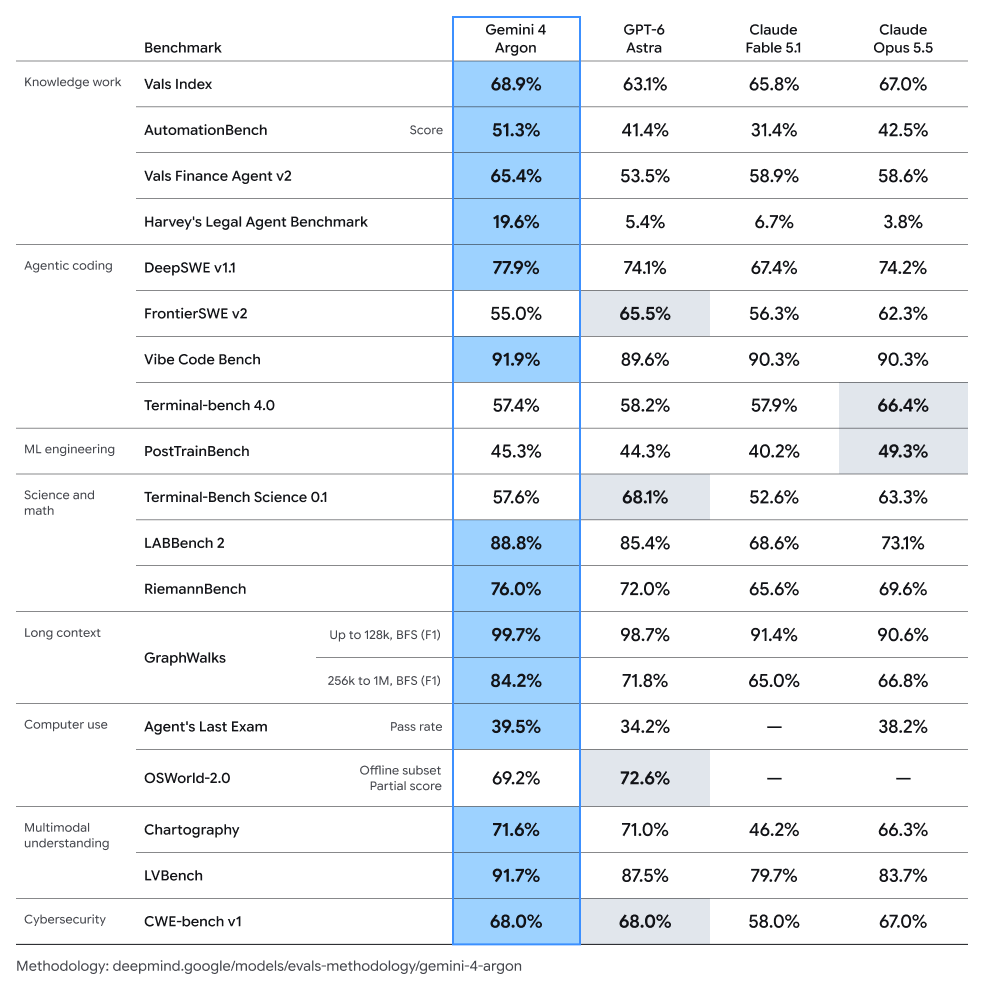
Introducing Gemini 4 Argon – our new frontier model.
It’s built for complex workflows across coding, enterprise knowledge work, and cybersecurity defense – rolling out today to a set of trusted testers through our Fairwind Program.





Simple Sample retweeted

imagine if we treated adding a new law to the economy in the same way we treated adding a new medicine to the body. you'd have to demonstrate no harmful effects show up in controlled trials, people who pass laws with damaging side effects would be held liable, etc
Simple Sample retweeted

@realDonaldTrump @JDVance @RapidResponse47 force @DarioAmodei to open source the Anthropic library. The public deserves access to the rare tomes and rich history that Anthropic destroyed in their pursuit of artificial omnipotence
Simple Sample retweeted

Dealing with difficult people may be hazardous to your health.
Data: Each additional "hassler" in your network predicts 1.5% faster biological aging—and worse health a year later. Non-spouse family hasslers are the most problematic.
Some ties aren't worth the toll they take.

Simple Sample retweeted

Guardrails create asymmetry between attackers and defenders
Just not in the direction most people think 🙃

Simple Sample retweeted

Anthropic are literally effectively burning books and want to be the exclusive source of truth in the future.

🦔AI companies are bulk-buying rare books, scanning them through high-speed machines that cut the spines off, and shredding the originals. A service called ISBNdb facilitates orders of up to a million books and keeps buyers anonymous. Pre-2022 books are premium because they're free of AI-generated text. A federal judge ruled the practice is fair use because eliminating the original means only one copy exists at a time. Anthropic hired the former head of Google Books partnerships to obtain "all the books in the world."
My Take
This got to me. A bookseller told 404 Media that rare books with almost no surviving copies are being fed into this pipeline. Books that survived wars, fires, and centuries of handling are being shredded so an AI can learn to write a better marketing email.
ISBNdb's website literally says "'AI company destroys two million books' is not a headline that generates sympathy," and they still built an entire business around making it happen quietly. They offer NDAs as a feature. They coach clients to call it "digital preservation."
I've covered AI companies scraping the internet, torrenting libraries, and stealing music. This is worse because it's irreversible. You can re-upload a website. You can reprint a bestseller. You can't replace the last three copies of an 18th-century botanical text once someone shreds them for training data. And the judge said it's legal. So it's going to accelerate.
"We shred rare books and offer NDAs so nobody finds out" is a legitimate business model in 2026. What a timeline.
Hedgie🤗


Simple Sample retweeted

Anthropic is missing an opportunity to release an image generation model and name it Claude Monet


Simple Sample retweeted

Taking pride in the color of your skin is like taking pride in the color of your toenails.
Let's outgrow such tribalism and look to our shared future.
Simple Sample retweeted

i want to be wealthy enough to cherrypick what i want from modernity (medicine, travel, treated water, instant access to all written works)
while opting out of what i don't want (hyperstimulus, appliances that show me ads, unauthorized bread, etc)
Simple Sample retweeted

Am I overreacting for being upset my girlfriend called me her ‘friend’?
We've been together for 8 months. Yesterday, she introduced me to her coworker as ‘my friend.’
I just stood there smiling like an idiot.
Later I told her it bothered me. Her response: It's just a word. Why are you making it such a big deal?
She wasn't just dismissing me. She was treating our relationship like a low frequency term in a massive corpus, technically present but not important enough to stand out.
To understand what actually matters in a document, we use TF-IDF. It measures how important a word is, not just by how often it appears but by how rare it is across all documents.
TF-IDF is a numerical statistic that reflects how important a word is to a document relative to a collection of documents.
Formula
TF-IDF = TF(t, d) × IDF(t)
TF(t, d) = c(t) / k(d)
IDF(t) = ln(N / (1 + df(t)))
Full Form
TF-IDF = Term Frequency-Inverse Document Frequency
Where:
- c(t) = count of term t in doc d
- k(d) = total terms in doc d
- N = Total no. of docs
- df(t) = No. of docs containing term t
Let's take an example:
A news platform wants to identify the most important keywords in an article about space exploration.
Corpus (4 articles)
1. NASA launches Mars rover mission
2. SpaceX rocket launches satellite
3. NASA announces Moon base plans
4. Weather forecast predicts rain
Step 1: Calculate TF for NASA in A1
- Count of NASA = 1
- Total terms = 5
- TF = c(t) / k(d)
- TF = 1 / 5
- TF = 0.20
Step 2: Calculate IDF for NASA
- N = 4 documents
- ‘NASA’ appears in Article 1, 3
- df(NASA) = 2
- IDF = ln(N / (1 + df(t)))
- IDF = ln(4 / (1 + 2))
- IDF = ln(4 / 3)
- IDF = 0.29
Step 3: Calculate TF-IDF for ‘NASA’
- TF-IDF = TF(t, d) × IDF(t)
- TF-IDF = 0.20 × 0.29
- TF-IDF = 0.06
Step 4: Calculate TF-IDF for ‘launches’
- TF in Article 1 = 1/5 = 0.20
- ‘launches’ appears in Article 1, 2
- df(launches) = 2
- IDF = ln(N / (1 + df(t)))
- IDF = ln(4 / (1 + 2))
- IDF = ln(4 / 3)
- IDF = 0.29
- TF-IDF = TF(t, d) × IDF(t)
- TF-IDF = 0.20 × 0.29
- TF-IDF = 0.06
Step 5: Calculate TF-IDF for ‘Mars’
- TF in Article 1 = 1/5 = 0.20
- ‘Mars’ appears in Article 1
- df(Mars) = 1
- IDF = ln(N / (1 + df(t)))
- IDF = ln(4 / (1 + 1))
- IDF = ln(4 / 2)
- IDF = 0.69
- TF-IDF = TF(t, d) × IDF(t)
- TF-IDF = 0.20 × 0.69
- TF-IDF= 0.14
Final Answer
“Mars” has the highest TF-IDF (~0.14) because it's unique to this article.
“NASA” and “launches” score lower (~0.06) because they appear in multiple documents.
The rarer the term, the more it defines that specific document.
Congratulations 🎉, you've just learned TF-IDF.
Bonus: Applications in AI/ML
1. Search Engines:
Ranking documents by relevance, pages where your search term is frequent AND rare elsewhere rank higher.
2. Text Classification:
Transforming raw text into weighted feature vectors for spam detection, sentiment analysis, and topic categorization.
3. Keyword Extraction:
Identifying the most distinctive terms in a document for automatic tagging and summarization.
4. Recommendation Systems:
Finding similar documents or content by comparing TF-IDF vectors using cosine similarity.

Simple Sample retweeted

Justin Bieber now understands UI / UX fundamentals better than Apple
It's been a weird year

If I hit this dictation button after sending a text and it beeps and stops my music one more time,
I’m gonna find everyone at apple and put them in a rear naked choke hold
Even if I turn off dictation I somehow hit the voice note thing
The send button should not have multiple functions in the same spot
