

Space economy, defense, and the money behind them. Writing Space Worthy, a weekly brief. Ex @boeing @google @openstreetmap. Proudly 🇪🇺
The Internet
Joined January 2008
- Tweets7.3K
- Following1.4K
- Followers1.9K
- Likes1.7K
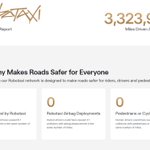




Tesla's Robotaxi fleet has now driven 3.3 million miles in Texas and Florida with no safety monitor on board. In those miles, according to Tesla's safety report, nobody was injured by a Robotaxi, no Robotaxi airbag went off, and no pedestrian or cyclist was hit.
Tesla compares this with police data from Austin, Dallas and Houston: human drivers covering the same miles would have caused about 9 collisions with injuries.
These are Tesla's own numbers, and the cars did have some minor collisions reported to the US road safety regulator. Zero injuries in 3.3 million miles with nobody at the wheel is still a strong result.
In Europe the supervised version, now called Tesla Assisted Driving, is legal in nine EU countries, starting with the Netherlands in April. There a driver stays at the wheel and remains responsible. Italy is not one of them. Tesla's application has been with the transport ministry of Matteo Salvini (@matteosalvinimi) since July, with no decision and no date.
Slovenia and Czechia accepted the Dutch approval without running their own tests. Italy could do the same tomorrow, and the decision sits with Salvini. Keeping a supervised system off Italian roads while the unsupervised one shows these numbers makes no sense.

Simone Cortesi retweeted

We are launching the Tesla Robotaxi safety report today.
Till date, Robotaxi has driven a total of 3.3 million miles autonomously, and has had zero injuries nor airbag deployments. If the same number of miles were to be manually driven, we should expect roughly 9 injuries to the occupants or other pedestrians and 4 airbag deployments on average.
We will continue to transparently share our progress with the public using this page.
tesla.com/robotaxi/safety

Last week Ukraine's military Starlink service, Starshield, was suddenly slowed down, and nobody would say who ordered it. Now the Wall Street Journal and CBS News, citing people familiar with the matter, say it was Elon Musk.
According to the Journal, Musk talked with Trump before the decision and again after it became public. CBS says he spoke with administration officials several times first, to understand what the president wanted. It isn't clear how the order was carried out.
Musk wrote last week that any limits on speed or usage are decided by the US military and ultimately by the president. On Tuesday Defense Secretary Hegseth said the Pentagon hasn't pulled anything back and that Starlink can make these decisions under its terms of service. On Monday Trump said he'd like to find out who did it.
Ukraine's strike and interceptor drones fly at 160 km/h or more, and some units lost the link at 90 km/h. Zelensky said on Sunday some limits are still in place.
Ukraine has no other network at this scale. That gives one company more power over this war than any contractor should have.

Telesat has until 6 December to repay about $1.7 billion of debt, and its own filings say its cash flow isn't enough to cover everything it owes.
Its lenders have now made a second offer, the Wall Street Journal and the Globe and Mail reported this week. A rescue worth about $2.3 billion: about $1.2 billion of new shares and a $1.1 billion loan, and the lenders get all their money back with interest. Shareholders could buy the new shares at about $22.40, roughly half Monday's price. Telesat fell almost 10% in Toronto on Tuesday.
The debt sits in the old geostationary business. The same lenders are suing Telesat for moving Lightspeed, its new low Earth orbit constellation, into a subsidiary outside their reach. Telesat says the move was legal.
Ottawa and Quebec lent about $1.8 billion to build Lightspeed. In August the armed forces signed a $1.6 billion contract to use it in the Arctic, and Carney has said Canada will diversify away from Starlink. Lightspeed service starts in 2028, and the satellites will go up on SpaceX rockets.
Canada's answer to Starlink now depends on shareholders putting in a lot more money first. If they refuse, Canada's plan to rely less on Starlink is in trouble.

Tomorrow up to 1.3 billion SpaceX shares held by employees and early investors become free to sell. It's the biggest release since the June IPO, about 40% larger than the 912 million freed on 6 August.
Two more come after it: about 328 million on 26 October and 798 million on 8 December. Musk's own shares stay locked until June 2027.
The six earlier releases didn't break the stock. On those days it moved between minus 4% and plus 6%. The stock closed Tuesday around $148, above the $135 IPO price, and rose about 5% after hours on strong results. Anyone who refused to sell below the IPO price now has less reason to wait.
Shares that can be sold won't all be sold. If a few large holders take money off the table, tomorrow will be the first release that pushes the stock down.

Simone Cortesi retweeted

SpaceX plans to have 13GW compute capacity by end of 2027 (normalized for IT power that’s ~10GW).
It’s as much AI compute as Google, Meta, Amazon, Microsoft, CoreWeave and Oracle have combined today!

SpaceX's AI business now brings in more revenue than Starlink.
Q3 results from last night: $14.6 billion in revenue, up 161% from a year ago, and $4.4 billion of net profit. AI and cloud brought in $7.56 billion, helped by the Cursor acquisition. Starlink brought in $5.25 billion. Launches and other space work, $1.77 billion.
Profit is split very differently. Starlink made $2.37 billion of operating income. AI made $431 million. The rocket business lost $7 million, with Starship spending still growing.
SpaceX put $19.6 billion into capital projects in the quarter, $16.4 billion of it for AI compute. For Q4 it expects $35 to 40 billion.
Starlink is the business paying the bills today: 13.6 million consumer subscribers, each paying $69 a month, down from $83 a year ago. Until AI earns margins close to Starlink's, SpaceX's profit still depends on broadband connectivity.

European launchers, part 5: Ariane 6.
Ariane 6 is Europe's heavy rocket, built by ArianeGroup and sold by Arianespace. It is 56 to 62 metres tall and flies from Kourou, French Guiana. With two boosters it carries 10.3 tonnes to low orbit, with four boosters 21.6 tonnes. The new P160C boosters add about 10%.
It has flown nine times since July 2024, and all nine reached orbit. On the first flight the upper stage missed its final burn, so it stayed in orbit instead of coming down.
Amazon has booked 24 Ariane 6 launches for its Leo constellation, and three of this year's four flights carried Amazon satellites.
Arianespace expected seven or eight launches in 2026. Then a problem with an engine turbopump, found in ground tests, pushed the next launch from 7 October to 23 November at the earliest. That makes six flights the likely total for 2026. The target for 2027 is nine to ten.
Ariane 6 works and has customers, but it flies too rarely. Europe has a reliable heavy rocket that still can't keep up with its own order book.

Simone Cortesi retweeted

Every SpaceX launch since 2019 against every dollar of revenue SpaceX has filed. Q3 lands tonight against
research.33fg.com/analysis/s…
Japan wants to hand its main rocket to industry. JAXA said today it is working on transferring H3 launch operations to Mitsubishi Heavy Industries, possibly as soon as 2027. MHI already builds the rocket. JAXA still runs the launches.
It's the same path H3's predecessor took: H-IIA launches moved to MHI in 2007, starting with its 13th flight.
The decision follows the launch of the MMX Mars moon mission on H3 flight 10. H3 has now flown 10 times, with two failures: the first flight in March 2023 and flight 8 in December 2025.
Nikkei frames the move as a way to compete with SpaceX. The numbers are far apart. MHI has said it aims for about 10 H3 launches a year at around 5 billion yen each, roughly $32 million. Falcon 9 has flown about 115 times so far in 2026. H3's foreign customers so far are Inmarsat and Eutelsat.
Handing launches to a private company should lower costs and make scheduling more flexible. H3 will stay far behind Falcon 9 on volume and price. Its realistic role is Japan's own reliable access to space and a second option for operators like Eutelsat that don't want to depend only on SpaceX.

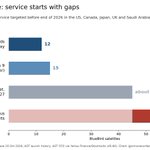
AST SpaceMobile says its phone service from space will start before the end of the year in the US, Canada, Japan, the UK and Saudi Arabia. At first it will be intermittent: it works only while a satellite is passing overhead.
AST has 12 working BlueBird satellites in orbit. Its CFO has said continuous service in its main markets needs about 45 to 60. The next three are waiting at Cape Canaveral for a Falcon 9 listed for late October, and AST is aiming for about 45 in early 2027.
The ground side is further along. In the US more than 3,000 of about 5,600 coverage cells are already enabled, with the rest due by year-end. Partners include AT&T, Verizon, Vodafone, Rakuten and Bell Canada.
The stock is around $42, down about 40% this year.
Patchy coverage helps for an emergency text from a valley with no signal. Everyday customers need continuous coverage, and that means at least 30 more satellites in orbit. Until then, AST's service is a trial run.

A farmer in Minnesota found an 11-foot burned metal dome in his cornfield last week while harvesting. Everything points to the upper stage of a Zhuque-2E, a rocket from the Chinese private company LandSpace, launched on September 15. Nobody has confirmed it officially yet.
That rocket put 10 satellites for China's Qianfan network into orbit. Then the upper stage fired its engine to come back down, which is good practice. Stages are normally steered to fall into the ocean. This one came down over Kansas and Minnesota less than 80 minutes after launch, so the burn probably went wrong. LandSpace hasn't commented. Nobody was hurt.
Under the 1972 Liability Convention, the launching country pays for any damage on the ground. Here that would be China.
China has launched 258 Qianfan satellites since 2024. The plan is 1,296 in the first phase and more than 15,000 later, so hundreds more launches and hundreds more stages coming down. No international body checks how rocket companies dispose of them. Each country regulates its own. A treaty from 1972 that only says who pays afterwards is too weak for this many launches.

Amazon's $11.6 billion purchase of Globalstar just cleared a big hurdle. The FCC has approved Globalstar's new C-3 system for service across the US: 48 satellites at 1,414 km plus 6 spares, built to connect straight to phones. The first launches are planned for next year.
Globalstar is the network behind the satellite SOS and messages on iPhones. Amazon agreed to buy it in April and promised Apple to keep that service running. The deal should close in 2027, once regulators approve and Globalstar hits milestones on its new satellites.
The satellites are built by MDA Space in Canada. France filed the system with the ITU, the UN body that coordinates satellite frequencies, and it will be controlled from Toulouse as well as from Louisiana.
Two weeks ago the FCC approved a constellation of up to 15,000 direct-to-phone satellites for SpaceX. 48 satellites can't compete with that. Amazon is paying for Globalstar's spectrum licences and for Apple as a customer, and its own direct-to-phone fleet only starts deploying in 2028. On phones from space, Starlink is years ahead of Amazon.

Infinite Orbits, a French startup founded in 2017, builds spacecraft that meet satellites in geostationary orbit to inspect them or extend their life. It has raised €52 million in two rounds and has more than €150 million in firm orders. Customers include French Space Command, SES and Eutelsat.
Its rides to orbit are American. It has four firm launch contracts to 2029 with Impulse Space, whose kick stage takes small spacecraft from a Falcon 9 up to geostationary orbit. The first launches are planned for 2027.
For comparison, in January the US Space Development Agency gave Starfish Space a contract worth up to $52.5 million for one satellite disposal mission, with options for more. €52 million is about $58 million, so a single American military contract comes close to everything Infinite Orbits has raised.
Europe has the customers for in-orbit servicing. The money behind its main company is small next to what the US military spends on one mission, and its launches depend on American companies. ESA or the EU should step in as an anchor customer, the way the Space Development Agency did for Starfish.



Japan's MMX launched right on schedule. The H3 rocket lifted off from Tanegashima at 04:41 Japan time (21:41 Monday in Rome), and JAXA confirmed the spacecraft separated after about 71 minutes and is working normally.
The plan: reach Mars around August 2027, send the German-French rover Idefix to scout the moon Phobos, then collect at least 10 grams of its surface and bring it to Earth in 2031.
NASA's Perseverance rover has been collecting Mars samples since 2021. The mission to bring them home was effectively cancelled after a vote in Congress in January. China plans to launch Tianwen-3 around 2028 and return Mars samples around 2031.
So the first material from the Mars system to reach Earth will most likely arrive on a Japanese or Chinese spacecraft, while the American samples stay in their tubes on Mars.

European launchers, part 4: Rocket Factory Augsburg.
Rocket Factory Augsburg, or RFA, was founded in 2018 in Augsburg, Germany. Its majority owner is OHB, the satellite maker from Bremen. RFA One is a three-stage rocket, about 30 metres tall, with nine Helix engines on the first stage. The current version is built for up to 500 kg to sun-synchronous orbit. It will launch from SaxaVord in Shetland, which would be the first vertical orbital launch from the United Kingdom.
RFA One has not flown. In August 2024 a first stage was destroyed in a ground test at SaxaVord. A new rocket stood on the pad in July 2026, but after a week of tests RFA found an issue and took it down. The August launch window was cancelled. There is still no new date.
The money keeps coming. In August the European Space Agency signed a €186.9 million contract that requires an orbital launch before 2028. In September it added €2.7 million for test stands at SaxaVord. On 5 October Alexander Dahm, from Hensoldt and Airbus, became CEO.
RFA has the funding and a spaceport, but its first flight has no date after two setbacks on the pad. Isar is already in orbit and PLD targets the first half of 2027, so RFA is behind both.

For a few months around the end of 2032, the US could be left without a spare geostationary weather satellite. That's the main warning in a report from the Government Accountability Office (GAO), released on Friday.
These are the satellites that watch hurricanes and severe storms over the Americas. The rule at NOAA, the US weather and oceans agency, is two working satellites plus one spare in orbit. The current spare should reach the end of its life in October 2032. The first satellite of the next generation, GeoXO, launches in 2032 but will be fully operational only several months later. If one of the two working satellites failed in that window, there would be a gap in the data.
The program was cut after the Commerce Department ordered a cheaper plan in 2025. Six satellites became four, five instruments became two, and the lifetime cost went from $19.6 billion to $13 billion. One of the instruments dropped was the lightning mapper, used for storm warnings. The GAO says the $13 billion hasn't been independently checked yet, and NOAA's backup plan doesn't analyse what happens if a satellite fails.
Saving $6.6 billion is real money. Still, for several months the US would rely on two satellites with no spare and no detailed plan B. That is too much risk for the system that warns Americans about hurricanes, and NOAA should fix its backup plan now.

Europe's four biggest mobile operators want a share of the satellite-to-phone band that the US ambassador threatened retaliation over this weekend.
On Monday Deutsche Telekom, Orange, Telefónica and Vodafone signed a letter of intent to explore a joint bid for the EU's 2 GHz band. They would build the ground stations and the control and monitoring centres in Europe. They won't invest in satellites themselves. Those would come from a partner they haven't picked yet. No money figures were given.
The four already have partners. In March Deutsche Telekom signed with Starlink for phone service in 10 European countries from 2028. Vodafone co-owns a joint venture with AST SpaceMobile, Satellite Connect Europe, and Orange and Telefónica agreed in March to work with it. AST shares were up about 6% on Monday.
Starlink and AST are both American. The letter says the plan should also support "the development of a European constellation", but that constellation doesn't exist yet. Last week Tech Commissioner Henna Virkkunen told Rapporteur that US suppliers aren't needed for this.
So for years Europe's own satellite-to-phone service would most likely run on American satellites, with only the ground stations and the control in Europe. That falls short of what Brussels wants for the part of the band it is keeping for European companies.

Goldman Sachs split Europe's two big satellite operators on Monday.
SES got a buy rating and a €7 target, against Friday's close of €4.17. The main reason is money from the US. SES is due about $5.6 billion, more than €3 billion net, for clearing C-band frequencies that the FCC will auction for 5G. The payments come in 2030 and 2031, if SES clears the band on time. Goldman puts that cash at about 1.4 times SES's market value today.
Eutelsat kept a neutral rating, and its target went from €5.22 to €1.60. That's below Friday's close of €1.77. Management's plan needs revenue to grow 8 to 9% a year until 2029. Between fiscal 2020 and 2026 it never grew more than 2% in a year.
Last week both stocks rose on hope of European defence orders, Eutelsat by 28%. Goldman thinks much of that defence money arrives after 2030.
Both companies sell the same European sovereignty story. SES also has a large US payment with dates attached, and that makes it the stronger case of the two right now.
