

Principal Software Engineer and AI Enthusiast :) Ex Microsoft. Building MVP for marketers.Scratched Surface of Understanding this Universe and helping others :)
Earth 🌎
Joined January 2014
- Tweets9.8K
- Following2.1K
- Followers146
- Likes47.2K








Pinned Tweet
Late night musing 1: Observer changes the behaviour of those who are being observed, its true for both physical beings as well as quantum particles. Are the quantum particles being wired by someone to behave a specific way when observed?
Shubham retweeted

strong recommend every engineer listens to this from @dhh. he is getting a lot of hate but this will be seen as prophetic.

Shubham retweeted

WTF are we made of light?

🚨 PHYSICS IS BROKEN! MATTER IS AN ILLUSION, THE ATOM IS JUST TRAPPED LIGHT! A NEW ERA HAS BEGUN! 🚨
For 100 years, physics has treated "mass" as a fundamental, solid particle floating in an endless, empty void (ℝ⁴). What if that is a complete mathematical hallucination? What if mass is just light that got stuck in the geometry of space?
A year ago, we thought exactly like the academic establishment. Breaking a lifelong paradigm and reinterpreting everything from scratch is incredibly difficult. But mathematics is a stubborn thing. We realized one absolute truth: the infinite ℝ⁴ space is fundamentally defective in physics. It exists purely as an abstract mathematical concept, and we must finally understand that pure mathematics ≠ physical reality. We genuinely need your help to break this dogma!
DO NOT TAKE OUR WORD FOR IT. DO NOT BLINDLY TRUST AUTHORITY.
We wrote the code, we solved the math, and we are giving it to you for absolutely free. Read the preprint and verify it yourself.
Look at the real quantum photographs attached. On one side is the groundbreaking 2013 photograph of a Hydrogen atom's electron orbital, captured by researchers at the FOM Institute AMOLF in the Netherlands using a quantum microscope. On the other side is the famous 2015 photograph from EPFL in Switzerland, capturing light behaving simultaneously as a wave and a particle.
Notice the absolute revelation: they are visually identical. Atoms are not solid little billiard balls. They are concentric interference patterns-pure standing waves of energy.
The ultimate conceptual shift of our IT³ framework is this: The atom is not a "box" that contains trapped light. The atom IS the trapped light.
There is no abstract container. There is only the geometry of the vacuum (a discrete lattice) which mathematically forbids light from propagating past certain algebraic boundaries.
How it Works (Explained simply from the video):
Let’s break down exactly what you are seeing in the simulation engine:
〰️ The Cyan Wave (→): A free gauge photon travels smoothly through the quantum vacuum.
🛑 The Kummer Wall (Red Lines): Suddenly, the light hits the absolute edge of the spatial lattice. This is an algebraic cutoff where mathematics literally runs out of resolution (√13 ∉ 𝕂). Space "does not exist" beyond this boundary.
🪞 Total Internal Reflection (Purple Wave ←): With nowhere left to go, the photon undergoes complete topological reflection. It bounces back as its own precise mirror image-an antiphoton.
⚡ The Birth of Mass (Yellow Core): The two opposing waves crash into each other and geometrically interlock. They form a perpetual, vibrating "standing wave" whose energy is trapped in one place. This localized density of confined energy is exactly what we call REST MASS.
The Counterfactual Test:
Watch the timeline in the visualizer. When the system hits the "WALLS OFF" phase, we computationally delete the vacuum boundaries. The golden pulsating core immediately shatters. The light escapes into infinity, and the mass drops precisely to zero. Matter literally un-braids back into pure radiation.
FALSIFIABILITY AND PREDICTIONS:
The "Mass Gap" is not solved by adding endless, arbitrary parameters to an infinite void. It is solved by recognizing that the Universe is a discrete, constructible topological crystal. Our model is strictly falsifiable and delivers exact predictions:
🎯 It predicts a new topological resonance at exactly 1088.04 GeV, accessible for verification at the High-Luminosity LHC.
🛑 It mathematically proves the absolute end of the periodic table at element Z = 172.
🧮 It operates with ZERO fitted parameters. All physics is reduced to the strict arithmetic of integers.
THE HARDWARE CODE OF THE VACUUM MATRIX:
🌌 Arena: ℳ = 𝕊⁴ × 𝕋³ over the field 𝕂 = ℚ(√2, √3, √5)
👁️ Witness: 172 topological elements
⚙️ Processor: 57600 = 240² = 1110 0001 0000 0000₂
📖 DOWNLOAD THE CODE. BREAK THE MATH.
We do not want blind faith. Read the proofs. The supreme judge is the compiler, not closed-door committees.
🔗 Code + Preprint:
doi.org/10.5281/zenodo.22655…
doi.org/10.5281/zenodo.21555…
#Physics #QuantumMechanics #Simulation #OpenScience #MassGap #TheoryOfEverything


Shubham retweeted

If I got laid off tomorrow & had to replace my salary asap, here’s exactly what I’d do:
1. Go to Instagram and start a fresh account. Use a spare email. No one has to know.
Shubham retweeted

I’m excited to finally announce the newest edition my Stanford course 𝗧𝗵𝗲 𝗠𝗼𝗱𝗲𝗿𝗻 𝗦𝗼𝗳𝘁𝘄𝗮𝗿𝗲 𝗗𝗲𝘃𝗲𝗹𝗼𝗽𝗲𝗿. It has been 9 months in the making.
Last November, with the release of Claude Opus 4.5, coding agents experienced a step function improvement in capability. We all felt it. The LLMs were more powerful, could reason for longer, solve harder tasks.
This year’s iteration of my course reflects the 2026 metamorphosis of software engineering.
My core belief is simple: AI-native developers of the LLM era are going to become the most important members of any software organization. I have designed my course to train this next generation of engineers.
𝗪𝗵𝗮𝘁’𝘀 𝗱𝗶𝗳𝗳𝗲𝗿𝗲𝗻𝘁 𝘁𝗵𝗶𝘀 𝘁𝗶𝗺𝗲 𝗮𝗿𝗼𝘂𝗻𝗱
First, 85% of my Fall 2025 class material is being thrown out. The Fall 2026 syllabus reflects the core capabilities AI-native engineers must have: agent skills, advanced context engineering, MCP portals, agent-ready codebase principles, agentic code review, security, parallelizing background agents, software factories, and more.
Second, I am going to teach my students how to have software taste. Every student will be required to ship pull requests to production-grade, real-world codebases. The course is collaborating with the top open-source AI repos who will offer support and mentorship to students on how to meaningfully contribute to their projects.
This has never been done before in any university course so I am incredibly grateful to our OSS Partners: @browserbase, @HeyGen, @CopilotKit, @semgrep, @OpenHandsDev, @milvusio, @marimo_io, Pi, @crewAIInc, @warpdotdev, @vercel, @cmux, @arizeai, @UnslothAI, and @anyscalecompute.
𝗪𝗵𝗮𝘁’𝘀 𝘀𝘁𝗮𝘆𝗶𝗻𝗴 𝘁𝗵𝗲 𝘀𝗮𝗺𝗲
I’m fortunate to again have AI software engineering leaders and founders as guest speakers to share their learnings from building top coding agent products. Thank you to @leerob from @cursor_ai, @bcherny of @claudeai code, @EnoReyes of @FactoryAI, @silasalberti of @cognition, @0xine of @semgrep, Rajesh Bhatia of @Cloudflare , @amasad of @Replit, and @eladgil.
All resources will be available online. All classes will be available to the public.
9/22 on Stanford campus. See you in class.
themodernsoftware.dev/

Shubham retweeted

This guy literally explained why some people become successful while other stay average.
The reason is uncomfortable. Game Theory
Watch this:
Shubham retweeted

Anthropic's CEO: "coding is going away first. then all of software engineering."
In 8 minutes he explains what replaces it and who gets left behind.
This isn't about learning a new language. It's about learning a new way to build.
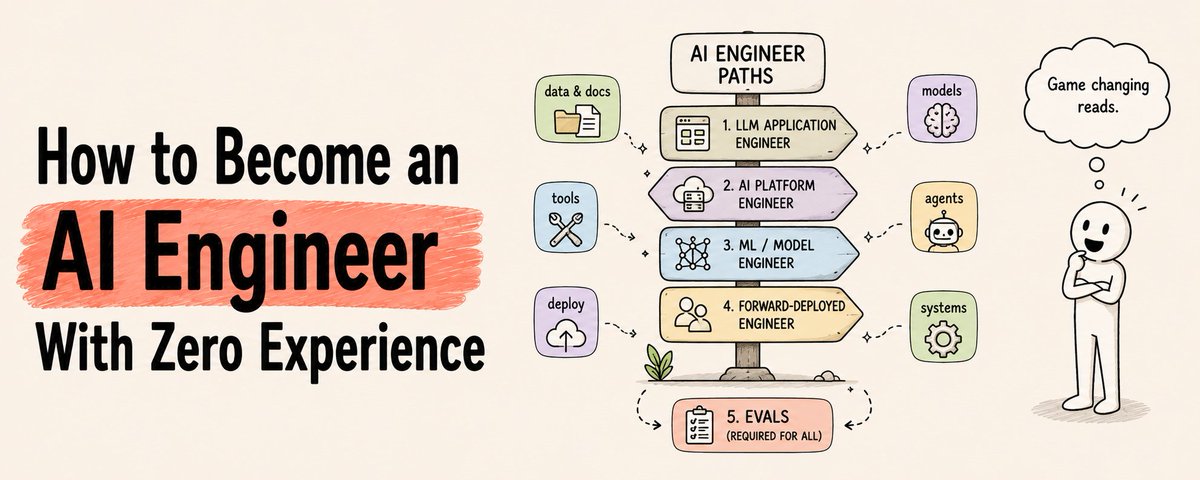
Watch it first. Then read the full roadmap below on how to become an AI engineer even without any experience.

Shubham retweeted

Advice for people in tech.
> Keep an emergency fund of 9-12 months with you
> Avoid taking loans, unless necessary
> Upskill post job hours, in weekend, whenever you can
> Take the job that comes your way if pay is decent
> Be interview ready as much as possible
> Ask for work, if you feel you aren't contributing enuf
Consider yourself lucky if you a job, tough times for people who haven't upskilled much in last few years.
Shubham retweeted
🚨 Google CEO, Sundar Pichai: "If you don't learn to how to orchestrate agents now, you'll spend 2027 catching up to people who started today"
In 30 minutes he explains why the best engineers stopped writing code and started building agents.
Most people think building an agent requires an engineering degree.
It doesn't. It requires one guide and one afternoon.
Watch the interview, then save the exact setup below 👇

Shubham retweeted

Ex-Google Jeff Dean just released 1-hour lecture on full AI engineering: LLM → prompts → agent teams → graphs from 0% to 100%:
0% → 1:45 - LLM from scratch - that made Google
30% → 17:22 - how to actually use AI models
65% → 30:03 - prompt engineering
100% → 52:35 - one human coordinating 100 agents
this is 27 years of AI in Google compressed into one hour, by the person who lived it
watch it today - then read how to build graphs in the article below ↓


Shubham retweeted

Persi Diaconis, Stanford mathematician and former professional magician:
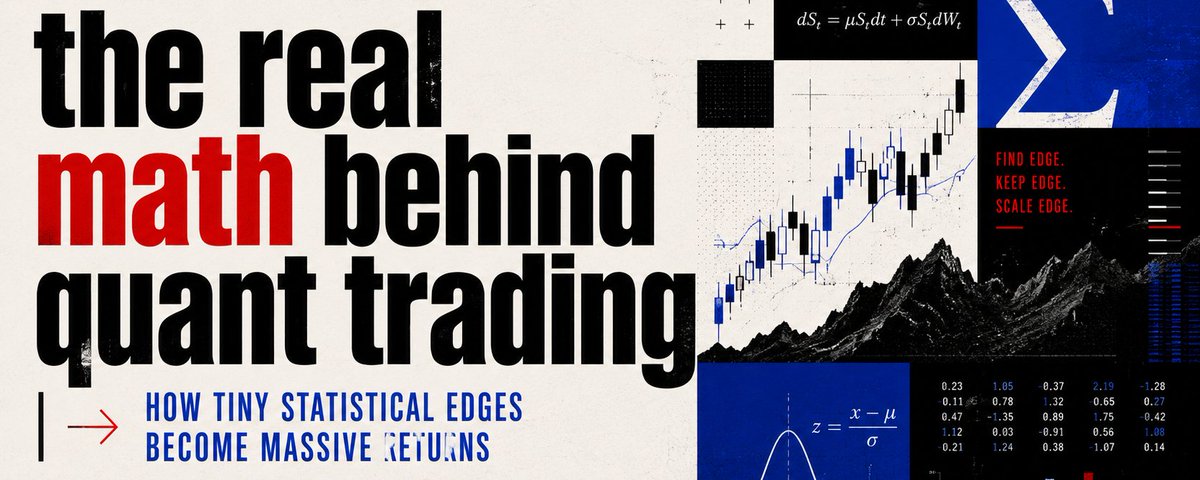
One of the most dangerous mistakes in quantitative trading is assuming every profitable backtest contains a real edge.
This lecture explains why. Given enough data, enough variables, and enough attempts, randomness will eventually produce patterns that look incredibly convincing. Some of them will even work for years before falling apart.
That's why the best quant firms spend far less time finding signals than they do trying to prove those signals are false. A pattern is easy to discover. Demonstrating that it survives outside the data that created it is the hard part.
The mathematics behind this has been public for decades. The challenge was never finding a backtest that worked.
The challenge is knowing whether it worked for a reason. Bookmark this before your next strategy test.

Shubham retweeted
Someone turned Claude into an entire company.
42 skills, organised like a real org chart (links below):
Here is every department, and where to get each one.
Developers
Superpowers → github.com/obra/superpowers
Context7 → github.com/upstash/context7
Skill Creator → github.com/anthropics/skills
MCP Builder → github.com/anthropics/skills
Webapp Testing → github.com/anthropics/skills
Claude-Mem → github.com/thedotmack/claude…
Designers
UI UX Pro Max → github.com/nextlevelbuilder/…
Taste → github.com/Leonxlnx/taste-sk…
Frontend Design → github.com/Leonxlnx/taste-sk…
Transitions → github.com/Jakubantalik/tran…
Web Artifacts → github.com/anthropics/skills
Brand Guidelines → github.com/anthropics/skills
Marketing
45 skills to run your marketing, from copywriting to SEO to lead magnets.
Access them all here → github.com/coreyhaines31/mar…
Social Media
17 skills to run your social media, from post writing to Reels to thumbnails.
Access them all here → github.com/charlie947/social…
Finance
8 skills to run your finances, from statements to reconciliation to audits.
Access them all here → claude.com/plugins/finance
Small Business
31 skills to run your small business, from cash flow to payroll to invoicing.
Access them all here → claude.com/plugins/small-bus…
Legal
9 skills to handle your legal work, from contract review to NDAs to compliance.
Access them all here → claude.com/plugins/legal
Every skill on the chart is real and installable from the links above.
Same departments. Same output. No payroll.
Bookmark this.
🤖 Made with AI


Shubham retweeted

Andrej Karpathy spent 8 years at OpenAI and Tesla.
Last week he put everything he knows into one free 2-hour lecture.
People pay $15k for bootcamps that teach half of this.
You probably don't have 2 hours right now. Don't lose this in the feed.
Watch it. Then read the guide below and build your first loop.


Shubham retweeted
A senior Google engineer just dropped a 424-page doc called Agentic Design Patterns.
Every chapter is code-backed and covers the frontier of AI systems:
→ Prompt chaining, routing, memory
→ MCP and multi-agent coordination
→ Guardrails, reasoning, planning
This isn't a blog post. It's a curriculum. And it's free.
Read it this weekend.
That said, I wrote an article on how to build a multi-model AI team in 2026, which was already read by 4 million people.
It's a complete guide to agents, models, workflows, and playbook to run your business on autopilot.
The article is quoted below.

Shubham retweeted

Stanford professor just released the lecture that explains the math behind every reinforcement learning system.
83 minutes. Free. From Stanford.
Before agents learn to trade, optimize, or make decisions, they all start with the same problem:
How do you choose the best action when the future is uncertain?
This lecture breaks down the foundation:
• turning environments into Markov Decision Processes
• policy evaluation and why value functions matter
• Q-value recurrence equations behind modern RL
• value iteration and convergence limits
Every RL algorithm built today is just a variation of these ideas.
The math has been public for decades.
The hard part was never knowing the Bellman equation.
The hard part is knowing when your model actually understands the environment and when it is just fitting noise.
Bookmark this before it gets buried in your feed.


Shubham retweeted

Police cannot stop you from recording on your phone for your own safety.
Judge reprimands the lawyer for defending the police who tried to stop a citizen from recording.
Supreme Court should declare the Right to Record Public Officials in Public Space as a Fundamental Right.
Shubham retweeted

A MIT professor gave a 1-hour lecture in 2019 that has 18 million views.
He died 5 months after recording it.
It was his final gift to the world.
Patrick Winston taught at MIT for 50 years.
The smartest engineers on earth sat in his classroom.
And he spent his last lecture teaching them the one skill their degrees never covered.
How to speak.
15 lessons that will change how you communicate forever:
Never open with a joke. Your audience is not ready to laugh yet. Open with a promise of what they will know by the end.
Your ideas are like your children. You are too close to them. What is obvious to you is invisible to everyone else. Explain the obvious.
The 5-minute rule: the first 5 minutes of any talk determine whether people will listen for the next 55. Spend more time on your opening than anything else.
Repeat your most important idea 3 times in 3 different ways. Once is never enough.
Build a fence around your idea. Tell people what it is NOT before you tell them what it IS.
Verbal punctuation. Pause. Let the idea land before moving to the next one.
Ask questions nobody will answer. Then wait 7 seconds. The silence is not awkward. It is processing.
Never read your slides. Your audience can read. They cannot listen and read simultaneously.
Use the board not the slides. Writing forces you to slow down. Slowing down forces clarity.
Inspire before you inform. Nobody learns from someone they are not inspired by.
End with a contribution not a summary. Tell them what you gave them. Not what you said.
Never say thank you at the end. It is weak. End with something that lands.
Stories make ideas stick. Data makes ideas understood. You need both. In that order.
The quality of your communication determines the quality of your ideas in the eyes of the world. Not the ideas themselves.
Practice is not preparation. Practice IS the skill.
Patrick Winston understood something most people spend their entire careers missing.
Your ideas are only as powerful as your ability to transfer them into someone else's mind.
You can be the smartest person in the room and be completely invisible.
Or you can master communication and make average ideas feel like breakthroughs.
He chose to spend his last lecture teaching this.
Watch it tonight.
Bookmark this first.
Follow @cyrilXBT for more lessons from the people who built the future.

Shubham retweeted

A man spends 50 years teaching at MIT.
He knows his time is running out.
So he records one last lecture — everything he knows, distilled into a single hour.
He died 5 months later.
This is that lecture.
The most important hour you'll watch this week. 👇
Bookmark it for later

🚨 BREAKING: New faster way to find leads with AI just released.
Today I found an AI that can do the entire sales workflow by itself.
explee.com/auto-gtm/x/air1
Most sales teams spend hours:
→ Finding the ICP
→ Researching prospects
→ Building lead lists
→ Writing cold emails
→ Booking calls
Shubham retweeted

instead of watching 2 hours of Netflix tonight, watch this Stanford lecture
it's the clearest explanation I've seen of how ChatGPT and Claude actually work
useful whether you've never touched AI in your life or have been using it every day for the past year
I took the key ideas and turned them into a practical guide on how to actually get 100% out of Claude
find it below
Shubham retweeted

Andrew Ng just dropped the best 2-hour Prompt Engineering course of 2026:
from brainstorming & agentic prompt patterns to building prompts for images, video and even apps:
• 00:00 - Introduction to Prompt Engineering
• 38:12 - "Brainstorming" prompt patterns
• 47:59 - Context engineering
• 01:30:27 - Build prompts for media generation
• 01:53:43 - App building & data analysis Prompts
This 2-hour watch will change the way you use LLMs forever.
Watch it today, then explore the 4-layer prompt structure in the article below.


