

Launchpad & Token Infrastructure 6qwBy48P8DQNEeXpzYtHRpUhvuGWckD83NuQMqGwSHFT
Solana
Joined August 2025
- Tweets354
- Following11
- Followers552
- Likes175





New Asset Integration: AI Frontier
AI Frontier by @useDiversiFi is a basket token featuring five AI companies: METAx, SPCX, OPENAI, GOOGLx, and Anthropic.
You can now launch tokens on Shift with AI Frontier as their treasury asset.
Your token. Exposure to five AI stocks.

There’s a lot of discussion about tokens needing deeper liquidity pools, with some launchpads even redirecting trading fees to strengthen LPs.
But what if there’s a better approach?
At Shift, we believe a speculative asset doesn’t need an oversized LP. It needs a way for holders to exit beyond the LP. That’s exactly what a redeemable treasury provides.
Instead of selling into a liquidity pool and worrying about price impact or slippage, holders can burn their tokens and redeem their proportional share of treasury assets at a transparent, NAV-based rate. No AMM slippage. No dependence on LP depth for redemption.
The initial LP serves its purpose: enabling speculation and price discovery.
Meanwhile, trading fees accumulate assets in a treasury, creating an alternative exit mechanism backed by actual value.
Liquidity lets you trade. A treasury gives you something to redeem.

It’s not a failed concept, but rather a flawed mechanism.
When users receive rewards in the quote token, they often just dump them, creating constant sell pressure.
A much better approach is something we’ve built at Shift.
Instead of distributing rewards, trading fees accumulate stocks (or any other supported asset) in a treasury that backs the token. This creates real, redeemable value for holders, rather than temporary buy pressure followed by selling.
The goal shouldn’t just be to create demand for another asset. It should be to accumulate and retain that value.
Introducing Anti-Vamp Protection on Shift.
One ticker. One active launch.
Once a ticker is used, it becomes unavailable for new launches across both Shift and Symbio (Pump Fun)
No duplicate tickers. No competing launches using the same ticker.
If the token fails to complete bonding and migrate within 24 hours, the ticker becomes available again on both modules.
Protect active launches. Prevent ticker hijacking. Reduce unnecessary PVP.

Why did we choose SOL as the trading pair for every token launched on Shift?
Because liquidity and treasury backing serve two different purposes.
SOL provides a consistent, liquid trading environment across all launches, without introducing dozens of different quote assets and fragmenting liquidity.
The treasury is where diversification happens. Trading fees are used to accumulate the token’s designated assets, whether that’s crypto, xStocks or something else.
You don’t need to pair a meme with NVIDIA to build an NVIDIA treasury.
And unlike distributed rewards, those accumulated assets remain available as proportional redeemable backing for holders.
Standardize liquidity around SOL. Diversify value through the treasury.
Introducing Symbio.
Deploy tokens directly on @pumpfun with the Shift treasury mechanism built in. Same Pump Fun launch experience. Different economics.
Instead of creator or holder rewards being extracted, they’re routed into the Shift treasury mechanism — accumulating assets and creating redeemable backing for the token.
Pumm Fun handles the launch.
Shift builds the treasury.
↑ shiftfun.xyz/symbio


That’s exactly why Shift exists.
Holders don’t receive stocks as rewards just to dump them. Instead, trading activity builds a treasury that accumulates assets like stocks, gold or crypto, creating actual backing behind the token.
If a holder wants to exit, selling into the LP isn’t the only option — they can burn their tokens and redeem their proportional share of the treasury.
The meme stays a meme. The treasury gives it something beyond the meme to price against.


All tokens launched on Shift are paired with SOL.
Through trading activity, the protocol uses accumulated fees to acquire each token’s designated treasury assets.
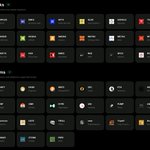
We’re starting with 42 supported assets, from crypto to xStocks — with more coming as Shift grows.
Built on @MeteoraAG with @Backpack and @sunrise powering the asset layer.

4/ Why treasury?
Traditional rewards are consumed as they're distributed. Shift capitalizes fees instead.
→ Trading activity accumulates assets
→ Treasury backing can compound with volume
→ Every holder has proportional redemption rights
→ Burns permanently reduce eligible supply
→ Existing backing remains even when new volume slows
→ Market discounts to redeemable value can create arbitrage opportunities
Rewards depend on future volume. Backing retains what past volume built.
3/ Burn, redeem & arbitrage
The treasury isn't just there to look good on a dashboard. It's redeemable.
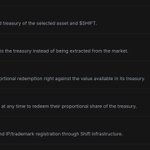
Each eligible token represents a proportional redemption right against the assets available in its treasury.
Holders can burn → redeem their share at any time.
If a token trades below its redeemable treasury value, that can create an economic arbitrage:
Buy token → Burn token → Redeem treasury assets
That mechanism can help close the gap between market value and redeemable backing. A direct relationship between the token supply and the assets accumulated behind it.
2/ Fees & mechanism
Every trade carries a 2% fee:
↑ 1.50% → Selected Treasury Asset (Crypto, xStocks & other supported assets)
↑ 0.25% → SHIFT
↑ 0.25% → Protocol
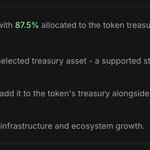
That means 87.5% of every trading fee is allocated to the token treasury. Fees accumulate in SOL and, once the applicable 1 SOL threshold is reached, the protocol acquires the corresponding asset.
Trading builds the treasury automatically.