Web3 Content Writer | Documenting my journey to 10K followers & 5-figures this year
Onchain
Joined August 2023
- Tweets47.7K
- Following2.9K
- Followers2K
- Likes51.9K





bio_the_great retweeted

Opeyemi Famakin has said nothing but the truth… You cannot bully Nigerians not to trivialize a tribal issue.
Since the time of Dora, the war against fake consumables has been a war against Igbo traders. She died in that war, her husband was killed like a dog in that war in Igbo land. More than 4 assassination attempt on her life from your people.
So, DONT come here today and gaslight Nigerians to ignore the fact that it’s your brothers that are poisoning us
bio_the_great retweeted

help reply S239 under this post to vote thesis.
by voting you also get a chance to win $2k from Bitget's reward pool
thanks ❤️


Pick the Hackathon S2 projects and win up to 2,000 USDT!
1. How to Vote
- Click the link in the comments to explore the submitted projects
- Comment with a project ID (e.g., SXXX) under this post
- Before Oct 28
2. Voting Rewards
- First person to correctly predict the winning project ID: 1,000 USDT
- Last person to cast a vote in the comments before the deadline: 1,000 USDT
- Rewards can be combined, with up to 2,000 USDT per person.


bio_the_great retweeted

I know I’ve been quiet lately. I spend most of my days working behind the scenes and apparently, I’m better at keeping everyone else busy than keeping my own X updated 😁
As many of you know however, I’ve always been drawn to projects that give people a reason to use their product or technology, and I think I’ve found the next gem.
Every generated image. Every chatbot response. Every AI feature running inside an app. Somewhere, hardware had to do that work… and someone had to pay for it.
@crynuxio has built a different way to supply that computing power: a decentralized network of independently operated GPUs.
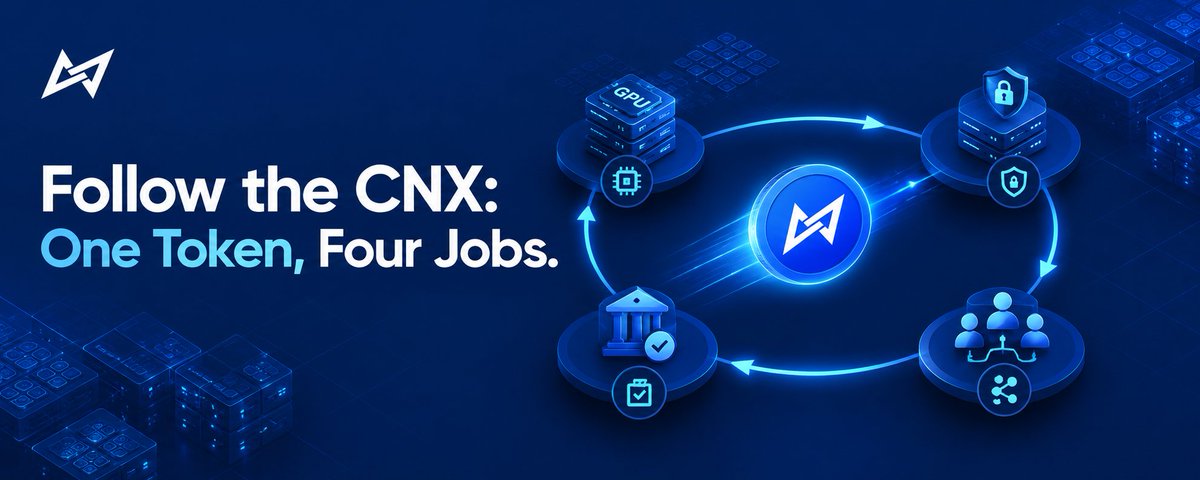
It starts with hardware people already own. A graphics card in a gaming PC that can also be used to run AI models. Crynux lets operators connect that hardware to a network and subsequently complete AI tasks and earn $CNX.
Developers get access to computing power for their applications. Hardware owners get a way to earn from capacity that otherwise sits unused.
Think about that connection: someone’s computer can help power an application used by someone on the other side of the world, with the network coordinating the work and payments.
But connecting computers is only half the problem. How can we trust that someone actually did the work correctly?
Crynux uses vssML, a verification system built around secret spot checks. Roughly 10% of tasks are selected for other nodes to repeat and cross-check. Operators cannot predict which tasks will be checked, and dishonest results put their staked CNX at risk.
That gives the network a way to check the work without paying to repeat every single task multiple times.
The video below shows what this looks like in practice.
This is Crynux Chat, an AI assistant powered by the Crynux network.
Choose an open AI model and start a conversation. Ask it to explain something, help with code, or work through an idea.
In the demo, someone asks for a blue origami fox and gets a generated image back. They also upload a photo and ask the AI to describe it and write an Instagram caption.
Those requests are processed by independently operated GPU nodes on the network.
Crynux Chat is one example of what developers can build using that computing power. The broader network supports other work such as:
• Running AI models for chatbots and assistants.
• Writing, summarizing, translating, and answering questions.
• Generating, explaining, and debugging code.
• Creating images and editing existing images.
• Fine-tuning models for particular tasks or styles.
• Training LoRA adapters to customize models.
Image understanding is also demonstrated in Crynux Chat, with audio and video among the capabilities covered in the broader roadmap.
Developers with compatible AI apps can connect by changing where their app sends its requests. They can keep the familiar tools and request format they already use, while Crynux supplies the computation behind them.
And let’s not forget the part of their tokenomics that caught my attention.
71% of the maximum CNX supply is allocated to task mining, with releases tied to demand and completed work
Why does that matter?
Because that allocation doesn’t enter circulation just because another day, month, or year has passed. Its release depends on actual network usage.
From an investor’s perspective, that makes actual adoption an important part of the supply story and it means my investment won’t be diluted simply by time passing.
Crynux launched its mainnet in June 2026, following a testnet that recorded 1,785 nodes and 55 million completed tasks.
What gets my attention is the problem Crynux is solving: developers need reliable, cost-efficient computation, GPU owners can supply it, and Crynux gives them a way to make that happen.
Check out the video yourself.
That GPU sitting idle could help someone get their next big idea off the ground.
bio_the_great retweeted
AI agents need a crazy amount of GPU power, and most of it sits inside a few big clouds.
@crynuxio flips that by running AI on idle gaming PCs instead. If you use the OpenAI SDK, switching is one line of code.
To keep it honest, some tasks get secretly re-run on other nodes, so faking results doesn’t pay. Just don’t send sensitive data through it, since anyone can run a node.
Explained it all in 1 min below.
bio_the_great retweeted

You built the app.
We make the switch simple.
Developers shouldn’t have to rebuild an application just to try decentralized AI.
With Crynux’s OpenAI-compatible API, getting started can be as simple as changing one line of code: swap the API URL to connect your existing app to our decentralized GPU network.
Same familiar request formats. No new SDK. No client rewrite.
That means less integration work and more time building what your users need.
From AI inference to fine-tuning, our goal is to make decentralized compute practical for the developers putting it to work.
Adoption starts with making the next step easier.
$CNX


bio_the_great retweeted

NEPTUNE AMA RECAP: PRIVATE VALUE, PROGRAMMABLE APPLICATIONS, AND CONFIDENTIAL AI
In our latest AMA with @ourcryptotalk, we explored what Neptune Privacy is building and where the ecosystem is heading next.
The discussion centered on three connected priorities: privacy by default, post-quantum security, and programmability. Check out the key takeaways below:
PRIVACY STARTS AT THE FOUNDATION
Neptune’s Layer 1 is secured by proof of work, with privacy built into the protocol for all transactions, including $XNT mining rewards.
Leviathan extends that foundation with programmability. Its account model defaults to private accounts, while allowing users to choose public accounts for applications and integrations that require transparency.
The goal is to make privacy the starting point while giving developers flexibility in what they build.
SECURITY DESIGNED FOR THE LONG TERM
Neptune uses hash-based zk-STARK proofs.
This architecture is central to its approach to post-quantum security: building around cryptographic foundations designed to withstand future quantum threats.
On Leviathan, Falcon-512 signatures extend that approach to wallet authentication.
EXPLORE THE LEVIATHAN PUBLIC TESTNET
The Leviathan public testnet gives users a practical way to explore the ecosystem through a familiar wallet and application experience.
Participants can:
• Set up the Chrome extension wallet.
• Claim test tokens through the faucet.
• Send and receive assets.
• Explore private swaps on NeptuneSwap.
• Provide and remove liquidity.
• Access Private AI using their Leviathan wallet.
You don’t need to be a developer to participate. Testing these workflows and sharing feedback helps improve the experience as development progresses. Testnet assets have no real-world value.
PRIVATE AI BEYOND THE PAYMENT LAYER
The AMA also explored how privacy extends to computation.
Private AI runs open-weight models inside a trusted execution environment, with prompts and responses encrypted between the user and the enclave. Access uses a Leviathan wallet, without requiring an email address or KYC.
The aim is to protect sensitive conversations, including discussions involving intellectual property, development plans, and new ideas.
Early testers are already exploring it as a tool for their own development work.
CONNECTING NEPTUNE AND LEVIATHAN
Another development discussed was the proof-based bridge between Layer 1 and Layer 2.
The bridge enables XNT to move into Leviathan as wrapped XNT and return to Layer 1, connecting Neptune’s private settlement layer with Leviathan’s programmable environment.
That connection allows users to move between private settlement and programmable applications within the same ecosystem.
WHAT BUILDERS CAN EXPLORE NEXT
The broader vision includes private lending and borrowing, additional exchanges, cross-chain connectivity, and other applications built on this infrastructure.
The discussion also touched on research into private key exchange: an approach to exchanging control of digital assets that could extend beyond assets native to Neptune.
These are areas for further development, with builders helping shape what comes next.
A central message from the AMA: privacy is about having control over your financial activity, your information, and how you participate online.
We’re building the infrastructure to make that control usable.
We encourage you to explore the testnet, read the docs, and connect with the Leviathan Pioneers community on Telegram.

GOING LIVE IN 20 MINUTES
We’re joining @ourcryptotalk to talk about what we’ve been building at Neptune.
Tune in and catch up with the team.
xitter.cf/i/spaces/1DGleVgrqWVJL

bio_the_great retweeted

Centralized AI runs on a quiet assumption most people never question: one company owns the model, owns the servers, and has the final word on whether a result is even correct. If they throttle access, change pricing, or the output is simply wrong, there's no appeal. You just accept it, because you have no way to check their work yourself.
Decentralized AI tries to fix the ownership problem by spreading compute across thousands of independent GPUs instead of one company's data center. But that creates a new problem nobody likes to talk about: how do you trust a stranger's hardware when there's no brand name backing it?
Most decentralized compute projects don't actually solve this. They check a provider's hardware once, at the start, then just believe whatever that provider reports afterward. A GPU owner running an old card could quietly fake its specs, claim to be running newer hardware, and charge more and nobody would catch it, because nobody's checking.
This is the exact gap Crynux is front-running. Instead of asking anyone to trust a provider's word, Crynux builds verification directly into the protocol spot-checking completed tasks and economically punishing anyone caught faking results. It's the same shift Bitcoin made for money: verification, not reputation, is what makes the system trustworthy.
So the real difference between centralized and decentralized AI isn't just who owns the servers. It's who gets to decide what's actually true. One model puts that decision in a single company's hands. The other tries to make the truth provable, so no one's word has to be trusted blindly including the node operator's.
#Crynux $CNX


bio_the_great retweeted
BITCOIN BROUGHT INDEPENDENT PARTICIPANTS TOGETHER TO POWER A MONETARY NETWORK. DECENTRALIZED AI BRINGS THAT SAME PRINCIPLE TO COMPUTE.
Blockchain showed us that independent participants could coordinate without a central intermediary. Decentralized AI applies that model to the infrastructure powering AI.
Instead of sourcing compute from a single provider, developers can access a network of independent GPU contributors around the world.
The opportunity goes beyond connecting GPUs. It means opening participation, reducing dependence on centralized infrastructure, and supporting AI workloads across a broader network of providers.
At Crynux, that’s the vision we’re building towards, through permissionless participation and verifiable execution.
Bitcoin powered a new way to transact without a central gatekeeper. Decentralized AI now challenges who gets to power intelligence.


bio_the_great retweeted
DID YOU KNOW?
You can already access the Leviathan public testnet through both our Chrome wallet and hosted web wallet.
There are two ways to start exploring Leviathan. Choose the Chrome extension or access the hosted wallet directly through your browser.
Both are live, marking two more completed milestones on our roadmap.
The roadmap is becoming reality, one milestone at a time.